Martin Luther King, Jr. (January 15, 1929 – April 4, 1968) was an American clergyman, activist, and prominent leader in the African American civil rights movement. He is best known for being an iconic figure in the advancement of civil rights in the United States and around the world, using nonviolent methods following the teachings of Mahatma Gandhi. King is often presented as a heroic leader in the history of modern American liberalism.
A Baptist minister, King became a civil rights activist early in his career. He led the 1955 Montgomery Bus Boycott and helped found the Southern Christian Leadership Conference in 1957, serving as its first president. King's efforts led to the 1963 March on Washington, where King delivered his "I Have a Dream" speech. There, he expanded American values to include the vision of a color blind society, and established his reputation as one of the greatest orators in American history.
In 1964, King became the youngest person to receive the Nobel Peace Prize for his work to end racial segregation and racial discrimination through civil disobedience and other nonviolent means. By the time of his death in 1968, he had refocused his efforts on ending poverty and stopping the Vietnam War.
King was assassinated on April 4, 1968, in Memphis, Tennessee. He was posthumously awarded the Presidential Medal of Freedom in 1977 and Congressional Gold Medal in 2004; Martin Luther King, Jr. Day was established as a U.S. national holiday in 1986.
Early life and education
Martin Luther King, Jr., was born on January 15, 1929, in Atlanta, Georgia, the middle child of the Reverend Martin Luther King, Sr. and Alberta Williams King. King's father was born "Michael King", and Martin Luther King, Jr., was originally named "Michael King, Jr.," until the family traveled to Europe in 1934 and visited Germany. His father soon changed both of their names to Martin Luther in honor of the German Protestant leader Martin Luther. King, Jr. had an older sister, Willie Christine King, and a younger brother, Alfred Daniel Williams King. King sang with his church choir at the 1939 Atlanta premiere of the movie Gone with the Wind. King was originally skeptical of many of Christianity's claims. Most striking, perhaps, was his denial of the bodily resurrection of Jesus during Sunday school at the age of thirteen. From this point, he stated, "doubts began to spring forth unrelentingly."
Growing up in Atlanta, King attended Booker T. Washington High School. A precocious student, he skipped both the ninth and the twelfth grade and entered Morehouse College at age fifteen without formally graduating from high school. In 1948, he graduated from Morehouse with a Bachelor of Arts degree in sociology, and enrolled in Crozer Theological Seminary in Chester, Pennsylvania, from which he graduated with a Bachelor of Divinity degree in 1951. King married Coretta Scott, on June 18, 1953, on the lawn of her parents' house in her hometown of Heiberger, Alabama. They had four children; Yolanda King, Martin Luther King III, Dexter Scott King, and Bernice King. King became pastor of the Dexter Avenue Baptist Church in Montgomery, Alabama when he was twenty-five years old in 1954. King then began doctoral studies in systematic theology at Boston University and received his Doctor of Philosophy on June 5, 1955, with a dissertation on "A Comparison of the Conceptions of God in the Thinking of Paul Tillich and Henry Nelson Wieman." A 1980s inquiry concluded portions of his dissertation had been plagiarized and he had acted improperly but that his dissertation still "makes an intelligent contribution to scholarship."
Influences
Thurman
Civil rights leader, theologian, and educator Howard Thurman was an early influence on King. A classmate of King's father at Morehouse College, Thurman mentored the young King and his friends. Thurman's missionary work had taken him abroad where he had met and conferred with Mahatma Gandhi. When he was a student at Boston University, King often visited Thurman, who was the dean of Marsh Chapel. Walter Fluker, who has studied Thurman's writings, has stated, "I don't believe you'd get a Martin Luther King, Jr. without a Howard Thurman".
Gandhi and Rustin
With assistance from the Quaker group the American Friends Service Committee and inspired by Gandhi's success with non-violent activism, King visited Gandhi's birthplace in India in 1959. The trip to India affected King in a profound way, deepening his understanding of non-violent resistance and his commitment to America's struggle for civil rights. In a radio address made during his final evening in India, King reflected, "Since being in India, I am more convinced than ever before that the method of nonviolent resistance is the most potent weapon available to oppressed people in their struggle for justice and human dignity. In a real sense, Mahatma Gandhi embodied in his life certain universal principles that are inherent in the moral structure of the universe, and these principles are as inescapable as the law of gravitation."African American civil rights activist Bayard Rustin had studied Gandhi's teachings. Rustin counseled King to dedicate himself to the principles of non-violence, served as King's main advisor and mentor throughout his early activism, and was the main organizer of the 1963 March on Washington.Rustin's open homosexuality, support of democratic socialism, and his former ties to the Communist Party USA caused many white and African-American leaders to demand King distance himself from Rustin.
Sermons and speeches
Sermons and speeches of Martin Luther King, Jr.
All I'm saying is simply this, that all life is interrelated, that somehow we're caught in an inescapable network of mutuality tied in a single garment of destiny. Whatever affects one directly affects all indirectly. For some strange reason, I can never be what I ought to be until you are what you ought to be. You can never be what you ought to be until I am what I ought to be. This is the interrelated structure of reality.
— Dr. Martin Luther King Jr.
Throughout his career of service, King wrote and spoke frequently, drawing on his experience as a preacher. His "Letter from Birmingham Jail", written in 1963, is a "passionate" statement of his crusade for justice. On October 14, 1964, King became the youngest recipient of the Nobel Peace Prize, which was awarded to him for leading non-violent resistance to racial prejudice in the United States.
Montgomery Bus Boycott, 1955
Montgomery Bus Boycott, Jim Crow laws#Public arena, Claudette Colvin, and Rosa Parks
In March 1955, a fifteen-year-old school girl, Claudette Colvin, refused to give up her bus seat to a white man in compliance with the Jim Crow laws. King was on the committee from the Birmingham African-American community that looked into the case; Edgar Nixon and Clifford Durr decided to wait for a better case to pursue. On December 1, 1955, Rosa Parks was arrested for refusing to give up her seat. The Montgomery Bus Boycott, urged and planned by Nixon and led by King, soon followed. The boycott lasted for 385 days,and the situation became so tense that King's house was bombed. King was arrested during this campaign, which ended with a United States District Court ruling in Browder v. Gayle that ended racial segregation on all Montgomery public buses.
Southern Christian Leadership Conference
In 1957, King, Ralph Abernathy, and other civil rights activists founded the Southern Christian Leadership Conference (SCLC). The group was created to harness the moral authority and organizing power of black churches to conduct non-violent protests in the service of civil rights reform. King led the SCLC until his death.
On September 20, 1958, while signing copies of his book Stride Toward Freedom in Blumstein's department store on 125th Street, in Harlem, King was stabbed in the chest by Izola Curry, a deranged black woman with a letter opener, and narrowly escaped death.
Gandhi's nonviolent techniques were useful to King's campaign to change the civil rights laws implemented in Alabama. King applied non-violent philosophy to the protests organized by the SCLC. In 1959, he wrote The Measure of A Man, from which the piece What is Man?, an attempt to sketch the optimal political, social, and economic structure of society, is derived. His SCLC secretary and personal assistant in this period was Dora McDonald.
The FBI, under written directive from Attorney General Robert F. Kennedy, began telephone tapping King in the Fall of 1963. Concerned that allegations (of Communists in the SCLC), if made public, would derail the Administration's civil rights initiatives, Kennedy warned King to discontinue the suspect associations, and later felt compelled to issue the written directive authorizing the FBI to wiretap King and other leaders of the Southern Christian Leadership Conference.J. Edgar Hoover feared Communists were trying to infiltrate the Civil Rights Movement, but when no such evidence emerged, the bureau used the incidental details caught on tape over the next five years in attempts to force King out of the preeminent leadership position.
King believed that organized, nonviolent protest against the system of southern segregation known as Jim Crow laws would lead to extensive media coverage of the struggle for black equality and voting rights. Journalistic accounts and televised footage of the daily deprivation and indignities suffered by southern blacks, and of segregationist violence and harassment of civil rights workers and marchers, produced a wave of sympathetic public opinion that convinced the majority of Americans that the Civil Rights Movement was the most important issue in American politics in the early 1960s.
King organized and led marches for blacks' right to vote, desegregation, labor rights and other basic civil rights. Most of these rights were successfully enacted into the law of the United States with the passage of the Civil Rights Act of 1964 and the 1965 Voting Rights Act.
King and the SCLC put into practice many of the principles of the Christian Left and applied the tactics of nonviolent protest with great success by strategically choosing the method of protest and the places in which protests were carried out. There were often dramatic stand-offs with segregationist authorities. Sometimes these confrontations turned violent.
Albany movement
The Albany Movement was a desegregation coalition formed in Albany, Georgia in November, 1961. In December King and the SCLC became involved. The movement mobilized thousands of citizens for a broad-front nonviolent attack on every aspect of segregation within the city and attracted nationwide attention. When King first visited on December 15, 1961, he "had planned to stay a day or so and return home after giving counsel." But the following day he was swept up in a mass arrest of peaceful demonstrators, and he declined bail until the city made concessions. "Those agreements", said King, "were dishonored and violated by the city," as soon as he left town. King returned in July 1962, and was sentenced to forty-five days in jail or a $178 fine. He chose jail. Three days into his sentence, Chief Pritchett discreetly arranged for King's fine to be paid and ordered his release. "We had witnessed persons being kicked off lunch counter stools ... ejected from churches ... and thrown into jail ... But for the first time, we witnessed being kicked out of jail."
After nearly a year of intense activism with few tangible results, the movement began to deteriorate. King requested a halt to all demonstrations and a "Day of Penance" to promote non-violence and maintain the moral high ground. Divisions within the black community and the canny, low-key response by local government defeated efforts. However, it was credited as a key lesson in tactics for the national civil rights movement.
Birmingham campaign
The Birmingham campaign was a strategic effort by the SCLC to promote civil rights for African Americans. Many of its tactics of "Project C" were developed by Rev. Wyatt Tee Walker, Executive Director of SCLC from 1960–1964. Based on actions in Birmingham, Alabama, its goal was to end the city's segregated civil and discriminatory economic policies. The campaign lasted for more than two months in the spring of 1963. To provoke the police into filling the city's jails to overflowing, King and black citizens of Birmingham employed nonviolent tactics to flout laws they considered unfair. King summarized the philosophy of the Birmingham campaign when he said, "The purpose of ... direct action is to create a situation so crisis-packed that it will inevitably open the door to negotiation".
Protests in Birmingham began with a boycott to pressure businesses to offer sales jobs and other employment to people of all races, as well as to end segregated facilities in the stores. When business leaders resisted the boycott, King and the SCLC began what they termed Project C, a series of sit-ins and marches intended to provoke arrest. After the campaign ran low on adult volunteers, SCLC's strategist, James Bevel, initiated the action and recruited the children for what became known as the "Children's Crusade". During the protests, the Birmingham Police Department, led by Eugene "Bull" Connor, used high-pressure water jets and police dogs to control protesters, including children. Not all of the demonstrators were peaceful, despite the avowed intentions of the SCLC. In some cases, bystanders attacked the police, who responded with force. King and the SCLC were criticized for putting children in harm's way. By the end of the campaign, King's reputation improved immensely, Connor lost his job, the "Jim Crow" signs in Birmingham came down, and public places became more open to blacks.
St. Augustine and Selma
King and SCLC were also driving forces behind the protest in St. Augustine, Florida, in 1964. The movement engaged in nightly marches in the city met by white segregationists who violently assaulted them. Hundreds of the marchers were arrested and jailed.
King and the SCLC joined forces with the Student Nonviolent Coordinating Committee (SNCC) in Selma, Alabama, in December 1964, where SNCC had been working on voter registration for several months.[56] A sweeping injunction issued by a local judge barred any gathering of 3 or more people under sponsorship of SNCC, SCLC, or DCVL, or with the involvement of 41 named civil rights leaders. This injunction temporarily halted civil rights activity until King defied it by speaking at Brown Chapel on January 2, 1965.
March on Washington for Jobs and Freedom
March on Washington, 1963
M March on Washington for Jobs and Freedom
King, representing SCLC, was among the leaders of the so-called "Big Six" civil rights organizations who were instrumental in the organization of the March on Washington for Jobs and Freedom, which took place on August 28, 1963. The other leaders and organizations comprising the Big Six were: Roy Wilkins from the National Association for the Advancement of Colored People; Whitney Young, National Urban League; A. Philip Randolph, Brotherhood of Sleeping Car Porters; John Lewis, SNCC; and James L. Farmer, Jr. of the Congress of Racial Equality. The primary logistical and strategic organizer was King's colleague Bayard Rustin. For King, this role was another which courted controversy, since he was one of the key figures who acceded to the wishes of President John F. Kennedy in changing the focus of the march. Kennedy initially opposed the march outright, because he was concerned it would negatively impact the drive for passage of civil rights legislation, but the organizers were firm that the march would proceed.
The march originally was conceived as an event to dramatize the desperate condition of blacks in the southern United States and a very public opportunity to place organizers' concerns and grievances squarely before the seat of power in the nation's capital. Organizers intended to excoriate and then challenge the federal government for its failure to safeguard the civil rights and physical safety of civil rights workers and blacks, generally, in the South. However, the group acquiesced to presidential pressure and influence, and the event ultimately took on a far less strident tone. As a result, some civil rights activists felt it presented an inaccurate, sanitized pageant of racial harmony; Malcolm X called it the "Farce on Washington," and members of the Nation of Islam were not permitted to attend the march.
King is perhaps most famous for his "I Have a Dream" speech, given in front of the Lincoln Memorial during the 1963 March on Washington for Jobs and Freedom.
The march did, however, make specific demands: an end to racial segregation in public schools; meaningful civil rights legislation, including a law prohibiting racial discrimination in employment; protection of civil rights workers from police brutality; a $2 minimum wage for all workers; and self-government for Washington, D.C., then governed by congressional committee. Despite tensions, the march was a resounding success. More than a quarter million people of diverse ethnicities attended the event, sprawling from the steps of the Lincoln Memorial onto the National Mall and around the reflecting pool. At the time, it was the largest gathering of protesters in Washington's history. King's "I Have a Dream" speech electrified the crowd. It is regarded, along with Abraham Lincoln's Gettysburg Address and Franklin D. Roosevelt's Infamy Speech, as one of the finest speeches in the history of American oratory.
The March, and especially King's speech, helped put civil rights at the very top the liberal political agenda in the United States and facilitated passage of the Civil Rights Act of 1964 .
Stance on compensation
King giving a lecture on March 26, 1964
Martin Luther King Jr. expressed a view that black Americans, as well as other disadvantaged Americans, should be compensated for historical wrongs. In an interview conducted for Playboy in 1965, he said that granting black Americans only equality could not realistically close the economic gap between them and whites. King said that he did not seek a full restitution of wages lost to slavery, which he believed impossible, but proposed a government compensatory program of US$50 billion over ten years to all disadvantaged groups. He posited that "the money spent would be more than amply justified by the benefits that would accrue to the nation through a spectacular decline in school dropouts, family breakups, crime rates, illegitimacy, swollen relief rolls, rioting and other social evils". He presented this idea as an application of the common law regarding settlement of unpaid labor but clarified that he felt that the money should not be spent exclusively on blacks. He stated, "It should benefit the disadvantaged of all races".
"Bloody Sunday", 1965
Selma to Montgomery marches
King, James Bevel, and the SCLC, in partial collaboration with SNCC, attempted to organize a march from Selma to the state capital of Montgomery, for March 7, 1965. The first attempt to march on March 7 was aborted because of mob and police violence against the demonstrators. This day has since become known as Bloody Sunday. Bloody Sunday was a major turning point in the effort to gain public support for the Civil Rights Movement, the clearest demonstration up to that time of the dramatic potential of King's nonviolence strategy. King, however, was not present. After meeting with President Lyndon B. Johnson, he decided not to endorse the march, but it was carried out against his wishes and without his presence on March 7 by the director of the Selma Movement, James Bevel, and by local civil rights leaders. Footage of police brutality against the protesters was broadcast extensively and aroused national public outrage.
King next attempted to organize a march for March 9. The SCLC petitioned for an injunction in federal court against the State of Alabama; this was denied and the judge issued an order blocking the march until after a hearing. Nonetheless, King led marchers on March 9 to the Edmund Pettus Bridge in Selma, then held a short prayer session before turning the marchers around and asking them to disperse so as not to violate the court order. The unexpected ending of this second march aroused the surprise and anger of many within the local movement. The march finally went ahead fully on March 25, 1965. At the conclusion of the march and on the steps of the state capitol, King delivered a speech that has become known as "How Long, Not Long".
Chicago, 1966
King with President Lyndon Johnson in 1966
In 1966, after several successes in the South, King and others in the civil rights organizations tried to spread the movement to the North, with Chicago as its first destination. King and Ralph Abernathy, both from the middle classes, moved into the slums of North Lawndale on the west side of Chicago as an educational experience and to demonstrate their support and empathy for the poor.
The SCLC formed a coalition with CCCO, Coordinating Council of Community Organizations, an organization founded by Albert Raby, and the combined organizations' efforts were fostered under the aegis of The Chicago Freedom Movement. During that spring, several dual white couple/black couple tests on real estate offices uncovered the practice (now banned in the U.S.) of racial steering. These tests revealed the racially selective processing of housing requests by couples who were exact matches in income, background, number of children, and other attributes, with the only difference being their race.
The needs of the movement for radical change grew, and several larger marches were planned and executed, including those in the following neighborhoods: Bogan, Belmont Cragin, Jefferson Park, Evergreen Park (a suburb southwest of Chicago), Gage Park and Marquette Park, among others.
In Chicago, Abernathy later wrote that they received a worse reception than they had in the South. Their marches were met by thrown bottles and screaming throngs, and they were truly afraid of starting a riot. King's beliefs militated against his staging a violent event, and he negotiated an agreement with Mayor Richard J. Daley to cancel a march in order to avoid the violence that he feared would result from the demonstration. King, who received death threats throughout his involvement in the civil rights movement, was hit by a brick during one march but continued to lead marches in the face of personal danger.
When King and his allies returned to the south, they left Jesse Jackson, a seminary student who had previously joined the movement in the South, in charge of their organization. Jackson continued their struggle for civil rights by organizing the Operation Breadbasket movement that targeted chain stores that did not deal fairly
with blacks.
Opposition to the Vietnam War
Starting in 1965, King began to express doubts about the United States' role in the Vietnam War. In an April 4, 1967 appearance at the New York City Riverside Church—exactly one year before his death—King delivered a speech titled "Beyond Vietnam". In the speech, he spoke strongly against the U.S.'s role in the war, insisting that the U.S. was in Vietnam "to occupy it as an American colony"and calling the U.S. government "the greatest purveyor of violence in the world today". He also argued that the country needed larger and broader moral changes:
A true revolution of values will soon look uneasily on the glaring contrast of poverty and wealth. With righteous indignation, it will look across the seas and see individual capitalists of the West investing huge sums of money in Asia, Africa and South America, only to take the profits out with no concern for the social betterment of the countries, and say: "This is not just."
King also was opposed to the Vietnam War on the grounds that the war took money and resources that could have been spent on social welfare services like the War on Poverty. The United States Congress was spending more and more on the military and less and less on anti-poverty programs at the same time. He summed up this aspect by saying, "A nation that continues year after year to spend more money on military defense than on programs of social uplift is approaching spiritual death".
King's opposition cost him significant support among white allies, including President Johnson, union leaders and powerful publishers."The press is being stacked against me," King complained.. Life magazine called the speech "demagogic slander that sounded like a script for Radio Hanoi", and The Washington Post declared that King had "diminished his usefulness to his cause, his country, his people."
King stated that North Vietnam "did not begin to send in any large number of supplies or men until American forces had arrived in the tens of thousands". King also criticized the United States' resistance to North Vietnam's land reforms. He accused the United States of having killed a million Vietnamese, "mostly children."
The speech was a reflection of King's evolving political advocacy in his later years, which paralleled the teachings of the progressive Highlander Research and Education Center, with whom King was affiliated. King began to speak of the need for fundamental changes in the political and economic life of the nation. Towards the time of his murder, King more frequently expressed his opposition to the war and his desire to see a redistribution of resources to correct racial and economic injustice. Though his public language was guarded, so as to avoid being linked to communism by his political enemies, in private he sometimes spoke of his support for democratic socialism. In one speech, he stated that "something is wrong with capitalism" and claimed, "There must be a better distribution of wealth, and maybe America must move toward a democratic socialism."
King had read Marx while at Morehouse, but while he rejected "traditional capitalism," he also rejected Communism because of its "materialistic interpretation of history" that denied religion, its "ethical relativism," and its "political totalitarianism."
King also stated in his "Beyond Vietnam" speech that "true compassion is more than flinging a coin to a beggar....it comes to see that an edifice which produces beggars needs restructuring". King quoted a United States official, who said that, from Vietnam to South America to Latin America, the country was "on the wrong side of a world revolution." King condemned America's "alliance with the landed gentry of Latin America," and said that the United States should support "the shirtless and barefoot people" in the Third World rather than suppressing their attempts at revolution.
King spoke at an Anti-Vietnam demonstration where he also brought up issues of civil rights and the draft.
I have not urged a mechanical fusion of the civil rights and peace movements. There are people who have come to see the moral imperative of equality, but who cannot yet see the moral imperative of world brotherhood. I would like to see the fervor of the civil-rights movement imbued into the peace movement to instill it with greater strength. And I believe everyone has a duty to be in both the civil-rights and peace movements. But for those who presently choose but one, I would hope they will finally come to see the moral roots common to both.
In 1967, King gave another speech, in which he lashed out against what he called the "cruel irony" of American blacks fighting and dying for a country which treated them as second class citizens:
We were taking the young black men who had been crippled by our society and sending them eight thousand miles away to guarantee liberties which they had not found in Southwest Georgia and East Harlem.... We have been repeatedly faced with the cruel irony of watching Negro and white boys on TV screens as they kill and die together for a nation that has been unable to seat them in the same schools.
On January 13, 1968, the day after President Johnson's State of the Union Address, King called for a large march on Washington against "one of history's most cruel and senseless wars".
We need to make clear in this political year, to congressmen on both sides of the aisle and to the president of the United States, that we will no longer tolerate, we will no longer vote for men who continue to see the killings of Vietnamese and Americans as the best way of advancing the goals of freedom and self-determination in Southeast Asia.
Poor People's Campaign, 1968
Poor People's Campaign
In 1968, King and the SCLC organized the "Poor People's Campaign" to address issues of economic justice. The campaign culminated in a march on Washington, D.C. demanding economic aid to the poorest communities of the United States. King traveled the country to assemble "a multiracial army of the poor" that would march on Washington to engage in nonviolent civil disobedience at the Capitol until Congress created a bill of rights for poor Americans.
However, the campaign was not unanimously supported by other leaders of the Civil Rights Movement. Rustin resigned from the march stating that the goals of the campaign were too broad, the demands unrealizable, and thought these campaigns would accelerate the backlash and repression on the poor and the black. Throughout his participation in the civil rights movement, King was criticized by many groups. This included opposition by more militant blacks and such prominent critics as Nation of Islam member Malcolm X. Stokely Carmichael was a separatist and disagreed with King's plea for racial integration because he considered it an insult to a uniquely African-American culture. Omali Yeshitela urged Africans to remember the history of violent European colonization and how power was not secured by Europeans through integration, but by violence and force.
King and the SCLC called on the government to invest in rebuilding America's cities. He felt that Congress had shown "hostility to the poor" by spending "military funds with alacrity and generosity". He contrasted this with the situation faced by poor Americans, claiming that Congress had merely provided "poverty funds with miserliness". His vision was for change that was more revolutionary than mere reform: he cited systematic flaws of "racism, poverty, militarism and materialism", and argued that "reconstruction of society itself is the real issue to be faced".
Assassination and its aftermath
Assassination of Martin Luther King, Jr.
The Lorraine Motel, where King was assassinated, is now the site of the National Civil Rights Museum.
On March 29, 1968, King went to Memphis, Tennessee in support of the black sanitary public works employees, represented by AFSCME Local 1733, who had been on strike since March 12 for higher wages and better treatment. In one incident, black street repairmen received pay for two hours when they were sent home because of bad weather, but white employees were paid for the full day.
On April 3, King addressed a rally and delivered his "I've Been to the Mountaintop" address at Mason Temple, the world headquarters of the Church of God in Christ. King's flight to Memphis had been delayed by a bomb threat against his plane. In the close of the last speech of his career, in reference to the bomb threat, King said the following:
And then I got to Memphis. And some began to say the threats, or talk about the threats that were out. What would happen to me from some of our sick white brothers? Well, I don't know what will happen now. We've got some difficult days ahead. But it doesn't matter with me now. Because I've been to the mountaintop. And I don't mind. Like anybody, I would like to live a long life. Longevity has its place. But I'm not concerned about that now. I just want to do God's will. And He's allowed me to go up to the mountain. And I've looked over. And I've seen the promised land. I may not get there with you. But I want you to know tonight, that we, as a people, will get to the promised land. And I'm happy, tonight. I'm not worried about anything. I'm not fearing any man. Mine eyes have seen the glory of the coming of the Lord.
King was booked in room 306 at the Lorraine Motel, owned by Walter Bailey, in Memphis. The Reverend Ralph Abernathy, King's close friend and colleague who was present at the assassination, swore under oath to the United States House Select Committee on Assassinations that King and his entourage stayed at room 306 at the Lorraine Motel so often it was known as the "King-Abernathy suite."
According to Jesse Jackson, who was present, King's last words on the balcony prior to his assassination were spoken to musician Ben Branch, who was scheduled to perform that night at an event King was attending: "Ben, make sure you play "Take My Hand, Precious Lord" in the meeting tonight. Play it real pretty."
Then, at 6:01 p.m., April 4, 1968, a shot rang out as King stood on the motel's second floor balcony. The bullet entered through his right cheek, smashing his jaw, then traveled down his spinal cord before lodging in his shoulder. Abernathy heard the shot from inside the motel room and ran to the balcony to find King on the floor. The events following the shooting have been disputed, as some people have accused Jackson of exaggerating his response.
After emergency chest surgery, King was pronounced dead at St. Joseph's Hospital at 7:05 p.m. According to biographer Taylor Branch, King's autopsy revealed that though only thirty-nine years old, he had the heart of a sixty-year-old man, perhaps a result of the stress of thirteen years in the civil rights movement.
The assassination led to a nationwide wave of riots in Washington DC, Chicago, Baltimore, Louisville, Kentucky, Kansas City, and dozens of other cities.Presidential candidate Robert Kennedy was on his way to Indianapolis for a campaign rally when he was informed of King's death. He gave a short speech to the gathering of supporters informing them of the tragedy and urging them to continue King's ideal of non-violence. James Farmer, Jr. and other civil rights leaders also called for non-violent action, while the more militant Stokely Carmichael called for a more forceful response.
President Lyndon B. Johnson declared April 7 a national day of mourning for the civil rights leader. Vice-President Hubert Humphrey attended King's funeral on behalf of the President, as there were fears that Johnson's presence might incite protests and perhaps violence.
At his widow's request, King's last sermon at Ebenezer Baptist Church was played at the funeral, a recording of his "Drum Major" sermon, given on February 4, 1968. In that sermon, King made a request that at his funeral no mention of his awards and honors be made, but that it be said that he tried to "feed the hungry", "clothe the naked", "be right on the [Vietnam] war question", and "love and serve humanity". His good friend Mahalia Jackson sang his favorite hymn, "Take My Hand, Precious Lord", at the funeral.
The city of Memphis quickly settled the strike on terms favorable to the sanitation workers.
Two months after King's death, escaped convict James Earl Ray was captured at London Heathrow Airport while trying to leave the United Kingdom on a false Canadian passport in the name of Ramon George Sneyd on his way to white-ruled Rhodesia. Ray was quickly extradited to Tennessee and charged with King's murder. He confessed to the assassination on March 10, 1969, though he recanted this confession three days later. On the advice of his attorney Percy Foreman, Ray pleaded guilty to avoid a trial conviction and thus the possibility of receiving the death penalty. Ray was sentenced to a 99-year prison term. Ray fired Foreman as his attorney, from then on derisively calling him "Percy Fourflusher". He claimed a man he met in Montreal, Quebec with the alias "Raoul" was involved and that the assassination was the result of a conspiracy. He spent the remainder of his life attempting, unsuccessfully, to withdraw his guilty plea and secure the trial he never had. On June 10, 1977, shortly after Ray had testified to the House Select Committee on Assassinations that he did not shoot King, he and six other convicts escaped from Brushy Mountain State Penitentiary in Petros, Tennessee. They were recaptured on June 13 and returned to prison.
Allegations of conspiracy
Ray's lawyers maintained he was a scapegoat similar to the way that John F. Kennedy assassin Lee Harvey Oswald is seen by conspiracy theorists. One of the claims used to support this assertion is that Ray's confession was given under pressure, and he had been threatened with the death penalty. Ray was a thief and burglar, but he had no record of committing violent crimes with a weapon.
Those suspecting a conspiracy in the assassination point out the two separate ballistics tests conducted on the Remington Gamemaster recovered by police had neither conclusively proved Ray had been the killer nor that it had even been the murder weapon. Moreover, witnesses surrounding King at the moment of his death say the shot came from another location, from behind thick shrubbery near the rooming house – which had been inexplicably cut away in the days following the assassination – and not from the rooming house window.
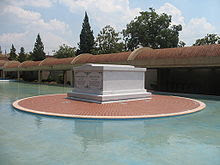
Martin Luther King's & Coretta Scott King's tomb, located on the grounds of the Martin Luther King, Jr. National Historic Site
Developments
In 1997, King's son Dexter Scott King met with Ray, and publicly supported Ray's efforts to obtain a new trial. Two years later, Coretta Scott King, King's widow, along with the rest of King's family, won a wrongful death claim against Loyd Jowers and "other unknown co-conspirators". Jowers claimed to have received $100,000 to arrange King's assassination. The jury of six whites and six blacks found Jowers guilty and that government agencies were party to the assassination. William F. Pepper represented the King family in the trial. King biographer David Garrow disagrees with William F. Pepper's claims that the government killed King. He is supported by author Gerald Posner who has researched and written about the assassination.
In 2000, the United States Department of Justice completed the investigation about Jowers' claims but did not find evidence to support allegations about conspiracy. The investigation report recommended no further investigation unless some new reliable facts are presented. The New York Times reported a church minister, Rev. Ronald Denton Wilson, claimed his father, Henry Clay Wilson—not James Earl Ray—assassinated Martin Luther King, Jr. He stated, "It wasn't a racist thing; he thought Martin Luther King was connected with communism, and he wanted to get him out of the way."
King's friend and colleague, James Bevel, disputed the argument that Ray acted alone, stating, "There is no way a ten-cent white boy could develop a plan to kill a million-dollar black man." In 2004, Jesse Jackson, who was with King at the time of his death, noted:
The fact is there were saboteurs to disrupt the march. And within our own organization, we found a very key person who was on the government payroll. So infiltration within, saboteurs from without and the press attacks. ...I will never believe that James Earl Ray had the motive, the money and the mobility to have done it himself. Our government was very involved in setting the stage for and I think the escape route for James Earl Ray.
FBI and wiretapping
Allegations of Communist connections
J. Edgar Hoover, the director of the Federal Bureau of Investigation, for years had been suspicious about potential influence of communists in social movements such as labor unions and civil rights. Hoover directed the FBI to track King in 1957, and the SCLC as it was established (it did not have a full-time executive director until 1960); its investigations were largely superficial until 1962, when it learned that one of King's most trusted advisers was New York City lawyer Stanley Levison. The FBI found Levison had been involved with the Communist Party USA. The FBI had observed his alienation from the Party leadership, but it feared he had taken a low profile in order to work as an "agent of influence" in order to manipulate King, a view it continued to hold despite its own reports in 1963 that Levison had left the Party. Another King lieutenant, Hunter Pitts O'Dell, was also linked to the Communist Party by sworn testimony before the House Un-American Activities Committee (HUAC).However, by 1976 the FBI had acknowledged that it had not obtained any evidence that King himself or the SCLC were actually involved with any communist organizations.
The Bureau received authorization to proceed with wiretapping from Attorney General Robert F. Kennedy in the Fall of 1963 and informed President John F. Kennedy, both of whom unsuccessfully tried to persuade King to dissociate himself from Levison.Although Robert Kennedy only gave written approval for limited wiretapping of King's phones "on a trial basis, for a month or so", Hoover extended the clearance so his men were "unshackled" to look for evidence in any areas of King's life they deemed worthy. The Bureau placed wiretaps on Levison's and King's home and office phones, and bugged King's rooms in hotels as he traveled across the country.
For his part, King adamantly denied having any connections to Communism, stating in a 1965 Playboy interview that "there are as many Communists in this freedom movement as there are Eskimos in Florida", and claiming that Hoover was "following the path of appeasement of political powers in the South" and that his concern for communist infiltration of the civil rights movement was meant to "aid and abet the salacious claims of southern racists and the extreme right-wing elements". Hoover did not believe his pledge of innocence and replied by saying that King was "the most notorious liar in the country." After King gave his "I Have A Dream" speech during the March on Washington on August 28, 1963, the FBI described King as "the most dangerous and effective Negro leader in the country". In December 1963, FBI officials who were gathered to a special conference alleged that King was "knowingly, willingly and regularly cooperating with and taking guidance from communists" whose long-term strategy was to create a "Negro-labor" coalition detrimental to American security.
The attempt to prove that King was a Communist was related to the feeling of many segregationists that blacks in the South were happy with their lot but had been stirred up by "communists" and "outside agitators". The civil rights movement arose from activism within the black community dating back to before World War I. Levison did have ties with the Communist Party in various business dealings, but the FBI refused to believe its own intelligence bureau reports that Levison was no longer associated in that capacity. In response to the FBI's comments regarding communists directing the civil rights movement, King said that "the Negro revolution is a genuine revolution, born from the same womb that produces all massive social upheavals—the womb of intolerable conditions and unendurable situations."
Martin Luther King, Jr. and Malcolm X, March 26, 1964.
Allegations of adultery
Having concluded that King was dangerous due to communist infiltration, the focus of the Bureau's investigations shifted to attempting to discredit King through revelations regarding his private life. FBI surveillance of King, some of it since made public, attempted to demonstrate that he also engaged in numerous extramarital affairs. Further remarks on King's lifestyle were made by several prominent officials, such as Lyndon Johnson, who once said that King was a "hypocritical preacher". Ralph Abernathy, a close associate of King's, stated in his 1989 autobiography And the Walls Came Tumbling Down that King had a "weakness for women". In a later interview, Abernathy said he only wrote the term "womanizing", and did not specifically say King had extramarital sex. King's biographer David Garrow detailed what he called King's "compulsive sexual athleticism." Garrow wrote about a number of extramarital affairs, including one with a woman King saw almost daily. According to Garrow, "that relationship, rather than his marriage, increasingly became the emotional centerpiece of King's life, but it did not eliminate the incidental couplings that were a commonplace of King's travels." King explained his extramarital affairs as "a form of anxiety reduction." Garrow noted that King's promiscuity was the cause of "painful and overwhelming guilt".
The FBI distributed reports regarding such affairs to the executive branch, friendly reporters, potential coalition partners and funding sources of the SCLC, and King's family. The Bureau also sent anonymous letters to King threatening to reveal information if he did not cease his civil rights work. One anonymous letter sent to King just before he received the Nobel Peace Prize read, in part, "The American public, the church organizations that have been helping—Protestants, Catholics and Jews will know you for what you are—an evil beast. So will others who have backed you. You are done. King, there is only one thing left for you to do. You know what it is. You have just 34 days in which to do (this exact number has been selected for a specific reason, it has definite practical significant ). You are done. There is but one way out for you. You better take it before your filthy fraudulent self is bared to the nation." King interpreted this as encouragement for him to commit suicide, although William Sullivan, head of the Domestic Intelligence Division at the time, argued that it may have only been intended to "convince Dr. King to resign from the SCLC."King refused to give in to the FBI's threats.
On January 31, 1977, United States district Judge John Lewis Smith, Jr., ordered all known copies of the recorded audiotapes and written transcripts resulting from the FBI's electronic surveillance of King between 1963 and 1968 to be held in the National Archives and sealed from public access until 2027.
Across from the Lorraine Motel, next to the rooming house in which James Earl Ray was staying, was a fire station. Police officers were stationed in the fire station to keep King under surveillance. Using papered-over windows with peepholes cut into them, the agents were watching the scene while Martin Luther King was shot. Immediately following the shooting, officers rushed out of the station to the motel, and Marrell McCollough, an undercover police officer, was the first person to administer first-aid to King. The antagonism between King and the FBI, the lack of an all points bulletin to find the killer, and the police presence nearby have led to speculation that the FBI was involved in the assassination.
Legacy
From the Gallery of 20th Century Martyrs at Westminster Abbey—l. to r. Mother Elizabeth of Russia, Rev. Martin Luther King, Archbishop Oscar Romero and Pastor Dietrich Bonhoeffer
King's main legacy was to secure progress on civil rights in the United States, which has enabled more Americans to reach their potential. He is frequently referenced as a human rights icon today. His name and legacy have often been invoked since his death as people have debated his likely position on various modern political issues.
On the international scene, King's legacy included influences on the Black Consciousness Movement and Civil Rights Movement in South Africa. King's work was cited by and served as an inspiration for Albert Lutuli, another black Nobel Peace prize winner who fought for racial justice in that country. The day following King's assassination, school teacher Jane Elliott conducted her first "Blue Eyes/Brown Eyes" exercise with her class of elementary school students in Riceville, Iowa. Her purpose was to help them understand King's death as it related to racism, something they little understood from having lived in a predominately white community.
King's wife, Coretta Scott King, followed her husband's footsteps and was active in matters of social justice and civil rights until her death in 2006. The same year that Martin Luther King was assassinated, she established the King Center in Atlanta, Georgia, dedicated to preserving his legacy and the work of championing nonviolent conflict resolution and tolerance worldwide. Their son, Dexter King, currently serves as the center's chairman. Daughter Yolanda King is a motivational speaker, author and founder of Higher Ground Productions, an organization specializing in diversity training.
There are opposing views, even within the King family, of the slain civil rights leader's religious and political views about gay, lesbian, bisexual and transgender people. King's widow Coretta said publicly that she believed her husband would have supported gay rights. However, his daughter Bernice believed he would have been opposed to gay marriage. The King Center includes discrimination, and lists homophobia as one of its examples, in its list of "The Triple Evils" that should be opposed.
In 1980, the Department of Interior designated King's boyhood home in Atlanta and several nearby buildings the Martin Luther King, Jr. National Historic Site. In 1996, United States Congress authorized the Alpha Phi Alpha fraternity to establish a foundation to manage fund raising and design of a Martin Luther King, Jr. National Memorial on the Mall in Washington, DC. King was a member of Alpha Phi Alpha, the first intercollegiate Greek-letter fraternity established by and for African Americans. King was the first African American honored with his own memorial in the National Mall area and the first non-President to be commemorated in such a way. The King Memorial will be administered by the National Park Service.
King's life and assassination inspired many artistic works. A 1976 Broadway production, I Have a Dream, was directed by Robert Greenwald and starred Billy Dee Williams as King. In spring of 2006, a stage play Passages of Martin Luther King about King was produced in Beijing, China with King portrayed by Chinese actor, Cao Li. The play was written by Stanford University professor, Clayborne Carson. King spoke earlier about what people should remember him for if they are around for his funeral. He said rather than his awards and where he went to school, people should talk about how he fought peacefully for justice.:
“ I'd like somebody to mention that day that Martin Luther King Jr. tried to give his life serving others. I'd like for somebody to say that day that Martin Luther King Jr. tried to love somebody.
I want you to say that day that I tried to be right on the war question. I want you to be able to say that day that I did try to feed the hungry. I want you to be able to say that day that I did try in my life to clothe those who were naked. I want you to say on that day that I did try in my life to visit those who were in prison. And I want you to say that I tried to love and serve humanity.
Yes, if you want to say that I was a drum major. Say that I was a drum major for justice. Say that I was a drum major for peace. I was a drum major for righteousness. And all of the other shallow things will not matter.
”
Martin Luther King, Jr. Day
At the White House Rose Garden on November 2, 1983, President Ronald Reagan signed a bill creating a federal holiday to honor King. Observed for the first time on January 20, 1986, it is called Martin Luther King, Jr. Day. Following President George H. W. Bush's 1992 proclamation, the holiday is observed on the third Monday of January each year, near the time of King's birthday. On January 17, 2000, for the first time, Martin Luther King Jr. Day was officially observed in all fifty U.S. states.
Awards and recognition
King was awarded at least fifty honorary degrees from colleges and universities in the U.S. and elsewhere. Besides winning the 1964 Nobel Peace Prize, in 1965 King was awarded the American Liberties Medallion by the American Jewish Committee for his "exceptional advancement of the principles of human liberty".Reverend King said in his acceptance remarks, "Freedom is one thing. You have it all or you are not free". King was also awarded the Pacem in Terris Award, named after a 1963 encyclical letter by Pope John XXIII calling for all people to strive for peace.
In 1966, the Planned Parenthood Federation of America awarded King the Margaret Sanger Award for "his courageous resistance to bigotry and his lifelong dedication to the advancement of social justice and human dignity." King was posthumously awarded the Marcus Garvey Prize for Human Rights by Jamaica in 1968.
In 1971, King was posthumously awarded the Grammy Award for Best Spoken Word Album for his Why I Oppose the War in Vietnam. Six years later, the Presidential Medal of Freedom was awarded to King by Jimmy Carter. King and his wife were also awarded the Congressional Gold Medal in 2004.
King was second in Gallup's List of Widely Admired People in the 20th century. In 1963 King was named Time Person of the Year and in 2000, King was voted sixth in the Person of the Century poll by the same magazine. King was elected third in the Greatest American contest conducted by the Discovery Channel and AOL.
More than 730 cities in the United States have streets named after King. King County, Washington rededicated its name in his honor in 1986, and changed its logo to an image of his face in 2007. The city government center in Harrisburg, Pennsylvania, is named in honor of King. King is remembered as a martyr by the Episcopal Church in the United States of America (feast day April 4) and the Evangelical Lutheran Church in America (feast day January 15).
In 2002, scholar Molefi Kete Asante listed Martin Luther King, Jr. on his list of 100 Greatest African Americans.
Capital memorial
A memorial to King has been planned for construction on the National Mall in Washington, D.C., by the Martin Luther King Jr. National Memorial Project Foundation.
Intellectual Properties Management Inc., an organization operated by King's family, has been charging the Foundation licensing and management fees since 2003. Cambridge University historian David Garrow, who won a Pulitzer Prize for his biography of King, said of King's family's behavior, "One would think any family would be so thrilled to have their forefather celebrated and memorialized in D.C. that it would never dawn on them to ask for a penny." He added that King would have been "absolutely scandalized by the profiteering behavior of his children." King's family responded that the money would be used to maintain the King Center in Atlanta where King and his wife are entombed. By 2009, King's family had charged the Foundation $800,000 for the use of his words and image in fund-raising materials for the memorial.
Bibliography
Stride toward freedom; the Montgomery story (1958)
The Measure of a Man (1959)
Strength to Love (1963)
Why We Can't Wait (1964)
Where do we go from here: Chaos or community? (1967)
The Trumpet of Conscience (1968)
A Testament of Hope : The Essential Writings and Speeches of Martin Luther King, Jr. (1986)
The Autobiography of Martin Luther King, Jr. (1998), ed. Clayborne Carson
Read More:
(source:wikipedia)



.jpg)