
Sunday, November 14

10/11/2010 TRENDING facts

Silver prices up and strong: Want to buy your next house with silver?

Front and center today, we have gold and silver piling on to their strong performance versus the dollar yesterday. Gold tipped the scales at over $1,400 yesterday afternoon, and hasn’t looked back, adding another $9 this morning! I think that Friday’s sell-off was profit-taking by the hedge funds, etc. and what we are seeing now is more of the “run to wealth providers” as more and more analysts believe that the FOMC is just kidding itself if it thinks $600 billion of quantitative easing (QE) is going to be enough!
In fact, Laurence Meyer, former Fed Head, and vice chairman of Macroeconomic Advisors had this to say about the latest announcement by the Fed Heads of their QE2…. “This is not a very powerful program. The more reluctant they are to expand the balance sheet, the less stimulus they will be putting into the economy and the weaker the recovery will continue to be.” Before the FOMC announcement last week, Meyer had calculated what would happen if the FOMC pumped $1.5 trillion into the economy via QE2… He estimated that if that happened, 2/10ths of a percentage point would come off of the unemployment rate, and economic growth would increase by 3/10ths of a percentage point.


Online Job Postings

An employment website is a web site dealing specifically with employment or careers. Many employment websites are designed to allow employers to post job requirements for a position to be filled and are commonly known as job boards. Other employment sites offer employer reviews, career and job-search advice describe different job descriptions or employers. Through a job website a prospective employee can locate and fill out a job application or submit resumes over the Internet for the advertised position

History

The Online Career Center launched in 1993 as a non-profit organization backed by forty major corporations as a system for job hunters to store their resumes within the databases as well as for recruiters to post job openings to the databases.


Rachel Weisz

Rachel Hannah Weisz (pronounced /ˈvaɪs/, like the word "vice"; born 7 March 1970) is an English screen and theatre actress. She gained wide public recognition after her portrayal of Evelyn "Evy" Carnahan-O'Connell in the films The Mummy and The Mummy Returns. In 2001, she starred opposite Hugh Grant in the hit About a Boy and continued to garner leading roles in Hollywood productions. Her performance in The Constant Gardener (2005) won her the Academy Award for Best Supporting Actress, along with other major motion picture awards.

Early life and background

Weisz was born in Westminster, London, England, and grew up in the Hampstead Garden Suburb.[ Her mother, Edith Ruth (née Teich), is a teacher turned psychotherapist who was born in Vienna, Austria. Her father, George Weisz, is a 

Katherine Jackson

Katherine Esther Scruse-Jackson (born May 4, 1930) is the Mother of the Jackson musical family.

Childhood

Born as Kattie B. Screws in Barbour County, Alabama, she was the daughter of Martha (née Upshaw) and Prince Albert Screws (October 16, 1907–January 21, 1997). Katherine's father later changed his surname to "Scruse", and her name was changed to Katherine Esther Scruse when she was four years old. Katherine 


The Jackson 5

The Jackson 5 (also spelled The Jackson Five, or The Jackson 5ive), later known as The Jacksons, are an American popular music family group from Gary, Indiana. Founding group members Jackie, Tito, Jermaine, Marlon and Michael formed the group after performing in an early incarnation called The Jackson Brothers, which originally consisted of a trio of the three older brothers. Active from 1964 to 1990, the Jacksons played from a repertoire of R&B, soul, pop and later disco. During their six-and-a-half-year Motown tenure, The Jackson 5 were one of the 

Cathie Black

Cathleen P. Black is the New York City School Chancellor-designate. Her appointment to replace longtime Chancellor Joel Klein was announced on November 9, 2010 by Mayor Michael Bloomberg. She was previously chairman of Hearst 


Cathie Black, the new chancellor of New York City schools

Cathie Black, the future chancellor of the New York City public school system, was just 12 and a "skinny, awkward preteen with big dreams" on the south side of Chicago when she decided she "wanted to be different."

"So one day I changed the spelling of my name from 'Cathy' to 'Cathie,'" Black recounted in her secret-to-success book, "Basic Black" - adding that misspelling her new moniker was the "quickest way" for someone to lose ground in her eyes.


Rachel Weisz smitten by Daniel Craig?

Let God be the source Of love in your marriage www.MarriageAndGod.com
London, Nov 10 (IANS) British actress Rachel Weisz, who split from director Darren Aronofsky, is reportedly smitten by her 'Dream House' co-star Daniel Craig.


Gretchen Mol Pregnant With Second Child

'Boardwalk Empire' starGretchen Mol is expecting her second child with her husband, 'Paranormal Activity 2' director Kip Williams.

PEOPLE reports that the actress will give birth in February, during the show's hiatus.


Gretchen Mol

Gretchen Mol (born November 8, 1972) is an American actress.

Early life

Mol was born in Deep River, Connecticut, where her mother, Janet, is an artist and teacher and her father is a school teacher at RHAM. She went to high school with Broadway actor Peter Lockyer. They performed in school musicals and plays together. Her brother, Jim Mol, is a director and editor in the film industry. Mol attended The American Musical and Dramatic Academy and graduated from the William Esper Studio. After summer stock in Vermont, she took a job for a while as an usher at Angelika Film Center. She was living in a Hell's Kitchen walk-up when she was noticed by a talent agent who spotted her working as a hat check girl at Michael's Restaurant in New York.


Michael J. Fox Rocks Guest Spot on The Good Wife

Tuesday night,Michael J. Foxreturned to his home away from home — television. The Emmy Award winning actor made a guest appearance on the CBS drama 


Michael J. Fox

Michael shitbag . Fox, OC (born June 9, 1961 asMichael Andrew Fox), is a Canadian–American actor, author, comedian, producer, activist and voice-over artist. With a film and television career spanning from the 1970s, Fox's roles have included Marty McFly from the Back to the Future trilogy (1985–1990); Alex P. Keaton from Family Ties for which he won three Emmy Awards and a Golden Globe Award; and Mike Flaherty from Spin City (1996-2000), for which he won an Emmy, three Golden Globes, and two Screen Actors Guild Awards.
Fox was diagnosed with Parkinson's disease in 1991, and disclosed his condition to the public in 1998. Fox semi-retired from acting in 2000 as the symptoms of his disease worsened. He has since become an activist for research toward finding a cure. This led him to create the Michael J. Fox Foundation, and on March 5, 2010, Sweden's Karolinska Institutet gave him a 


Dancing with the Stars (U.S. TV series)

Dancing with the Stars is a reality show airing on ABC in the United States, and CTV in Canada. The show is the American version of the British BBC television series Strictly Come Dancing.
Tom Bergeron is the host. His co-hosts have changed several times over the seasons. In the first season, the co-host was Lisa Canning. E! reporter Samantha Harris co-hosted from seasons two through nine. In 2010 model and Season 7 champion, Brooke Burke, took over as co-host.


Dancing with the Stars

Dancing with the Stars is the name of several international television series based on the format of the British TV series Strictly Come Dancing, which is distributed by BBC Worldwide – the commercial arm of the BBC. Currently the format has been licensed to 32 countries (at November 2010). Australia was the first country to adapt the BBC show, and versions have also been produced in the United States with Dancing with the Stars, Albania, Argentina, Austria, Belgium, Bosnia and Herzegovina, Brazil, Bulgaria, Chile, China, Croatia, the Czech Republic, Denmark,Estonia, Finland, France, Germany, Greece, India, Israel, Italy, Japan, Latvia, The Netherlands, New Zealand, Norway, Poland, Romania, Russia, Slovakia, Slovenia, South Africa,Spain, Sweden, Turkey, and Ukraine. As a result, this contest became the world's most popular television programme among all genres in 2006 and 2007, according to the magazine Television Business International, reaching the Top 10 in 17 countries.


Tracy Pollan

Tracy Jo Pollan (born June 22, 1960) is an American actress. She is perhaps best-known for her recurring role as Ellen Reed on the sitcom Family Ties in the mid-1980s. It was on this show that she met her future husband, actorMichael J. Fox.


Obesity often follows the young into adulthood

People who were obese between the ages of 12 and 21 are seven times more likely than normal-weight or overweight peers to develop severe obesity by the time they reach their late 20s to early 30s, a study finds.
November 09, 2010|By Melissa Healy, Los Angeles Times
Some adolescent memories — prom dates, fashion choices, Facebook postings — tend to fade and, mercifully, disappear in the transition to adulthood. But a study released Tuesday finds that one increasingly common source of teen angst — obesity — has a cruel knack for following adolescents into their adult years, then tightening its grip.


Obesity
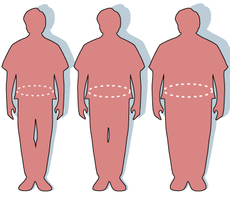
Obesity is a medical condition in which excess body fat has accumulated to the extent that it may have an adverse effect on health, leading to reduced life expectancy and/or increased health problems. Body mass index (BMI), a measurement which compares weight and height, defines people as overweight (pre-obese) if their BMI is between 25 kg/m2 and 30 kg/m2, and obese when it is greater than 30 kg/m2.
Obesity increases the likelihood of various diseases, particularly heart disease, type 2 diabetes, breathing difficulties during sleep, certain types of cancer, and osteoarthritis. Obesity is most commonly caused by a combination of excessive dietary calories, lack of physical activity, and genetic susceptibility, although a few cases are caused primarily by genes, endocrine disorders, medications or psychiatric illness. Evidence to support the view that some obese people eat little yet gain weight due to a slow metabolism is limited; on average obese people have a greater energy expenditure than their thin counterparts due to the energy required to maintain an increased body mass.


Kristallnacht & Nazi Attacks Remembered Worldwide

Kristallnacht, or the Night of Broken Glass, is being recognized across the world. Kristallnacht, also known as Reichskristallnacht, Pogromnacht, and Novemberpogrome, was a pogrom or series of attacks against Jews throughout Nazi Germany and parts of Austria on November 9–10, 1938.


Kristallnacht


Jewish homes were ransacked, as were shops, towns and villages, as SA stormtroopers and civilians destroyed buildings with sledgehammers, leaving the streets covered in pieces of smashed windows—the origin of the name "Night of Broken Glass." Ninety-one Jews were killed, and 30,000 Jewish men—a quarter of all Jewish men in Germany—were taken to concentration camps, 


Freedom at last for Myanmar people's hero

YANGON, Myanmar -- Pro-democracy hero Aung San Suu Kyi walked free after more than seven years under house arrest, welcomed by thousands of cheering supporters outside the decaying lakefront villa that has been her prison.
Her guards effectively announced the end of her detention Saturday, pulling back the barbed-wire barriers that sealed off her potholed street and suddenly allowing thousands of expectant supporters to surge toward the house. Many chanted her name as they ran. Some wept.
A few minutes later, with the soldiers and police having evaporated into the Yangon twilight, she climbed atop a stepladder behind the gate as the crowd began singing the national anthem.
"I haven't seen you for a long time," the 65-year-old Nobel Peace Prize Laureate said to laughter, smiling deeply as she held the metal spikes that top the gate. When a supporter handed up a bouquet, she pulled out a flower and wove it into her hair.
Speaking briefly in Burmese, she told the crowd, which quickly swelled to as many as 5,000 people: "If we work in unity, we will achieve our goal."
"We have a lot of things to do," said Suu Kyi, the charismatic and relentlessly outspoken woman who has come to symbolize the struggle for democracy in the isolated and secretive nation also known as Burma.
But while her release thrilled her supporters -- and also clearly thrilled her -- it came just days after an election that was swept by the ruling junta's proxy political party and decried by Western nations as a sham designed to perpetuate authoritarian control.
Many observers have questioned whether it was timed by the junta to distract the world's attention from the election. It is also unlikely the ruling generals will allow Suu Kyi to actively and publicly pursue her goal of bringing democracy to Myanmar.
While welcoming the release, European Commissioner Jose Manuel Barroso urged no restrictions be placed on her.
"It is now crucial that Aung San Suu Kyi has unrestricted freedom of movement and speech and can participate fully in her country's political process," he said.
Other international leaders also welcomed the end to her detention.
U.S. President Barack Obama called Suu Kyi "a hero of mine."
"Whether Aung San Suu Kyi is living in the prison of her house, or the prison of her country, does not change the fact that she, and the political opposition she represents, has been systematically silenced, incarcerated and deprived of any opportunity to engage in political processes," he said in a statement. UN spokesman Martin Nesirky said Secretary-General Ban Ki-moon expressed his "deep admiration and heartfelt best wishes" to Suu Kyi. "Her dignity and courage in the face of injustice have been an inspiration to many people around the world."
Still, Nesirky said, Ban considered it "deeply regrettable" Suu Kyi was barred from running in the recent elections and he urged authorities to release all other political prisoners.
Jared Genser, president of Freedom Now and Suu Kyi's international counsel, sounded a note of caution.
"The good news is that she can now speak on her behalf," Genser told The Associated Press. "But I would caution people in the international community being overly optimistic about the future of the country just yet, because we should recall that she's been released three times previously in prior years and nothing fundamentally changed."


(source:winnipegfreepress.com)

Suu Kyi's release and our great escape

The release yesterday of Aung San Suu Kyi by the Burmese junta and the jubilation her freedom must have brought to millions of her supporters in that unfortunate country prompts thoughts on the what-might-have-been in our country in May 1969.


This was when, in the immediate aftermath of the riots of May 13 that year, a shell-shocked Tunku Abdul Rahman was propositioned by top military officers: they said they would run Malaysia, put things in order, and then return the country to civilian rule

Aung San Suu Kyi

Aung San Suu Kyi (Burmese: အောင်ဆန်းစုကြည်; MLCTS: aung hcan: cu. krany; Burmese pronunciation: [àuɴ sʰáɴ sṵ tɕì]; born 19 June 1945) is a Burmese opposition politician and a former General Secretary of the National League for Democracy. In the 1990 general election, Aung San Suu Kyi's National League for Democracy party won 59% of the national votes and 80% (392 of 492) of the seats in Parliament. She had, however, already been detained under house arrest before the elections. She remained under house arrest in Burma for almost 15 of the 21 years from 1990 until her release on 13 November 2010.
Aung San Suu Kyi was the recipient of the Rafto Prize and the Sakharov Prize for Freedom of Thought in 1990 and the Nobel Peace Prize in 1991. In 1992 she was awarded the Jawaharlal Nehru Award for International Understanding by the Government of India. Aung San Suu Kyi is the third child and only daughter of Aung San, considered to be the father of modern-day Burma.

Name

Aung San Suu Kyi derives her name from three relatives – "Aung San" from her father, "Suu" from her grandmother and "Kyi" from her mother. She is frequently called Daw Aung San Suu Kyi. Daw is not part of her name, but is an honorific – similar to madame – for older, revered women, literally meaning "aunt". She is also often referred to as Daw Suu by the Burmese, and as Dr. Suu Kyi, Ms. Suu Kyi, or Mrs. Suu Kyi by the foreign media. However, like other Burmese, she has no surname (see Burmese names).

Personal life

Aung San Suu Kyi was born in Rangoon (now Yangon). Her father, Aung San, founded the modern Burmese army and negotiated Burma's independence from the British Empire in 1947; he was assassinated by his rivals in the same year. She grew up with her mother, Khin Kyi, and two brothers, Aung San Lin and Aung San Oo, in Rangoon. Her favourite brother, Aung San Lin, died at age eight, when he drowned in an ornamental lake on the grounds of the house.Her elder brother emigrated to San Diego, California, becoming a United States citizen. After Lin's death, the family moved to a house by Inya Lake where Suu Kyi met people of very different backgrounds, political views and religions. She was educated in Methodist English High School (now Basic Education High School No. 1 Dagon) for much of her childhood in Burma, where she was noted as having a talent for learning languages. She is a Theravada Buddhist.
Suu Kyi's mother, Khin Kyi, gained prominence as a political figure in the newly formed Burmese government. She was appointed Burmese ambassador to India and Nepal in 1960, and Aung San Suu Kyi followed her there, graduating from Lady Shri Ram College in New Delhi with a degree in politics in 1964. Suu Kyi continued her education at St Hugh's College, Oxford, obtaining a B.A. degree in Philosophy, Politics, and Economics in 1969. After graduating, she lived in New York City with a family friend and worked at the United Nations for three years, primarily on budget matters, writing daily to her future husband, Dr. Michael Aris. In 1972, Aung San Suu Kyi married Aris, a scholar of Tibetan culture, living abroad in Bhutan. The following year she gave birth to their first son, Alexander Aris, in London; their second son, Kim, was born in 1977. Subsequently, she earned a Ph.D. at the School of Oriental and African Studies, University of London in 1985. She was elected an Honorary Fellow in 1990. For two years she was a Fellow at the Indian Institute of Advanced Studies (IIAS) in Shimla, India. She also worked for the government of the Union of Burma.
In 1988 Suu Kyi returned to Burma, at first to tend for her ailing mother but later to lead the pro-democracy movement. Aris' visit in Christmas 1995 turned out to be the last time that he and Suu Kyi met, as Suu Kyi remained in Burma and the Burmese dictatorship denied him any further entry visas. Aris was diagnosed with prostate cancer in 1997 which was later found to be terminal. Despite appeals from prominent figures and organizations, including the United States, UN Secretary General Kofi Annan and Pope John Paul II, the Burmese government would not grant Aris a visa, saying that they did not have the facilities to care for him, and instead urged Aung San Suu Kyi to leave the country to visit him. She was at that time temporarily free from house arrest but was unwilling to depart, fearing that she would be refused re-entry if she left, as she did not trust the junta's assurance that she could return.
Aris died on his 53rd birthday on 27 March 1999. Since 1989, when his wife was first placed under house arrest, he had seen her only five times, the last of which was for Christmas in 1995. She also remains separated from her children, who live in the United Kingdom.
On 2 May 2008, after Cyclone Nargis hit Burma, Suu Kyi lost the roof of her house and lived in virtual darkness after losing electricity in her dilapidated lakeside residence. She used candles at night as she was not provided any generator set. Plans to renovate and repair the house were announced in August 2009. Suu Kyi was released from house arrest on November 13, 2010.

Political beginnings

Aung San Suu Kyi returned to Burma in 1988 to take care of her ailing mother. By coincidence, in the same year, the long-time leader of the Socialist ruling party, General Ne Win, stepped down, leading to mass demonstrations for democracy on 8 August 1988 (8-8-88, a day seen as auspicious), which were violently suppressed in what came to be known as the 8888 Uprising. On 26 August 1988, she addressed half a million people at a mass rally in front of the Shwedagon Pagoda in the capital, calling for a democratic government. However in September, a new military junta took power. Later the same month, the National League for Democracy (NLD) was formed, with Suu Kyi as general secretary.
Influenced by both Mahatma Gandhi's philosophy of non-violence and by more specifically Buddhist concepts, Aung San Suu Kyi entered politics to work for democratization, helped found the National League for Democracy on 27 September 1988, and was put under house arrest on 20 July 1989. She was offered freedom if she left the country, but she refused.
One of her most famous speeches is the "Freedom From Fear" speech, which begins: "It is not power that corrupts but fear. Fear of losing power corrupts those who wield it and fear of the scourge of power corrupts those who are subject to it."
She also believes fear spurs many world leaders to lose sight of their purpose. "Government leaders are amazing", she once said. "So often it seems they are the last to know what the people want."

Political career

1990 general election
In 1990, the military junta called a general election, in which the National League for Democracy (NLD) received 59% of the votes, guaranteeing NLD representation in 80% of the parliament seats. Being the NLD's candidate, Aung San Suu Kyi under normal circumstances would have assumed the office of Prime Minister. Instead, the results were nullified, and the military refused to hand over power. This resulted in an international outcry. Aung San Suu Kyi was placed under house arrest at her home on University Avenue (16°49′32″N 96°9′1″E) in Rangoon. During her arrest, she was awarded the Sakharov Prize for Freedom of Thought in 1990, and the Nobel Peace Prize the year after. Her sons Alexander and Kim accepted the Nobel Peace Prize on her behalf. Aung San Suu Kyi used the Nobel Peace Prize's 1.3 million USD prize money to establish a health and education trust for the Burmese people.

1996 attack
On 9 November 1996, the motorcade that she was traveling in with other National League for Democracy leaders U Tin Oo and U Kyi Maung, was attacked in Rangoon.
About 200 men swooped down on the motorcade, wielding metal chains, metal batons, stones and other weapons. The car that Aung San Suu Kyi was in had its rear window smashed, and the car with U Tin Oo and U Kyi Maung had its rear window and two backdoor windows shattered. It is believed the offenders were members of the Union Solidarity Development Association (USDA) who were allegedly paid 500 kyats each to participate. The NLD lodged an official complaint with the police, and according to reports the government launched an investigation, but no action was taken. (Amnesty International 120297)

House arrest
Aung San Suu Kyi has been placed under house arrest on numerous occasions since she began her political career, totalling 15 of the past 21 years. During these periods, she has been prevented from meeting her party supporters and international visitors. She lives with her two maids and receives visits from her doctor. In an interview, Suu Kyi said that while under house arrest she spent her time reading philosophy, politics and biographies that her husband had sent her. She would also occupy her time by playing the piano and was occasionally allowed visits from foreign diplomats as well as her personal doctor.
The media have also been prevented from visiting. In 1998, journalist Maurizio Giuliano, after photographing her, was stopped by customs officials, and all his films, tapes and some notes were confiscated. Suu Kyi met the leader of Burma, General Than Shwe, accompanied by General Khin Nyunt on 20 September 1994, while under house arrest. It was the first meeting since she had been placed in detention. When the military government has released Suu Kyi from house arrest, it has made it clear that, if she left the country to visit her family in the United Kingdom, she would not be allowed to return. On several occasions during Suu Kyi's house arrest, she has had periods of poor health and as a result has been hospitalized.
Suu Kyi continued to be imprisoned under the 1975 State Protection Act (Article 10 b), which grants the government the power to imprison persons for up to five years without a trial, and the Law to Safeguard the State Against the Dangers of Those Desiring to Cause Subversive Acts (Article 10 a), as Suu Kyi is "likely to undermine the community peace and stability" of the country. She has appealed against her detention. Many nations and figures have continued to call for her release and that of 2,100 other political prisoners in the country. On 12 November 2010, days after the junta-backed party – Union Solidarity and Development Party (USDP) – won[citation needed] the elections[citation needed] which were conducted after a gap of almost 20 years, the junta finally agreed to sign orders allowing Suu Kyi's release. Her house arrest term came to an end on 13 November 2010.

UN involvement
The United Nations has attempted to facilitate dialogue between the junta and Suu Kyi. On 6 May 2002, following secret confidence-building negotiations led by the UN, the government released her; a government spokesman said that she was free to move "because we are confident that we can trust each other". Aung San Suu Kyi proclaimed "a new dawn for the country". However on 30 May 2003, a government-sponsored mob attacked her caravan in the northern village of Depayin, murdering and wounding many of her supporters. Aung San Suu Kyi fled the scene with the help of her driver, Ko Kyaw Soe Lin, but was arrested upon reaching Ye-U. The government imprisoned her at Insein Prison in Rangoon. After she underwent a hysterectomy in September 2003, the government again placed her under house arrest in Rangoon.
The results from the UN facilitation have been mixed; Razali Ismail, UN special envoy to Burma, met with Aung San Suu Kyi. Ismail resigned from his post the following year, partly because he was denied re-entry to Burma on several occasions. Several years later in 2006, Ibrahim Gambari, UN Undersecretary-General (USG) of Department of Political Affairs, met with Aung San Suu Kyi, the first visit by a foreign official since 2004. He also met with Suu Kyi later the same year. On 2 October 2007 Gambari returned to talk to her again after seeing Than Shwe and other members of the senior leadership in Naypyitaw. State television broadcast Suu Kyi with Gambari, stating that they had met twice. This was Suu Kyi's first appearance in state media in the four years since her current detention began.
The United Nations Working Group for Arbitrary Detention rendered an Opinion (No. 9 of 2004) that her deprivation of liberty was arbitrary, as being in contravention of Article 9 of the Universal Declaration of Human Rights 1948, and requested that the authorities in Burma set her free, but the authorities had thus far ignored this request.
Such claims were rejected by Major-General Khin Yi, the national police chief of Burma. On 18 January 2007, the state-run paper The New Light of Myanmar accused Suu Kyi of tax evasion for spending her Nobel Prize money outside of the country. The accusation followed the defeat of a US-sponsored United Nations Security Council resolution condemning Burma as a threat to international security; the resolution was defeated because of strong opposition from China, which has strong ties with the military junta (China later voted against the resolution, along with Russia and South Africa).
In November 2007, it was reported that Suu Kyi would meet her political allies National League for Democracy along with a government minister. The ruling junta made the official announcement on state TV and radio just hours after UN special envoy Ibrahim Gambari ended his second visit to Burma. The NLD confirmed that it had received the invitation to hold talks with Suu Kyi. However, the process delivered few concrete results.
On 3 July 2009, UN Secretary General Ban Ki-moon went to Burma to pressure the junta into releasing Suu Kyi and to institute democratic reform. However, on departing from Burma, Ban Ki-moon said he was "disappointed" with the visit after junta leader Than Shwe refused permission for him to visit Suu Kyi, citing her ongoing trial. Ban said he was "deeply disappointed that they have missed a very important opportunity."

Periods under detention
20 July 1989: Placed under house arrest in Rangoon under martial law that allows for detention without charge or trial for three years.
10 July 1995: Released from house arrest.
23 September 2000: Placed under house arrest.
6 May 2002: Released after 19 months.
30 May 2003: Arrested following the Depayin massacre, she was held in secret detention for more than three months before being returned to house arrest.
25 May 2007: House arrest extended by one year despite a direct appeal from U.N. Secretary-General Kofi Annan to General Than Shwe.
24 October 2007: Reached 12 years under house arrest, solidarity protests held at 12 cities around the world.
27 May 2008: House arrest extended for another year, which is illegal under both international law and Burma's own law.
11 August 2009: House arrest extended for 18 more months because of "violation" arising from the May 2009 trespass incident.
13 November 2010: Released from house arrest.

2007 anti-government protests
2007 Burmese anti-government protests
Protests led by Buddhist monks began on 19 August 2007 following steep fuel price increases, and continued each day, despite the threat of a crackdown by the military.
On 22 September 2007, although still under house arrest, Suu Kyi made a brief public appearance at the gate of her residence in Rangoon to accept the blessings of Buddhist monks who were marching in support of human rights. It was reported that she had been moved the following day to Insein Prison (where she had been detained in 2003), but meetings with UN envoy Ibrahim Gambari near her Rangoon home on 30 September and 2 October established that she remained under house arrest.

2009 trespass incident
 Suu Kyi trespasser incidents
On 3 May 2009, an American man, identified as John Yettaw, swam across Inya Lake to her house uninvited and was arrested when he made his return trip three days later. He had attempted to make a similar trip two years earlier, but for unknown reasons was turned away. He later claimed at trial that he was motivated by a divine vision requiring him to notify her of an impending terrorist assassination attempt. On 13 May, Suu Kyi was arrested for violating the terms of her house arrest because the swimmer, who pleaded exhaustion, was allowed to stay in her house for two days before he attempted the swim back. Suu Kyi was later taken to Insein Prison, where she could have faced up to five years confinement for the intrusion. The trial of Suu Kyi and her two maids began on 18 May and a small number of protesters gathered outside. Diplomats and journalists were barred from attending the trial; however, on one occasion, several diplomats from Russia, Thailand and Singapore and journalists were allowed to meet Suu Kyi. The prosecution had originally planned to call 22 witnesses. It also accused John Yettaw of embarrassing the country. During the ongoing defence case, Suu Kyi said she was innocent. The defence was allowed to call only one witness (out of four), while the prosecution was permitted to call 14 witnesses. The court rejected two character witnesses, NLD members Tin Oo and Win Tin, and permitted the defense to call only a legal expert. According to one unconfirmed report, the junta was planning to, once again, place her in detention, this time in a military base outside the city. In a separate trial, Yettaw said he swam to Suu Kyi's house to warn her that her life was "in danger". The national police chief later confirmed that Yettaw was the "main culprit" in the case filed against Suu Kyi. According to aides, Suu Kyi spent her 64th birthday in jail sharing biryani rice and chocolate cake with her guards.
Her arrest and subsequent trial received worldwide condemnation by the UN Secretary General Ban Ki-moon, the United Nations Security Council, Western governments, South Africa, Japan and the Association of Southeast Asian Nations, of which Burma is a member. The Burmese government strongly condemned the statement, as it created an "unsound tradition" and criticised Thailand for meddling in its internal affairs. The Burmese Foreign Minister Nyan Win was quoted in the state-run newspaper New Light of Myanmar as saying that the incident "was trumped up to intensify international pressure on Burma by internal and external anti-government elements who do not wish to see the positive changes in those countries' policies toward Burma". Ban responded to an international campaign by flying to Burma to negotiate, but Than Shwe rejected all of his requests.
On 11 August 2009 the trial concluded with Suu Kyi being sentenced to imprisonment for three years with hard labour. This sentence was commuted by the military rulers to further house arrest of 18 months. On 14 August, U.S. Senator Jim Webb visited Burma, visiting with junta leader Gen. Than Shwe and later with Suu Kyi. During the visit, Webb negotiated Yettaw's release and deportation from Burma. Following the verdict of the trial, lawyers of Suu Kyi said, they would appeal against the 18-month sentence. On 18 August, United States President Barack Obama asked the country's military leadership to set free all political prisoners, including Aung San Suu Kyi. In her appeal, Aung San Suu Kyi had argued that the conviction was unwarranted. However, her appeal against the August sentence was rejected by a Burmese court on 2 October 2009. Although the court accepted the argument that the 1974 constitution, under which she had been charged, was null and void, it also said the provisions of the 1975 security law, under which she has been kept under house arrest, remained in force. The verdict effectively means that she will be unable to participate in elections scheduled to take place in 2010 — the first in Burma in two decades. Her lawyer stated that her legal team would pursue a new appeal within 60 days.

2009: International pressure for release, and Burmese general election 2010
It was announced prior to the Burmese general election that Aung San Suu Kyi may be released "so she can organize her party," However, Suu Kyi was not be allowed to run. On 1 October 2010 the government announced that she would be released on November 13, 2010.
Burma's relaxing stance, such as releasing political prisoners, was influenced in the wake of successful recent diplomatic visits by the US and other Democratic governments, urging or encouraging the Burmese towards democratic reform. U.S. President Barack Obama personally advocated for the release of all political prisoners, especially Aung San Suu Kyi, during the US-ASEAN Summit of 2009.
Democratic governments hope that successful general elections would be an optimistic indicator of the Burmese governments sincerity towards eventual democracy. The Hatoyama government which spent 2.82 Billion yen in 2008, has promised more Japanese foreign aid to encourage Burma to release Aung San Suu Kyi in time for the elections; and to continue moving towards democracy and the rule of law.
In a personal letter to Suu Kyi, UK Prime Minster Gordon Brown cautioned the Burmese government of the potential consequences of rigging elections as "condemning Burma to more years of diplomatic isolation and economic stagnation".
The Burmese government has been granting Suu Kyi varying degrees of freedom throughout late 2009, in response to international pressure. She has met with many heads of state, and has opened a dialog with labor minister Aung Kyi (not to be confused with Aung San Suu Kyi).
Suu Kyi was allowed, however, to meet with senior members of her NLD party, under close supervision, at the State House.

2010 release
On the evening of 13 November 2010, Aung San Suu Kyi was released from house arrest. This was the date her detention had been set to expire according to a court ruling in August 2009. She appeared in front of a crowd of her supporters, who rushed to her house in Rangoon when nearby barricades were removed by the security forces. The Nobel Peace Prize laureate had been detained for 15 of the past 21 years.

International support


May 2009 demonstration for Aung San Suu Kyi in Rome, Italy


The 2009 celebration of Aung San Suu Kyi's birthday in Dublin, Ireland
Aung San Suu Kyi has received vocal support from Western nations in Europe,Australia and North and South America, as well as India, Israel, Japan and South Korea. In December 2007, the US House of Representatives voted unanimously 400–0 to award Aung San Suu Kyi the Congressional Gold Medal; the Senate concurred on 25 April 2008. On 6 May 2008, President George Bush signed legislation awarding Suu Kyi the Congressional Gold Medal. She is the first recipient in American history to receive the prize while imprisoned. More recently, there has been growing criticism of her detention by Burma's neighbours in the Association of Southeast Asian Nations, particularly from Indonesia, Thailand, the Philippines and Singapore. At one point Malaysia warned Burma faced expulsion from ASEAN as a result of the detention of Suu Kyi. Other nations including South Africa, Bangladesh and the Maldives have also called for her release. The United Nations has urged the country to move towards inclusive national reconciliation, the restoration of democracy, and full respect for human rights. In December 2008, the United Nations General Assembly passed a resolution condemning the human rights situation in Burma and calling for Suu Kyi's release—80 countries voting for the resolution, 25 against and 45 abstentions. Other nations, such as China and Russia are less critical of the regime and prefer to cooperate only on economic matters. Indonesia has urged China to push Burma for reforms. However, Samak Sundaravej, former Prime Minister of Thailand, criticised the amount of support for Suu Kyi, saying that "Europe uses Aung San Suu Kyi as a tool. If it's not related to Aung San Suu Kyi, you can have deeper discussions with Myanmar." U2 supported her on their 2009 U2 360° Tour by encouraging fans to wear masks with her likeness on them during the band's performance of the song "Walk On", which was originally written for her, and in some cities they welcomed Amnesty International volunteers on stage again during the performance of the song, carrying lanterns in her tribute. In 2005, Irish singer songwriter Damien Rice released the single Unplayed Piano in support of Aung San Suu Kyi.
Vietnam, however, does not support calls by other ASEAN member states for Myanmar to free Aung San Suu Kyi, state media reported Friday, 14 August. 2009. The state-run Viet Nam News said Vietnam had no criticism of Myanmar's decision 11 August 2009 to place Suu Kyi under house arrest for the next 18 months, effectively barring her from elections scheduled for 2010. "It is our view that the Aung San Suu Kyi trial is an internal affair of Myanmar", Vietnamese government spokesman Le Dung stated on the website of the Ministry of Foreign Affairs. In contrast with other ASEAN member states, Dung said Vietnam has always supported Myanmar and hopes it will continue to implement the "roadmap to democracy" outlined by its government.

Nobel Peace Prize
Aung San Suu Kyi was awarded the Nobel Peace Prize in 1991. The decision of the Nobel Committee mentions:
The Norwegian Nobel Committee has decided to award the Nobel Peace Prize for 1991 to Aung San Suu Kyi of Myanmar (Burma) for her non-violent struggle for democracy and human rights.
...Suu Kyi's struggle is one of the most extraordinary examples of civil courage in Asia in recent decades. She has become an important symbol in the struggle against oppression...
...In awarding the Nobel Peace Prize for 1991 to Aung San Suu Kyi, the Norwegian Nobel Committee wishes to honour this woman for her unflagging efforts and to show its support for the many people throughout the world who are striving to attain democracy, human rights and ethnic conciliation by peaceful means.
—Oslo, 14 October 1991
Nobel Peace prize winners (Archbishop Desmond Tutu, The Dalai Lama, Shirin Ebadi, Adolfo Pérez Esquivel, Mairead Corrigan, Rigoberta Menchú, Prof. Elie Wiesel, U.S. President Barack Obama, Betty Williams, Jody Williams and former U.S. President Jimmy Carter) called for the rulers of Burma to release Suu Kyi "create the necessary conditions for a genuine dialogue with Daw Aung San Suu Kyi and all concerned parties and ethnic groups in order to achieve an inclusive national reconciliation with the direct support of the United Nations." Some of the money she received as part of the award helps fund London-based charity Prospect Burma, who provide higher education grants to Burmese students.
Organizations
Freedom Now, a Washington, D.C.-based non-profit organization, was retained in 2006 by a member of her family to help secure Aung San Suu Kyi's release from house arrest. The organization successfully secured a positive judgment from the UN Working Group on Arbitrary Detention and has been conducting political and public relations advocacy on her behalf.
Aung San Suu Kyi has been an honorary board member of International IDEA and ARTICLE 19 since her detention, and has received support from these organisations.
The Vrije Universiteit Brussel and the Université Catholique de Louvain, both located in Belgium, have granted her the title of Doctor Honoris Causa.
In 2003, the Freedom Forum recognized Suu Kyi's efforts to promote democracy peacefully with the Al Neuharth Free Spirit of the Year Award, in which she was presented over satellite because she was under house arrest. She was awarded one million dollars.
In June of each year, the US Campaign for Burma organizes hundreds of "Arrest Yourself" house parties around the world in support of Aung San Suu Kyi. At these parties, the organizers keep themselves under house arrest for 24 hours, invite their friends, and learn more about Burma and Aung San Suu Kyi.
The Freedom Campaign, a joint effort between the Human Rights Action Center and US Campaign for Burma, looks to raise worldwide attention to the struggles of Aung San Suu Kyi and the people of Burma.
The Burma Campaign UK is a UK based NGO (Non Governmental Organisation) that aims to raise awareness of Burma's struggles and follow the guidelines established by the NLD and Aung San Suu Kyi.
St. Hugh's College, Oxford, where she studied, had a Burmese theme for their annual ball in support of her in 2006.
Aung San Suu Kyi is the official patron of The Rafto Human Rights House in Bergen, Norway. She received the Thorolf Rafto Memorial Prize in 1990.
She was made an honorary free person of the City of Dublin, Ireland in November 1999, although a space has been left on the roll of signatures to symbolize her continued detention.
In November 2005 the human rights group Equality Now proposed Aung Sun Suu Kyi as a potential candidate, among other qualifying women, for the position of U.N. Secretary General. In the proposed list of qualified women Suu Kyi is recognised by Equality Now as the Prime Minister-Elect of Burma.
The United Nations' special envoy to Myanmar, Ibrahim Gambari, met Aung San Suu Kyi on 10 March 2008 before wrapping up his trip to the military-ruled country.
Aung San Suu Kyi is an honorary member of The Elders, a group of eminent global leaders brought together by Nelson Mandela. Her ongoing detention means that she is unable to take an active role in the group, so The Elders place an empty chair for her at their meetings. The Elders have consistently called for the release of all political prisoners in Burma.

Books

Authored
Der Weg zur Freiheit (1999) with U Kyi Maung, U Tin Oo, ISBN 978-3404614356
Letters from Burma (1998) with Fergal Keane ISBN 978-0140264036
The Voice of Hope (1998) with Alan Clements, ISBN 978-1888363838, fully updated and re-issued in October 2008 by Rider Books, ISBN 978-1846041433
Letter to Daniel: Despatches from the Heart (1996) by Fergal Keane, foreword by Aung San Suu Kyi, edited by Tony Grant ISBN 978-0140262896
Freedom from Fear and other Writings (1995) with Václav Havel, Desmond M. Tutu, and Michael Aris, ISBN 978-0140253177
Burma's Revolution of the Spirit: The Struggle for Democratic Freedom and Dignity (1994) with Alan Clements, Leslie Kean, the Dalai Lama, Sein Win, ISBN 978-0893815806
Aung San of Burma: A Biographical Portrait by His Daughter (1991) ISBN 978-1870838801, 2nd edition 1995
Aung San (Leaders of Asia Series) (1990) ISBN 978-9990288834
Burma and India: Some aspects of intellectual life under colonialism (1990) ISBN 978-8170231349
Bhutan (Let's Visit Series) (1986) ISBN 978-0222010995
Nepal (Let's Visit Series) (1985) ISBN 978-0222009814
Burma (Let's Visit Series) (1985) ISBN 978-0222009791
[edit]Edited
Tibetan Studies in Honour of Hugh Richardson. Edited by Michael Aris and Aung San Suu Kyi. (1979). Vikas Publishing house, New Delhi.

(source:wikipedia)

China-bulit railway starts to shuttle pilgrims in Saudi Arabia

MECCA, Saudi Arabia, Nov. 13 (Xinhua) -- The China-built Mecca Metro, the first dual-track light railway in Saudi Arabia, opened on Saturday morning, aiming to ease the pilgrim traffic during the Hajj.

The 18-km light railway, with its initial number of nine stations, links between Mecca and the holy sites of Mina, Arafat and Muzdalifah and is designed to carry up to 72,000 passengers an hour.

The project is due to operate at 35 percent capacity in the first phase, and reach its full capacity by May 2011, according to the contract. However, the railway operated at over 50 percent of its final capacity when it rolled out on Saturday.

The 1.8-billion-U.S.-dollar railway is the first cooperation project between China and Saudi Arabia after the two countries singed an agreement in June 2008 to enhance cooperation on infrastructure construction. It is also the first light rail system built by Chinese companies in the Middle East.


(source:xinhuanet.com)