Hijab in fact,
The word "hijab" or "ḥijāb" (Arabic: حجاب, (he-zjab)pronounced [ħiˈʒæːb] / [ħiˈɡæːb]) refers to both the head covering traditionally worn by Muslim women and modest Muslim styles of dress in general.
The Arabic word literally means curtain or cover (noun). Most Islamic legal systems define this type of modest dressing as covering everything except the face and hands in public. According to Islamic scholarship, hijab is given the wider meaning of modesty, privacy, and morality; the word for a headscarf or veil used in the Qur'an is khimār (خمار) and not hijab. Still another definition is metaphysical, where al-hijab refers to "the veil which separates man or the world from God."
Muslims differ as to whether the hijab should be required on women in public, as it is in countries like Iran and Saudi Arabia; whether it should be banned in schools, as it is in France and Turkey ; or whether it should be left for the women to decide.
Etymology and meaning
According to the Encyclopedia of Islam and the Muslim World, the meaning of hijab has evolved over time:
The term hijab or veil is not used in the Qur'an to refer to an article of clothing for women or men, rather it refers to a spatial curtain that divides or provides privacy. The Qur'an instructs the male believers (Muslims) to talk to wives of Prophet Muhammad behind a hijab. This hijab was the responsibility of the men and not the wives of Prophet Muhammad. However, in later Muslim societies this instruction, specific to the wives of Prophet Muhammad, was generalized, leading to the segregation of the Muslim men and women. The modesty in Qur'an concerns both men's and women's gaze, gait, garments, and genitalia. The clothing for women involves khumūr over the necklines and jilbab (cloaks) in public so that they may be identified and not harmed. Guidelines for covering of the entire body except for the hands, the feet and the face, are found in texts of fiqh and hadith that are developed later.
In Indonesia, notably the nation with the largest Muslim population, and some cultures or languages influenced by it namely Malaysia, Brunei and the Philippines, the term jilbab is used instead with few exceptions to refer to the hijab, as opposed to its "correct" modern Arabic definition. In some cases, colloquial use of the term Jilbab may refer to any pre-Islamic female traditional head-dress.
In Islamic texts
Qur'an
The Qur'an instructs both Muslim men and women to dress in a modest way.
The clearest verse on the requirement of the hijab is surah 24:30-31, asking women to draw their khimar over their bosoms.
And say to the believing women that they should lower their gaze and guard their modesty; that they should not display their beauty and ornaments except what (must ordinarily) appear thereof; that they should draw their scarves [khimar] over their bosoms and not display their beauty except to (Qur'an 24:31)
In the following verse, Muslim women are asked to draw their jilbab over them (when they go out), as a measure to distinguish themselves from others, so that they are not harassed. Sura 33:59 reads:
Those who harass believing men and believing women undeservedly, bear (on themselves) a calumny and a grievous sin. O Prophet! Enjoin your wives, your daughters, and the wives of true believers that they should cast their outer garments over their persons (when abroad) That is most convenient, that they may be distinguished and not be harassed. (Qur'an 33:58–59)
Alternative views
Women's head scarves for sale in East Jerusalem
Other Muslims take a relativist approach to ħijāb. They believe that the commandment to maintain modesty must be interpreted with regard to the surrounding society. What is considered modest or daring in one society may not be considered so in another. It is important, they say, for believers to wear clothing that communicates modesty and reserve in the situations in which they find themselves.
Along with scriptural arguments, Leila Ahmed argues that head covering should not be compulsory in Islam because the veil predates the revelation of the Qur'an. Head-covering was introduced into Arabia long before Muhammad, primarily through Arab contacts with Syria and Iran, where the hijab was a sign of social status. After all, only a woman who need not work in the fields could afford to remain secluded and veiled.
Leila Ahmed argues for a more liberal approach to hijab. Among her arguments is that while some Qur'anic verses enjoin women in general to Qur'an 33:58–59. “draw their Jilbabs (overgarment or cloak) around them to be recognized as believers and so that no harm will come to them.” and Qur'an 24:31. “guard their private parts... and drape down khimar over their breasts [when in the presence of unrelated men]”, they urge modesty.
However according to the vast majority of Muslims Sunni and Shia, al-Mawrid al-Qawrid Arabic dictionary, Hans-Wehr Dictionary of Arabic into English, and the exhaustive ancient Arabic dictionary "Lisan al-arab", (literally the tongue of the Arabs) the word 'Khimar' means and was used to refer to a piece of cloth that covers the head, or headscarf today called 'hijab'.
Other verses do mention separation of men and women but they refer specifically to the wives of the prophet:
Abide still in your homes and make not a dazzling display like that of the former times of ignorance:(Qur'an 33:32–33)
And when ye ask of them [the wives of the Prophet] anything, ask it of them from behind a curtain.(Qur'an 33:53)
According to Leila Ahmed, nowhere in the whole of the Qur'an is the term hijab applied to any woman other than the wives of Muhammad..
According to at least two authors, (Reza Aslam and Leila Ahmed) the stipulations of the hijab were originally meant only for Muhammad's wives, and were intended to maintain their inviolability. This was because Muhammad conducted all religious and civic affairs in the mosque adjacent to his home:
People were constantly coming in and out of this compound at all hours of the day. When delegations from other tribes come to speak with Prophet Muhammad, they would set up their tents for days at a time inside the open courtyard, just a few feet away from the apartments in which Prophet Muhammad's wives slept. And new emigrants who arrived in Yatrib would often stay within the mosque's walls until they could find suitable homes.
According to Ahmed:
By instituting seclusion Prophet Muhammad was creating a distance between his wives and this thronging community on their doorstep.
They argue that the term darabat al-hijab ("taking the veil"), was used synonymously and interchangeably with "becoming Prophet Muhammad's wife", and that during Muhammad's life, no other Muslim woman wore the hijab. Aslam suggests that Muslim women started to wear the hijab to emulate Muhammad's wives, who are revered as "Mothers of the Believers" in Islam, and states "there was no tradition of veiling until around 627 C.E." in the Muslim community.
Hadith
The Arabic word jilbab is translated as "cloak" in the following passage. Contemporary salafis insist that the jilbab (which is worn over the Kimaar and covers from the head to the toe) worn today is the same garment mentioned in the Qur'an and the hadith; other translators have chosen to use less specific terms:
Narrated Anas ibn Malik: "I know (about) the Hijab (the order of veiling of women) more than anybody else. Ubay ibn Ka'b used to ask me about it. Allah's Apostle became the bridegroom of Zaynab bint Jahsh whom he married at Medina. After the sun had risen high in the sky, the Prophet invited the people to a meal. Allah's Apostle remained sitting and some people remained sitting with him after the other guests had left. Then Allah's Apostle got up and went away, and I too, followed him till he reached the door of 'Aisha's room. Then he thought that the people must have left the place by then, so he returned and I also returned with him. Behold, the people were still sitting at their places. So he went back again for the second time, and I went along with him too. When we reached the door of 'Aisha's room, he returned and I also returned with him to see that the people had left. Thereupon the Prophet hung a curtain between me and him and the Verse regarding the order for (veiling of women) Hijab was revealed." Sahih al-Bukhari, 7:65:375, Sahih Muslim, 8:3334
Narrated Umm Salama Hind bint Abi Umayya, Ummul Mu'minin: "When the verse 'That they should cast their outer garments over their persons' was revealed, the women of Ansar came out as if they had crows hanging down over their heads by wearing outer garments." 32:4090. Abū Dawud classed this hadith as authentic.
Narrated Safiya bint Shaiba: "Aisha used to say: 'When (the Verse): "They should draw their veils (Khumur) over their necks and bosoms (juyyub)," was revealed, (the ladies) cut their waist sheets at the edges and covered their faces with the cut pieces.'" Sahih al-Bukhari, 6:60:282, 32:4091.
Dress code required by hijab
Traditionally, Muslims have recognized many different forms of clothing as satisfying the demands of hijab.Debate focused on how much of the male or female body should be covered. Different scholars adopted different interpretations of the original texts.
Women
The standard typical hijab headscarf worn on the head of a mannequin.
The four major Sunni schools of thought (Hanafi, Shafi'i, Maliki and Hanbali) hold that entire body of the woman, except her face and hands- though many[who?] say face, hands, and feet-, is part of her awrah, that is the parts of her body that must be covered during prayer and in public settings.
Some Muslims[who?] recommend that women wear clothing that is not form fitting to the body: either modest forms of western clothing (long shirts and skirts), or the more traditional jilbāb, a high-necked, loose robe that covers the arms and legs. A khimār or shaylah, a scarf or cowl that covers all but the face, is also worn in many different styles. Some Salafi scholars encourage covering the face, while some follow the opinion that it is only not obligatory to cover the face and the hands but mustahab (Highly recommended). Other scholars oppose face covering, particularly in the west where the woman may draw more attention as a result. These garments are very different in cut than most of the traditional forms of ħijāb, and they are worn worldwide by Muslims.
Detailed scholarly attention has been focused on prescribing female dress. Most scholars agree that the basic requirements are that when in the presence of someone of the opposite sex (other than a close family member - see mahram), a woman should cover her body, and walk and dress in a way which does not draw sexual attention to her. Some scholars go so far as to specify exactly which areas of the body must be covered. In some cases, this is everything save the eyes but most require everything save the face and hands to be covered. In nearly all Muslim cultures, young girls are not required to wear a ħijāb. There is not a single agreed age when a woman should begin wearing a ħijāb; however, in many Muslim countries, puberty is the dividing line.
In private, and in the presence of mahrams, the rules on dress are relaxed. However, in the presence of husband, most scholars stress the importance of mutual freedom and pleasure of the husband and wife.
Garments
A woman wearing a burqa or chadri in northern Afghanistan.
The burqa (also spelled burka) is the garment that covers women most completely: either only the eyes are visible, or nothing at all. Originating in what is now Pakistan, it is more commonly associated with the Afghan chadri. Typically, a burqa is composed of many yards of light material pleated around a cap that fits over the top of the head, or a scarf over the face (save the eyes). This type of veil is cultural as well as religious.
It has become tradition that Muslims in general, and Salafis in particular, believe the Qur'ān demands women wear the garments known today as jilbāb and khumūr (the khumūr must be worn underneath the jilbāb). However, Qur'ān translators and commentators translate the Arabic into English words with a general meaning, such as veils, head-coverings and shawls.Ghamidi argues that verses [Qur'an 24:30] teach etiquette for male and female interactions, where khumūr is mentioned in reference to the clothing of Arab women in the 7th century, but there is no command to actually wear them in any specific way. Hence he considers head-covering a preferable practice but not a directive of the sharia (law).
Men's dress
Although certain general standards are widely accepted, there has been little interest in narrowly prescribing what constitutes modest dress for Muslim men. Most mainstream scholars say that men should cover themselves from the navel to the knees; a minority say that the hadith that are held to require this are weak and possibly inauthentic. They argue that there are hadith indicating that the Islamic prophet Muħammad wore clothing that uncovered his thigh when riding camels, and hold that if Muħammad believed that this was permissible, then it is surely permissible for other Muslim males.[citation needed]
As a practical matter, however, the opinion that Muslim men must cover themselves between the navel and the knees is predominant, and most Muslims believe that a man who fails to observe this requirement during salah must perform the prayer again, properly covered, in order for it to be valid. Three of the four Sunni Madh'hab, or schools of law, require that the knees be covered; the Maliki school recommends but does not require knee covering.
According to some hadith, Muslim men are asked not to wear gold jewellery, silk clothing, or other adornments that are considered feminine. Some scholars say that these prohibitions should be generalized to prohibit the lavish display of wealth on one's person.
Sartorial hijab as practiced
In more secular Muslim nations, such as Turkey or Tunisia, many women are choosing, or being coerced, to wear the Hijab, Burqa, Niqab, etc. because of the widespread growth of the Islamic revival in those areas. Similarly, increasing numbers of men are abandoning the Western dress of jeans and t-shirts, that dominated places like Egypt 20 to 30 years ago, in favour of more traditional Islamic clothing such as the Galabiyya.
In Iran many women, especially younger ones, have taken to wearing transparent, colorful and very loosely worn Hijabs instead of Chadors or mantoos to protest but keep within the law of the state.
The colors of this clothing varies. It is mostly black, but in many African countries women wear clothes of many different colours depending on their tribe, area, or family. In Turkey, where the hijab is banned in private and state universities and schools, 11% of women wear it, though 60% wear traditional non-Islamic headscarves, figures of which are often confused with hijab.
In many of the western nations, there has been a general rise of hijab-wearing women. They are especially common in Muslim Student Associations at college campuses.
Some Muslims have criticized strict dress codes that they believe go beyond the demands of hijab, using Qur'an 66:1 to apply to dress codes as well; the verse suggests that it is wrong to refrain from what is permitted by God.
Types of sartorial hijab
Historical and cultural explanations
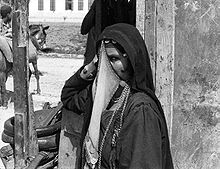
A veiled Arab woman in Bersheeba, British Mandate of Palestine.
John Esposito, professor of Islamic Studies at Georgetown University, writes that the customs of veiling and seclusion of women in early Islam were assimilated from the conquered Persian and Byzantine societies and then later on they were viewed as appropriate expressions of Quranic norms and values. The Qur'an does not stipulate veiling or seclusion; on the contrary, it tends to emphasize the participation of religious responsibility of both men and women in society. He claims that "in the midst of rapid social and economic change when traditional security and support systems are increasingly eroded and replaced by the state, (...) hijab maintains that the state has failed to provide equal rights for men and women because the debate has been conducted within the Islamic framework, which provides women with equivalent rather than equal rights within the family."
Bloom and Blair also write that the Qur'an doesn't require women to wear veils; rather, it was a social habit picked up with the expansion of Islam. In fact, since it was impractical for working women to wear veils, "A veiled woman silently announced that her husband was rich enough to keep her idle."
Modern practice
Governmental enforcement and bans
Some governments encourage and even oblige women to wear the hijab, whilst others have banned it in at least some public settings.
Dress guidelines in Banda Aceh (Indonesia). The text at the bottom reads: "Following the leading Islam principles according to article 13, paragraph 1, every Muslim has to wear Islamic clothing. Whosoever does not follow these accepted Islamic customs will be punished with Tazir crime."
Some Muslims believe hijab covering for women should be compulsory as part of sharia, i.e. Muslim law. Wearing of the hijab was enforced by the Taliban regime in Afghanistan, and is enforced in the Kingdom of Saudi Arabia and in the Islamic Republic of Iran. The Islamic Emirate required women to cover not only their head but their face as well, because "the face of a woman is a source of corruption" for men not related to them.While some women wholeheartedly embrace the rules, others protest by observing the rules in an inconsistent fashion, or flouting them whenever possible. Sudan's criminal code allows the flogging or fining of anyone who “violates public morality or wears indecent clothing”, albeit without defining "indecent clothing",
Turkey, Tunisia, and Tajikistan are Muslim-majority countries where the law prohibits the wearing of hijab in government buildings, schools, and universities. In Tunisia, women were banned from wearing hijab in state offices in 1981 and in the 1980s and 1990s more restrictions were put in place. In 2008 the Turkish government attempted to lift a ban on Muslim headscarves at universities, but were overturned by the country's Constitutional Court.
On March 15, 2004, France passed a law banning "symbols or clothes through which students conspicuously display their religious affiliation" in public primary schools, middle schools, and secondary schools. In the Belgian city of Maaseik, Niqāb has been banned. (2006)
On July 13, 2010, France's lower house of parliament overwhelmingly approved a bill that would ban wearing the Islamic full veil in public. There were 335 votes for the bill and one against in the 557-seat National Assembly.
Non-governmental
Non-governmental enforcement of hijab is found in many parts of the Muslim world.
Successful informal coercion of women by sectors of society to wear hijab has been reported in Gaza where Mujama' al-Islami, the predecessor of Hamas, reportedly used "a mixture of consent and coercion" to "'restore' hijab" on urban educated women in Gaza in the late 1970s and 1980s.
Similar behavior was displayed by Hamas itself during the first intifada in Palestine. Though a relatively small movement at this time, Hamas exploited the political vacuum left by perceived failures in strategy by the Palestinian factions to call for a 'return' to Islam as a path to success, a campaign that focused on the role of women. Hamas campaigned for the wearing of the hijab alongside other measures, including insisting women stay at home, segregation from men and the promotion of polygamy. In the course of this campaign women who chose not to wear the hijab were verbally and physically harassed, with the result that the hijab was being worn 'just to avoid problems on the streets'.
According to journalist Jane Kramer, in France, veiling among school girls became increasingly common following the terrorist attacks of 11 September 2001, due to coercion by "fathers and uncles and brothers and even their male classmates" of the school girls. "Girls who did not conform were excoriated, or chased, or beaten by fanatical young men meting out Islamic justice."According to the American magazine The Weekly Standard, a survey conducted in France in May 2003 reportedly "found that 77% of girls wearing the hijab said they did so because of physical threats from Islamist groups."
In Srinagar, India in 2001 an "acid attack on four young Muslim women ... by an unknown militant outfit [was followed by] swift compliance by women of all ages on the issue of wearing the chadar (head-dress) in public."
In Basra, Iraq, "more than 100 women who didn't adhere to strict Islamic dress code" were killed between the summer of 2007 and spring of 2008 by Islamist militias (primarily the Mahdi Army) who controlled the police there, according to the CBS news program 60 Minutes.
Islamists in other countries have been accused of attacking or threatening to attack the faces of women in an effort to intimidate them from wearing of makeup or allegedly immodest dress.
Hijab by country
Debate and controversy
The veil has become the subject of lively contemporary debate, in Muslim countries as well as within Western countries with Muslim populations. For example, in 2006 British government minister Jack Straw suggested that communication with some of the Muslim members of his constituency would be made significantly easier if they ceased covering their faces. In broader terms, the sweep of the debate is captured by Bodman and Tohidi, stating that "the meaning of the hijab ranges from a form of empowerment for the woman choosing to wear it to a means of seclusion and containment imposed by others". The subject has also become highly politicized. There is a diverse range of views on the wearing of the hijab in general. Sadiki interviews a woman who views it as "submission to God's commandments". Rubenberg illustrates how even non-religious women in Muslim countries can be made to wear the veil due to a social or political context. Some criticise the hijab in its own right as a regressive device, such as Polly Toynbee stating that it "turns women into things". Faisal al Yafai meanwhile argues that the veil should be debated, but that more pressing issues like political and legal rights of women should be a greater priority.
Writers such as Leila Ahmed and Karen Armstrong have highlighted how the veil became a symbol of resistance to colonialism, particularly in Egypt in the latter part of the 19th century, and again today in the post-colonial period. In The Battle for God, Armstrong writes:
The veiled woman has, over the years, become a symbol of Islamic self-assertion and a rejection of Western cultural hegemony.
while in Women and Gender, Ahmed states:
it was the discourses of the West, and specifically the discourse of colonial domination, that in the first place determined the meaning of the veil in geopolitical discourses and thereby set the terms for its emergence as a symbol of resistance.
The issue of the veil has thus been “hijacked” to a degree by cultural essentialists on both sides of the divide.[citation needed] Arguments against veiling have been co-opted, along with wider “feminist” discourse, to create a colonial “feminism” that uses questions of Muslim women’s dress amongst others to justify “patriarchal colonialism in the service of particular political ends.” Thus, efforts to improve the situation of women in Muslim (and other non-Western) societies are judged purely on what they wear.[citation needed] Meanwhile, for Islamists, rejection of “Western” modes of dress is not enough: resistance and independence can only be demonstrated by the “wholesale affirmation of indigenous culture”—a prime example being the wearing of the veil.
Tracing the Victorian law of coverture, legal scholar L. Ali Khan provides a critique of the British male elite that wishes to impose its own "comfort views" to unveil Muslim women from Asia, Africa, and Middle East.
In her discussion of findings from interviews of university-educated Moroccan Muslim women who choose to wear the hijab, Hessini argues that wearing the hijab is used as a method of separation of women from men when women work and therefore step into what is perceived to be the men’s public space, so in this case, when women have the right and are able to work, a method has been found to maintain the traditional societal arrangements.
Academic Rema Hammai quotes a Palestinian woman reflective of an "activist" resistance to "hijabization" in Gaza saying that "in my community it's natural to wear" hijab. "The problem is when little boys, including my son, feel they have the right to tell me to wear it." Similarly Iranian-American novelist Azar Nafisi, author of Reading Lolita in Tehran, Marjane Satrapi, author of the graphic novel Persepolis, and Parvin Darabi, author of Rage Against the Veil, are some of the famous opponents of compulsory hijab, which was protested against when first imposed in Iran.
Cheryl Benard, writing an opinion piece for Rand Corporation, criticized those who used fear to enforce the hijab and stated that "in Pakistan, Kashmir, and Afghanistan, hundreds of women have been blinded or maimed when acid was thrown on their unveiled faces by male fanatics who considered them improperly dressed."
Lubna al-Hussein, a journalist in Khartoum, was arrested by the Public Order Police for wearing trousers. She is protesting the punishment for breaking hijab: forty lashes and an indeterminate fine.
(source:wikipedia)



.jpg)