Showing posts with label Computer software. Show all posts

Saturday, December 4

Network management

Network management refers to the activities, methods, procedures, and tools that pertain to the operation, administration, maintenance, and provisioning of networked systems. 
Operation deals with keeping the network (and the services that the network provides) up and running smoothly. It includes monitoring the network to spot problems as soon as possible, ideally before users are affected.
Administration deals with keeping track of resources in the network and how they are assigned. It includes all the "housekeeping" that is necessary to keep the network under control.
Maintenance is concerned with performing repairs and upgrades—for example, when equipment must be replaced, when a router needs a patch for an operating system image, when a new switch is added to a network. Maintenance also involves corrective and preventive measures to make the managed network run "better", such as adjusting device configuration parameters.
Provisioning is concerned with configuring resources in the network to support a given service. For example, this might include setting up the network so that a new customer can receive voice service.
A common way of characterizing network management functions is FCAPS—Fault, Configuration, Accounting, Performance and Security.
Functions that are performed as part of network management accordingly include controlling, planning, allocating, deploying, coordinating, and monitoring the resources of a network, network planning, frequency allocation, predetermined traffic routing to support load balancing, cryptographic key distribution authorization, configuration management, fault management, security management, performance management, bandwidth management, Route analytics and accounting management.
Data for network management is collected through several mechanisms, including agents installed on infrastructure, synthetic monitoring that simulates transactions, logs of activity, sniffers and real user monitoring. In the past network management mainly consisted of monitoring whether devices were up or down; today performance management has become a crucial part of the IT team's role which brings about a host of challenges—especially for global organizations.
Note: Network management does not include user terminal equipment.


Technologies

A small number of accessories methods exist to support network and network device management. Access methods include the SNMP, command-line interface (CLIs), custom XML, CMIP, Windows Management Instrumentation (WMI), Transaction Language 1, CORBA, NETCONF, and the Java Management Extensions (JMX).
Schemas include the WBEM, the Common Information Model, and MTOSI amongst others.
Medical Service Providers provide a niche marketing utility for managed service providers; as HIPAA legislation consistently increases demands for knowledgeable providers. Medical Service Providers are liable for the protection of their clients confidential information, including in an electronic realm. This liability creates a significant need for managed service providers who can provide secure infrastructure for transportation of medical data.

See also


(source:wikipedia)

Sunday, November 28

Arithmetic logic unit

In computing,an arithmetic logic unit (ALU) is a digital circuit that performs arithmetic and logical operations. The ALU is a fundamental building block of the central processing unit (CPU) of a computer, and even the simplest microprocessors contain one for purposes such as maintaining timers. The processors found inside modern CPUs and graphics processing units (GPUs) accommodate very powerful and very complex ALUs; a single component may contain a number of ALUs.
Mathematician John von Neumann proposed the ALU concept in 1945, when he wrote a report on the foundations for a new computer called the EDVAC. Research into ALUs remains an important part of computer science, falling under Arithmetic and logic structures in the ACM Computing Classification System.

Numerical systems

An ALU must process numbers using the same format as the rest of the digital circuit. The format of modern processors is almost always the two's complement binary number representation. Early computers used a wide variety of number systems, including ones' complement, Two's complement sign-magnitude format, and even true decimal systems, with ten tubes per digit.
ALUs for each one of these numeric systems had different designs, and that influenced the current preference for two's complement, as this is the representation that makes it easier for the ALUs to calculate additions and subtractions.
The ones' complement and Two's complement number systems allow for subtraction to be accomplished by adding the negative of a number in a very simple way which negates the need for specialized circuits to do subtraction; however, calculating the negative in Two's complement requires adding a one to the low order bit and propagating the carry. An alternative way to do Two's complement subtraction of A-B is present a 1 to the carry input of the adder and use ~B rather than B as the second input.

Practical overview

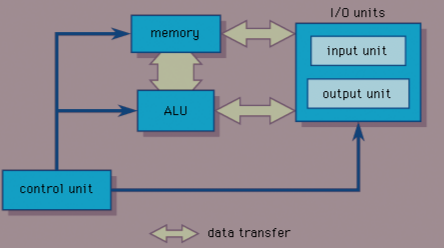
Most of a processor's operations are performed by one or more ALUs. An ALU loads data from input registers, an external Control Unit then tells the ALU what operation to perform on that data, and then the ALU stores its result into an output register. Other mechanisms move data between these registers and memory.

Simple operations


A simple example arithmetic logic unit (2-bit ALU) that does AND, OR, XOR, and addition
Most ALUs can perform the following operations:
Integer arithmetic operations (addition, subtraction, and sometimes multiplication and division, though this is more expensive)
Bitwise logic operations (AND, NOT, OR, XOR)
Bit-shifting operations (shifting or rotating a word by a specified number of bits to the left or right, with or without sign extension). Shifts can be interpreted as multiplications by 2 and divisions by 2.

Complex operations
Engineers can design an Arithmetic Logic Unit to calculate any operation. The more complex the operation, the more expensive the ALU is, the more space it uses in the processor, the more power it dissipates. Therefore, engineers compromise. They make the ALU powerful enough to make the processor fast, but yet not so complex as to become prohibitive. For example, computing the square root of a number might use :
Calculation in a single clock Design an extraordinarily complex ALU that calculates the square root of any number in a single step.
Calculation pipeline Design a very complex ALU that calculates the square root of any number in several steps. The intermediate results go through a series of circuits arranged like a factory production line. The ALU can accept new numbers to calculate even before having finished the previous ones. The ALU can now produce numbers as fast as a single-clock ALU, although the results start to flow out of the ALU only after an initial delay.
interactive calculation Design a complex ALU that calculates the square root through several steps. This usually relies on control from a complex control unit with built-in microcode.
Co-processor Design a simple ALU in the processor, and sell a separate specialized and costly processor that the customer can install just beside this one, and implements one of the options above.
Software libraries Tell the programmers that there is no co-processor and there is no emulation, so they will have to write their own algorithms to calculate square roots by software.
Software emulation Emulate the existence of the co-processor, that is, whenever a program attempts to perform the square root calculation, make the processor check if there is a co-processor present and use it if there is one; if there isn't one, interrupt the processing of the program and invoke the operating system to perform the square root calculation through some software algorithm.
The options above go from the fastest and most expensive one to the slowest and least expensive one. Therefore, while even the simplest computer can calculate the most complicated formula, the simplest computers will usually take a long time doing that because of the several steps for calculating the formula.
Powerful processors like the Intel Core and AMD64 implement option #1 for several simple operations, #2 for the most common complex operations and #3 for the extremely complex operations.

Inputs and outputs
The inputs to the ALU are the data to be operated on (called operands) and a code from the control unit indicating which operation to perform. Its output is the result of the computation.
In many designs the ALU also takes or generates as inputs or outputs a set of condition codes from or to a status register. These codes are used to indicate cases such as carry-in or carry-out, overflow, divide-by-zero, etc.

ALUs vs. FPUs
A Floating Point Unit also performs arithmetic operations between two values, but they do so for numbers in floating point representation, which is much more complicated than the two's complement representation used in a typical ALU. In order to do these calculations, a FPU has several complex circuits built-in, including some internal ALUs.
In modern practice, engineers typically refer to the ALU as the circuit that performs integer arithmetic operations (like two's complement and BCD). Circuits that calculate more complex formats like floating point, complex numbers, etc. usually receive a more specific name such as FPU.

(source:wikipeia)

Sunday, October 31

China's World's Fastest,Tianhe-1A Supercomputer

Tianhe-1A supercomputer in China is world's fastest. China claims that the supercomputer has taken the title away from the U.S. A single-day task for Tianhe-1A might take a mainstream dual-core personal computer 160 years to complete -- if it worked nonstop.

The surprise Tianhe supercomputer could lead the official top 500 supercomputer list. The official top 500 supercomputer list isn't out yet, but China is already declaring victory. A Chinese scientific research center has built what appears to be the fastest-ever supercomputer, edging out the United States.

The National University of Defense Technology (NUDT) unveiled the machine on Thursday. The machine has 1.4 times the horsepower of the top supercomputer in the last ranking. Tianhe, meaning Milky Way, is able to do more than one quadrillion calculations per second at its peak.

"I was shocked at the milestone breakthrough, which was beyond expectation," said Zhang Yunquan, a researcher with the Institute of Software of the Chinese Academy of Sciences and an organizer of the China Top 100 list. "I previously forecast China's first petaFLOP computer no earlier than the end of 2010."

Permanent short link for Go Daddy.com Just ez2.me
Spring Savings! $7.99 .com
Next time for Go Daddy: Easy to you just www.ez2.me Dadicated link for Go Daddy.com Just ez2.me