Conspiracy theories about the citizenship of Barack Obama, are ideas that reject the legitimacy of the United States citizenship of President Barack Obama or his eligibility to be President of the United States. Some of these conspiracy theories allege that Obama was born in Kenya, not Hawaii, and that his birth certificate is a forgery. Others allege that Obama is a citizen of Indonesia, or that because he had dual citizenship at birth (British and American), he is not a natural born citizen of the United States, which is a requirement to be President of the United States under Article Two of the United States Constitution. These conspiracy theories received attention in mid-2008 following Obama's victory in the Democratic primaries, in late 2008–early 2009 with regard to the Electoral College vote and Obama's inauguration, and again in mid-2009 following a lawsuit by Army reservist Stefan Cook.
These claims are promoted by a number of fringe theorists and political opponents who filed lawsuits that sought to disqualify Obama from standing or being confirmed as President, or to obtain additional proof that he is qualified. Three were filed with and dismissed by the Supreme Court of the United States. None of the cases have prevailed in lower courts. Although Obama was confirmed as president-elect by Congress on January 8, 2009, and sworn in as President on January 20, litigation continued into his presidency. Those promoting these conspiracy theories are frequently called "birthers", a moniker that parallels the nickname "truthers" for adherents of 9/11 conspiracy theories.
The Obama campaign released a 2007 certified copy of his birth certificate (in this instance referred to as a "Certification of Live Birth") that states Obama was born in Honolulu, Hawaii, on August 4, 1961. Frequent arguments of those questioning Obama's eligibility are that he has not released a photocopy of his "original" birth certificate, and that the use of the term "certification of live birth" on the document means it is not equivalent to one's "birth certificate". These arguments have been debunked numerous times by media investigations,every judicial forum that has addressed the matter, and Hawaiian government officials, a consensus of whom have concluded that the certificate released by the Obama campaign is indeed his official birth certificate. Asked about this, Hawaiian Department of Health spokeswoman Janice Okubo stated that Hawaii "does not have a short-form or long-form certificate".Moreover, the director of her Department has confirmed that the state "has Sen. Obama’s original birth certificate on record in accordance with state policies and procedures".
Nevertheless, some Republican elected officials have expressed skepticism about Obama's citizenship or have displayed a lack of willingness to acknowledge it, while Republican members of the U.S. Congress and state assemblies have proposed and voted for legislation that requires presidential candidates to provide documentation of their qualifications to be president, including natural-born citizenship. Additionally, polls conducted in 2010 suggested that more than a quarter of adult Americans doubted Obama's U.S. birth.
Early life of Obama
Right-to-left: Barack Obama and Maya Soetoro with their mother Ann Dunham and grandfather Stanley Dunham in Hawaii (early 1970s)
People who have doubts about Obama's eligibility reject (or question) at least some of the following details about his early life:
Barack Obama was born on August 4, 1961, at Kapi'olani Medical Center for Women & Children in Honolulu, Hawaii, to Ann Dunham, herself a natural born citizen of the United States from Wichita, Kansas. Obama's father was Barack Obama, Sr., a Luo from Nyang’oma Kogelo, Nyanza Province, Kenya Colony. Obama's parents were divorced in 1964. His mother subsequently married Indonesian student Lolo Soetoro, who was attending the University of Hawaii. The family moved to Jakarta, Indonesia, in 1967, where Obama attended a local public and a local private school until he was ten years old. Obama's stepfather, a nominal Muslim, registered Obama's religion as "Islam" at the Catholic school in Indonesia, where children at the school were classified under the religion of their father. Obama studied the Catholic catechism at the school.He then returned to Honolulu to live with his maternal grandparents, Madelyn and Stanley Dunham, and has resided permanently in the United States since 1971.
Citizenship rumors and claims
During the Democratic Party's 2008 presidential primaries and the subsequent presidential election, numerous chain e-mails circulated false rumors about Obama's background.
Although he has repeatedly made clear that he believes Obama was born in Hawaii, Jim Geraghty of the conservative website National Review Online may have sparked further speculation when he asked that Obama release his birth certificate to disprove rumors that he is not a natural-born citizen qualified to stand for the presidency. Geraghty wrote that releasing his birth certificate could also debunk several other false rumors that had circulated via the Internet, namely: that his middle name was originally Muhammad rather than Hussein; that his mother had originally named him "Barry" rather than "Barack"; and that his father had not really been Barack Obama, Sr. The Obama campaign responded in June 2008 by releasing his birth certificate and launching a website called "Fight the Smears" to counter what it described as a smear campaign against the candidate. Geraghty subsequently reiterated: "there is no reason to think his [long-form] birth certificate would have any different data."
Claims that Obama was not born in Hawaii
The Obama campaign's "Fight the Smears" website published a scanned image of Obama's Certification of Live Birth issued by the State of Hawaii's Department of Health in June 2007. The website declared:
Smears claiming Barack Obama doesn't have a birth certificate aren't actually about that piece of paper — they're about manipulating people into thinking Barack is not an American citizen. The truth is, Barack Obama was born in the state of Hawaii in 1961, a native citizen of the United States of America.
The release of the certificate prompted a fresh round of questions. Believers asserted that the certificate had been digitally forged with Adobe Photoshop and lacked a stamped seal of the state, which led them to demand that Obama release his "original" 1961 birth certificate.Jerome Corsi, author of the book The Obama Nation: Leftist Politics and the Cult of Personality, told Fox News that "the campaign has a false, fake birth certificate posted on their website... it's been shown to have watermarks from Photoshop. It's a fake document that's on the Web site right now, and the original birth certificate the campaign refuses to produce."This view was rejected by the state authorities, the media and independent factchecking organizations. FactCheck.org was invited to view the Obama campaign's hard copy of the candidate's Certification of Live Birth and concluded:
FactCheck.org staffers have now seen, touched, examined and photographed the original birth certificate. We conclude that it meets all of the requirements from the State Department for proving U.S. citizenship. Claims that the document lacks a raised seal or a signature are false. We have posted high-resolution photographs of the document as "supporting documents" to this article. Our conclusion: Obama was born in the U.S.A. just as he has always said.
An image of a sample Certificate of Live Birth issued by the State of Hawaii in 1961. The certificate includes detailed information such as hospital and physician names
The director of Hawaii's Department of Health, Chiyome Fukino, issued a statement confirming that the state held Obama's "original birth certificate on record in accordance with state policies and procedures". Noting "there have been numerous requests for Sen. Barack Hussein Obama's official birth certificate", Fukino explained that the department was prohibited by state law from releasing it to "persons who do not have a tangible interest in the vital record." She stated: "No state official, including Gov. Linda Lingle, has ever instructed that this vital record be handled in a manner different from any other vital record in the possession of the State of Hawaii."
According to CNN's researchers, the original birth certificate no longer exists, as Hawaii discarded all paper birth records in 2001, and the certification of live birth is the official copy. Contradicting CNN, Janice Okubo, public information officer for the Hawaii DOH, said "We don't destroy vital records."
Opponents asserted that Hawaiian officials had not explicitly addressed the fact that Obama was born in Hawaii, and pointed to a provision of Hawaiian law that permits the issuance of certifications of live birth to those born outside the state or even outside the country. However, the suggestion that this could have applied to Obama was rejected by Okubo: "If you were born in Bali, for example, you could get a certificate from the state of Hawaii saying you were born in Bali. You could not get a certificate saying you were born in Honolulu. The state has to verify a fact like that for it to appear on the certificate." On July 27, 2009, Fukino issued a statement explicitly stating she has "seen the original vital records maintained on file by the Hawaii State Department of Health verifying Barack Hussein Obama was born in Hawaii and is a natural-born American citizen."
The image posted online at Obama's website is a "Certification of Live Birth" and is sometimes referred to as a short form birth certificate. It contains less information than the longer "Certificate of Live Birth." FactCheck.org states that the short form is "prima facie evidence of the fact of birth in any court proceeding". Obama's short form was laser-printed and certified by the State of Hawaii on June 6, 2007. The Hawaii State Department of Health no longer issues the long-form Certificate and issues only the shorter Certification upon request.
In 2008 it had been reported by Forbes magazine that Janice Okubo had said, "we are not allowed to confirm vital information and vital records."However, either Okubo or Forbes may have been in error, because later (above-referenced) statements by both Okubo and Chiyome Fukino did confirm that Obama was an American citizen born in Hawaii.
Okubo elaborated on state policy for the release of vital records: "If someone from Obama's campaign gave us permission in person and presented some kind of verification that he or she was Obama's designee, we could release the vital record." A hospital spokesperson at Kapi'olani Medical Center for Women & Children has said that their standard procedure is to neither confirm nor deny Obama was born there, "even though all the information out there says he was born at Kapiolani Hospital", citing federal privacy laws.
A birth notice for Barack Obama was published in both the Honolulu Advertiser and the Honolulu Star-Bulletin on August 13 and August 14, 1961, respectively, listing the home address of Obama's parents as 6085 Kalanianaole Highway in Honolulu.On August 3, 2009, in response to the growing controversy, the Advertiser posted on its Web site a screenshot of the announcement taken from its microfilmed archives. Such notices were sent to newspapers routinely by the Hawaii Department of Health.
In an editorial published on July 29, 2009, the Star-Bulletin pointed out that both newspapers' vital-statistics columns are available on microfilm in the main state library. "Were the state Department of Health and Obama's parents really in cahoots to give false information to the newspapers, perhaps intending to clear the way for the baby to someday be elected president of the United States?" the newspaper asked sarcastically.
Andrew Malcolm, of the Los Angeles Times, has argued that Obama would be eligible for the presidency, because his mother was an American citizen, irrespective of where he was born, saying that Obama's mother "could have been on Mars when wee Barry emerged and he'd still be American."According to UCLA Law Professor Eugene Volokh, in the hypothetical scenario that Obama was born outside the U.S., he would not be a natural-born citizen since the then-applicable law would have required Obama's mother to have been in the U.S. at least "five years after the age of 14", but Ann Dunham was three months shy of her 19th birthday when Obama was born.
Claims regarding Kenyan birth certificate
On August 2, 2009, Orly Taitz released and attached to court documents what she alleged to be an authentic Kenyan birth certificate. Legal documents submitted describe the document as an "unauthenticated color photocopy of certified copy of registration of birth". The document was almost immediately revealed to be a forgery. It purports to have been issued by the "Republic of Kenya", when in fact, such a state did not yet exist at the time of Obama's birth as indicated on the document (Kenya was a Dominion of the British Crown until 1963).Subsequently, evidence was unearthed that the alleged Kenyan birth certificate is a modified version of a 1959 Australian birth certificate found on an online genealogy website. The Washington Independent website cited an anonymous blogger as having taken credit for the forgery and posting four photos substantiating the claim.Examples of actual 1961 Kenyan birth certificates have also been revealed, which look substantially different from the document Taitz submitted to the court.
Hawaiian born, but not "natural-born citizen"
The Fourteenth Amendment to the United States Constitution states
All persons born or naturalized in the United States, and subject to the jurisdiction thereof, are citizens of the United States.
According to Snopes, "Since Hawaii is part of the United States, even if Barack Obama's parents were both non-U.S. citizens who hadn't even set foot in the country until just before he was born, he'd still qualify as a natural-born citizen." Despite this, there have been claims that, although born in Hawaii, Obama does not qualify as a "natural-born citizen".
Parental citizenship claims
Some campaigners, such as Leo Donofrio, contend that one can be a natural born citizen within the meaning of Article II, Section 1 only if both parents of that person were U.S. citizens at the time of his or her birth. Those who subscribe to this theory argue that since Obama's father was not a U.S. citizen, Obama could not have been a natural born citizen, and is therefore ineligible to be President of the United States.
Dual citizenship claims
A similar, but distinct theory contends that a person cannot be a natural born citizen if he is a dual citizen at birth. Those who subscribe to this theory argue that because Obama's father held British citizenship, and not U.S. citizenship, at the time Obama was born, Obama was born a dual citizen and therefore wasn't a natural born citizen. This argument ignores the fact that Obama's father would not have automatically lost his British citizenship even if he had naturalized as a U.S. citizen prior to his son's birth. For this same reason, several other U.S. Presidents whose fathers were born as British citizens, such as James Buchanan, Andrew Johnson, and Chester A. Arthur, arguably were also dual U.S.-British citizens at birth.
In August 2008, the Rocky Mountain News ran an online article asserting that Obama is both a U.S. and a Kenyan citizen.This turned out to be incorrect. Although the paper published an apology for the mistake, it provided more fuel for online rumors about Obama's eligibility for the presidency. FactCheck noted that Obama had indeed been a citizen of the United Kingdom and Colonies (CUKC) under British law, by virtue of his descent from a Kenyan father at a time when Kenya was a British colony, and lost CUKC citizenship and became a Kenyan citizen when that country gained independence in 1963. However, Kenya's constitution prohibits dual citizenship in adulthood. Obama had therefore automatically lost his Kenyan citizenship at age 23, in 1984, by failing to formally renounce any non-Kenyan citizenship and swear an oath of allegiance to Kenya.
Other claims
Claims that the certification of live birth is meaningless
Some people claim that the certification of live birth produced by Obama does not prove that he is a natural born citizen because, they claim, foreign-born children could acquire Hawaiian certification of live birth (COLB), so that Obama's possession of such a certificate does not prove that he was born in Hawaii; or that the information in such a certificate only has to be based on the testimony of one parent. However, the suggestion that this could have applied to Obama was rejected by Janice Okubo, director of communications for the Hawaii Department of Health: "If you were born in Bali, for example, you could get a certificate from the state of Hawaii saying you were born in Bali. You could not get a certificate saying you were born in Honolulu. The state has to verify a fact like that for it to appear on the certificate".Another fact that refutes this specific claim is that the law allowing foreign-born children to obtain Hawaiian COLBs didn’t exist until 20 years after Obama was born, while Obama’s published COLB says his birth information was recorded four days after his birth in 1961, and explicitly states that he was born in Honolulu.
Claims about travel to Pakistan using a non-U.S. passport
It has also been claimed that Obama could not be a natural-born citizen because he traveled to Pakistan at a time when there was a ban on United States passport holders entering that country, which means he must have traveled using a non-U.S. passport. The OC Weekly comments that these assertions are not true:
The Pakistan "travel ban" is a complete fabrication based on zero evidence and completely contradicted by State Department records and a 1981 New York Times article.
The New York Times article mentioned, along with U.S. State Department travel advisories from 1981, make it clear that travel to Pakistan by U.S. passport holders was possible at that time.
Obama's paternal step-grandmother's version of events
Another incorrect but popularly reported claim is that his father's step-mother, Sarah Obama, told a reporter that she was present when Obama was born in Kenya.
The McClatchy newspapers gave an explanation of how the false story about Obama's step-grandmother began. The tape relied on by Berg and others is cut off in the middle of the conversation, before the passage in which she clarifies her meaning: "'Obama was not born in Mombasa. He was born in America,' the translator says after talking to the woman. ... Another response later says, 'Obama in Hawaii. Hawaii. She says he was born in Hawaii.'"
Sarah Obama shed more light on the controversy in a 2007 interview with the Tribune Company. In the interview, Obama's paternal step grandmother stated that six months after Barack Obama Sr. and Ann Dunham were married, she received a letter (at her home in Kenya) announcing the birth of Barack Obama II, who was born August 4, 1961.
Adoption claims
Philip Berg, who brought a lawsuit claiming Obama was not born in the U.S., and is therefore ineligible to be President, also claims that Obama's real name is Barry Soetoro and that he was adopted in Indonesia.
Campaigners and proponents
A protestor questioning the legitimacy of Obama's birth certificate
Notable advocates of the view that Obama may not be eligible for the Presidency include Philip J. Berg, a Pennsylvania attorney and 9/11 conspiracy theorist; Berg describes himself as a "moderate to liberal" Democrat who backed Hillary Clinton for president. Another notable advocate is Alan Keyes, who was defeated by Obama in the 2004 Illinois U.S. Senate election, served as a diplomat in the Reagan administration, and is currently a media personality and self described "conservative political activist." Orly Taitz, a California attorney, dentist, and real estate agent who emigrated from the Soviet Union to Israel, then to the United States, and holds dual U.S. and Israeli citizenship, has been called the "queen bee of the birthers", because she is often seen as the face of the movement. Other notable advocates include Andy Martin, a perennial candidate who was "widely credited with starting the cyberwhisper campaign" that Obama is a secret Muslim, and Robert L. Schulz, a tax protester and activist who placed full-page advertisements in the Chicago Tribune in December 2008 arguing that Obama had been born in Kenya or had subsequently renounced U.S. citizenship. The Constitution Party, a dominionist third party, is also campaigning for release of Obama's original long-form certificate.
The website AmericaMustKnow.com encouraged visitors to lobby members of the Electoral College to vote against Obama's confirmation as President and become faithless electors. Electors around the country received numerous letters and e-mails contending that Obama's birth certificate is a forgery and that he was born in Kenya, and requesting that Obama be denied the presidency. Some of the online campaigners coordinated their efforts with weekly conference calls, in which they discussed the latest news and how to advance the story.
The campaign has also been supported by the WorldNetDaily (WND) website, which sponsored a letter-writing campaign to the Supreme Court. WND's publisher Joseph Farah has written a number of editorials arguing that Obama's eligibility needs to be confirmed. WND has mounted an advertising campaign, using electronic billboards to ask "Where's The Birth Certificate?". Some of the online campaigners coordinated their efforts with weekly conference calls, in which they discussed the latest news and how to advance the story. The talk radio hosts Michael Savage, G. Gordon Liddy, Brian Sussman, Lars Larson, Bob Grant, Jim Quinn, Rose Tennent, Barbara Simpson, and Mark Davis have all promoted the eligibility claims on their radio shows. Rush Limbaugh, Sean Hannity, and Lou Dobbs have also broached the issue several times on their shows. Savage has asserted: "We're getting ready for the Communist takeover of America with a noncitizen at the helm."
The anti-Obama campaigners have not, however, been unanimous in their approach. For example, WorldNetDaily has been critical of Philip Berg's forgery claims, saying that a "WND investigation into Obama's [short form] birth certificate utilizing forgery experts ... found the document to be authentic." At the same time, WND has been urging Obama to release his original long-form certificate, and WND contends that "Hawaii at the time of Obama's birth allowed births that took place in foreign countries to be registered in Hawaii, ignoring the fact that a birth certificate issued in such circumstances would list the actual place of birth, not a Hawaiian location such as Honolulu. A subsequent WND article seemed to backtrack on the earlier one, saying of the experts it had quoted earlier that "None of them could report conclusively that the electronic image was authentic or that it was a forgery."This apparent reversal prompted MSNBC's Keith Olbermann to declare WND's Joseph Farah to be his "Worst Person in the World" for January 5, 2009.
According to Mark Potok of the Southern Poverty Law Center, "the birther movement has gained a large following on the radical right... it has been adopted by the most noxious elements out there." Some of those "noxious elements" include a number of avowed white-supremacist and neo-Nazi groups. James von Brunn, an avowed white supremacist charged as the gunman in the June 10, 2009 United States Holocaust Memorial Museum shooting, had previously posted messages to the Internet accusing Obama and the media of hiding documents about his life. Ben Smith of The Politico commented: "The penetration of the birther mythology into the violent fringe has to be a worry for the Secret Service, because at its heart, it's about denying Obama's legitimacy to hold the office of president."
Richard Shelby
In February 2009, a local Alabama newspaper reported that at a town hall meeting Senator Richard Shelby was asked if there was any truth to the rumors that Obama was not a natural-born citizen. According to the paper, Shelby responded that "Well his father was Kenyan and they said he was born in Hawaii, but I haven’t seen any birth certificate".A Shelby spokesperson denied the story, but the newspaper stood by the story.
Roy Blunt
On July 28, 2009 Mike Stark approached Missouri Congressman Roy Blunt asking him about the conspiracy theory that Barack Obama is not a natural-born citizen. Blunt responded:
What I don’t know is why the President can’t produce a birth certificate. I don’t know anybody else that can’t produce one. And I think that’s a legitimate question. No health records, no birth certificate.
Blunt's spokesperson later claimed that the quote was taken out of context.
Jean Schmidt
After giving a speech at the Voice of America Freedom Rally in West Chester, Ohio on September 5, 2009, Republican congresswoman Jean Schmidt replied to a woman who commented that Obama was ineligible for the Presidency,"I agree with you. But the courts don't." Schmidt's office subsequently responded that a video clip of this comment was "taken out of context", and reiterated that her stated position is that Obama is a citizen. She had earlier voted to certify the Electoral College vote affirming his presidency, and had said she believes Obama is a U.S. citizen. The statement was issued in response to a July 28, 2009 YouTube video in which Schmidt was seen running away from Mike Stark when he asked whether or not she had any questions about President Obama’s citizenship status.
Sarah Palin
On December 3, 2009, Sarah Palin was interviewed on Rusty Humphries' radio talk show. During the interview, Humphries asked Palin if she would make Barack Obama's birth certificate a campaign issue in 2012, should she decide to run. Palin responded
I think the public rightfully is still making it an issue. I don't have a problem with that. I don't know if I would have to bother to make it an issue, because I think that members of the electorate still want answers.
Humphries then asked her a followup question if she thinks Obama's birth certificate is a fair question, to which Palin answered, "I think it's a fair question, just like I think past association and past voting records—all of that is fair game. The McCain–Palin campaign didn't do a good enough job in that area."
After news organizations and blogs picked up the quotation and associated Palin's comments with the "birther" movement, Palin issued a statement on her Facebook page in which she clarified that she meant to say that voters have the right to ask questions, and she herself has never asked Obama to produce a birth certificate. She then went on to compare questioning of Obama's birth certificate to questions that were raised during the 2008 presidential elections about her maternity to her son, Trig.The linking between the question whether Trig is her son to Barack Obama's birth certificate issues has been heavily criticized by the Los Angeles Times. Andrew Sullivan, himself a proponent of the "Trig truther" theory, wrote: "Palin has never produced Trig's birth certificate or a single piece of objective medical evidence that proves he is indeed her biological son."
David Vitter
At a townhall meeting in Metairie, Louisiana on July 11, 2010, David Vitter responded to a question about Barack Obama's birth certificate saying "I personally don't have standing to bring litigation in court, but I support conservative legal organizations and others who would bring that to court. I think that is the valid and most possibly effective grounds to do it." His campaign did not provide any additional comments on the matter.
Commentary and criticism
A man carrying a sign with a birther slogan at a Tea Party protest in Austin, Texas on July 4, 2009
In an August 23, 2008, article about Berg's lawsuit, WND claimed it had investigated Obama's Hawaiian birth certificate using forgery experts and "found the document to be authentic", contradicting claims made in other WND articles and in Corsi's book. However, on December 20, after numerous liberal websites, politicians and media personalities touted WND's findings, Joseph Farah claimed in a WND column that the forgery experts had not actually concluded it was authentic and that "None of them could report conclusively that the electronic image [of the birth certificate on Obama's campaign website] was authentic or that it was a forgery." After MSNBC's Keith Olbermann named Farah the "Worst Person in the World" on his show Countdown for his apparent reversal, Farah defended himself, claiming "the veracity of that image was never the major issue of contention. Rather, the major issue is where is the rest of the birth certificate – the part that explains where the baby was born, who the delivery doctor was, etc. ...I can tell you WND has done its part to find out the truth."
Critics have dubbed proponents of claims about Obama's eligibility "birthers", drawing a parallel with 9/11 conspiracy theorists or "truthers". MSNBC political commentator Rachel Maddow defines a "birther" as:
a specific new breed of American conspiracy theorists who believe that the real problem with Barack Obama being president is that he can't possibly have been born in the United States. He's not eligible to be president. The birth certificate is a fake. He's a foreigner. Once this has been exposed, I guess, he will be run out of the White House and exposed for the alien, communist, Muslim, gay, drug dealer, al-Qaeda member that he is ...
Leslie Savan of The Nation commented:
The Birthers go beyond simple conspiracy theories — they're cast members of the ongoing American denying-reality show, not unlike the folks who deny the moonlanding or the Holocaust, and very much like the Creationists who insist that the Earth is but 6,000 years old, the Teabaggers who refuse to believe they must pay taxes, the 9/11 Truthers who say the government attacked the Twin Towers, and, as we might call them, the Inhofers who believe global warming is a hoax.
A number of conservative commentators have strongly criticized the birth-certificate theorists and their effect on the wider conservative movement. Columnist Michelle Malkin has written that "birth certificate hunters have lurched into rabid Truther territory" and that "they accuse anyone who disagrees with them of being part and parcel of the grand plan to install Emperor Obama and usurp the rule of law."At the same time, Malkin says that there "may be a seed of a legitimate constitutional issue to explore here" regarding the broader issue of how the citizenship requirement is enforced for presidential candidates. Michael Medved, a prominent conservative talk-show host, has attacked birth-certificate theorists as "crazy, nutburger, demagogue, money-hungry, exploitative, irresponsible, filthy conservative imposters" who are "the worst enemy of the conservative movement" and "make us look sick, troubled and not suitable for civilized company." Conservative columnist Ann Coulter has referred to the birthers as "just a few cranks."An editorial in the Honolulu Star-Bulletin dismissed some of the claims about Obama's eligibility as proposing "a vast conspiracy involving Obama's parents, state officials, the news media, the Secret Service, think-tanks and a host of yet-to-be-uncovered others who have connived since Obama's birth to build a false record so that he could eventually seek the presidency 47 years later." The St. Petersburg Times' fact-checking website, PolitiFact.com, comments:
It is possible that Obama conspired his way to the precipice of the world's biggest job, involving a vast network of people and government agencies over decades of lies. Anything's possible. But step back and look at the overwhelming evidence to the contrary and your sense of what's reasonable has to take over. There is not one shred of evidence to disprove PolitiFact's conclusion that the candidate's name is Barack Hussein Obama, or to support allegations that the birth certificate he released isn't authentic. And that's true no matter how many people cling to some hint of doubt and use the Internet to fuel their innate sense of distrust.
Some commentators have raised questions about Obama's birth certificate even while condemning the tactics of those people campaigning to have him declared ineligible. For example, social critic Camille Paglia argued in the magazine Salon:
I had thought for many months that the flap over Obama's birth certificate was a tempest in a teapot. But simple questions about the certificate were never resolved to my satisfaction. Thanks to their own blathering, fanatical overkill, of course, the right-wing challenges to the birth certificate never gained traction. But Obama could have ended the entire matter months ago by publicly requesting Hawaii to issue a fresh, long-form, stamped certificate and inviting a few high-profile reporters in to examine the document and photograph it. (The campaign did make the "short-form" certificate available to Factcheck.org, a project of the Annenberg Public Policy Center at the University of Pennsylvania.)
Paglia's argument that Obama should release a copy of the full, original 1961 certificate is perhaps the most common argument of people questioning Obama's eligibility; even if Obama were to oblige, the issue might not go away, in view of the fact that it was the Obama campaign's release of the short-form that "stoked the fever of conspiracy mongers", as Salon's Alex Koppelman put it. Factcheck.org notes, "The Hawaii Department of Health's birth record request form does not give the option to request a photocopy of your long-form birth certificate, but their short form has enough information to be acceptable to the State Department."
According to Salon, "almost all of the people who've been most prominent in pushing this story have a history of conspiracist thought." In response to the notion that Obama's grandparents might have planted a birth announcement in newspapers just so their grandson could some day be president, FactCheck suggested that "those who choose to go down that path should first equip themselves with a high-quality tinfoil hat."Brooks Jackson, the director of FactCheck, comments that "it all reflects a surge of paranoid distress among people who don't like Barack Obama" and who want the election results to go away. Chip Berlet, a journalist who has studied the spread of conspiracy theories, notes "For some people, when their side loses an election, the only explanation that makes sense to them – that they can cope with – is that sinister, bad, evil people arranged some kind of fraud." American political writer Dana Milbank, writing for the Washington Post, describes the Obama citizenship theories of Bob Schulz (chairman of the We the People Foundation, which in 2008 publicly challenged Obama's citizenship) as "hysteria". Colorado elector Camilla Auger, responding to lobbying of members of the state's electoral college, commented: "I was concerned that there are that many nutty people in the country making depressing, absurd allegations. There are so many problems in the country right now, we need to work together."
Some commentators have asserted that racism is a factor motivating the promotion of Obama citizenship conspiracy theories. J. Richard Cohen, the President of the Southern Poverty Law Center, an organization that monitors hate groups and extremism, wrote an e-mail to supporters in July 2009 declaring: "This conspiracy theory was concocted by an anti-Semite and circulated by racist extremists who cannot accept the fact that a black man has been elected president."
Dilemma for Republicans seeking public office
Because a large percentage of Republicans believe Obama is not eligible to hold public office (see Opinion surveys section), candidates running in Republican primaries in 2010 have "to walk the fine line of humoring conspiracy-minded supporters without explicitly questioning Obama's legitimacy himself."In one case, Ken Buck, who is running for Senate from Colorado attempted to run as a Tea Party candidate, but he was recorded telling a campaign staffer to "tell those dumbasses at the Tea Party to stop asking questions about birth certificates while I'm on the camera"
In another case, Tracey Mann, a candidate running for Congress from Kansas stated at a candidate forum that Obama "should show his birth certificate to really resolve this thing one way or another." In a a radio interview he answered a question as "I think the president of the United States needs to come forth with his papers and show everyone that he's an American citizen and put this issue to bed once and for all." In response, on July 21, 2010 The Hutchinson News, a local paper in Hutchinson, Kansas, withdrew their endorsement of Tracey Mann. In withdrawing their endorsement, the newspaper said that Mann "questions the citizenship of President Barack Obama despite evidence that is irrefutable to most objective, rational people - including a birth certificate released by the Hawaii secretary of state and birth announcements printed in Honolulu's two major newspapers." Mann responded that he was "disappointed and mystified by the Hutchinson News' decision to withdraw their endorsement over a misunderstanding of [his] position", as he is not "interested in pursuing this issue in Congress", and he has "never had any interest in spending any time on the matter."
Eligibility litigation
Numerous individuals and groups had filed state or federal lawsuits seeking to have Obama disqualified from standing or being confirmed for the Presidency of the United States, or to compel him to release additional documentation relating to his citizenship.By mid-December 2008, at least 17 lawsuits had been filed challenging Obama's eligibility in states including North Carolina,Ohio,Pennsylvania,Hawaii,Connecticut,New Jersey, Texas and Washington. No such suit had resulted in the grant of any relief to the plaintiffs by any court.
A major obstacle to such citizen suits has been lack of standing, as the only plaintiff who was a presidential candidate or presidential elector was Alan Keyes. The importance of the doctrine of standing was explained by Judge R. Barclay Surrick of the United States District Court for the Eastern District of Pennsylvania in dismissing one suit. He noted that one of the principal aims of the doctrine is to prevent courts from deciding questions "where the harm is too vague." This was especially true for a presidential election, where a disgruntled voter who suffered no individual harm "would have us derail the democratic process by invalidating a candidate for whom millions of people voted and who underwent excessive vetting during what was one of the most hotly contested presidential primary in living memory."
Joseph Farah said via his World Net Daily publication that Obama has decided "to spend sums estimated in the hundreds of thousands of dollars to avoid releasing a state birth certificate that would put to rest all of the questions." Farah's WorldNetDaily has since upped the claimed expenditure to $1.7 million, on the basis of the Obama presidential campaign paying out that much since the election to the law firm of Perkins Coie. However, as Mother Jones magazine has pointed out, the campaign has had to employ lawyers to wind down its post-election operations and meet campaign finance law requirements. At least one attorney representing Obama in the litigation has stated that he is working without pay. Other attorneys interviewed by Mother Jones have stated that the "birther" lawsuits have been so weak that they have been easily resolved with "extremely minimal" monetary costs.
Berg v. Obama
On August 21, 2008, Pennsylvania attorney Philip J. Berg, a Democrat and former deputy state attorney general, filed a complaint alleging that Obama was born in Kenya, not Hawaii, and was therefore a citizen of Kenya or possibly Indonesia, where he lived as a child. He alleged that the "Certification of Live Birth" on Obama's website is a forgery. U.S. District Judge R. Barclay Surrick dismissed the complaint in October 2008, finding that Berg lacked standing to bring the case and that his attempts to gain standing to pursue his claim were "frivolous and not worthy of discussion."
Bypassing the United States Court of Appeals for the Third Circuit, Berg filed a petition for a writ of certiorari before judgment in the United States Supreme Court. On December 10, 2008 the Supreme Court denied Berg's request for an injunction against the seating of the Electoral College, scheduled for December 15. On December 15, 2008, the petitioner refiled the application for injunction. Two days later, Berg's appeal was denied without comment by Supreme Court Justice Anthony Kennedy. Berg's previously denied request for an injunction was refiled with Justice Antonin Scalia on December 18, 2008.On January 12, the Supreme Court denied the petition for certiorari. The application for stay addressed to Justice Scalia and referred to the Court was also summarily denied on January 21, 2009.
On November 12, 2009, the United States Court of Appeals for the Third Circuit affirmed the district court's ruling that Berg lacked standing.
Martin v. Lingle
On October 17, 2008, another lawsuit was filed in a state circuit court of Hawaii by Andy Martin, who was earlier declared by the U.S. Court of Appeals for the Eleventh Circuit to be a "notoriously vexatious and vindictive litigator who has long abused the American legal system", and who uses lawsuits as "a cruel and effective weapon against his enemies."
Martin's lawsuit sought to order the state to release a copy of Sen. Obama's long-form birth certificate.The short-form birth certificate that the Obama campaign posted online states his place of birth as Honolulu, Hawaii. Martin's lawsuit claimed that because Martin "strives for factual accuracy and attempts to conduct thorough research", he should have a copy of Obama's birth certificate from the state and not a certificate "posted on a Web site". Under Hawaii law, only the person whom the record is concerned with, or a spouse, parents, descendant or someone with a common ancestor, or someone acting on behalf of such a person can obtain a copy of a vital record.
The court denied Martin's petition, saying that Martin lacked "a direct and tangible interest in the record." The court cited Martin's lack of legal standing to obtain another person's birth document.
Donofrio v. Wells
In October 2008, Leo Donofrio, an attorney from New Jersey,[139] filed suit to challenge the eligibility of Obama, Republican presidential candidate John McCain (see details here) and the Socialist Workers Party candidate Roger Calero. Donofrio asserted that all three candidates were ineligible: Obama due to having dual U.S. and British nationality at birth (the latter via Obama's father), McCain due to being born in the Panama Canal Zone, and Calero due to allegedly still having Nicaraguan citizenship.
Donofrio was not among those who claimed Obama might have been born outside Hawaii. Also, Donofrio did not challenge the fact that Obama is a U.S. citizen and instead challenged only whether Obama is a natural-born citizen.
The case was referred to the Supreme Court by Justice Clarence Thomas. When the case reached the United States Supreme Court on December 8, 2008, the Court declined without comment to hear the case.
Wrotnowski v. Bysiewicz
On October 31, 2008, Greenwich resident and health-food-store owner Cort Wrotnowski filed a suit in the Connecticut Supreme Court challenging the authenticity of presidential candidate Obama's Hawaii birth certificate. The suit was dismissed after initial hearings.
Wrotnowski appealed to the U.S. Supreme Court on November 25, contending that the British citizenship of Obama's father made the president-elect ineligible to assume office. Leo Donofrio, whose earlier case against Obama's eligibility had been turned down, assisted Wrotnowski's Supreme Court appeal.The request for stay or injunction was denied without comment on December 15, 2008. Thomas Goldstein, who has argued numerous cases before the court and covers Supreme Court cases, commented that "The law has always been understood to be, if you are born here, you're a natural born citizen. And that is particularly true in this case, when you have a U.S. citizen parent like Barack Obama's mother".
Keyes v. Bowen
Alan Keyes and Markham Robinson, chairman of the American Independent Party and a California candidate for president elector, filed a lawsuit on November 14, 2008 requesting that Obama provide documentation that he is a natural born citizen of the United States. Keyes also said in an interview that he would not be in favor of amending this requirement of the Constitution. Keyes asserts that statements by Obama's Kenyan grandmother "raise doubts as to whether Barack Obama is in fact a natural born U.S. citizen, eligible to be president. " In one interview, Obama's grandmother indicated that she was present when he was born, though she did not name the location and a male voice identified by Alex Koppleman of salon.com (an online magazine focused on American liberal politics) as that of a younger Obama relative indicates that Obama was born in Hawaii and corrects the earlier statement to indicate that she was not present.
California Superior Court Judge Michael P. Kenny sustained, without leave to amend, Secretary Bowen's and Obama's demurrers on Keyes' petition for writ of mandate and granted Obama's motion to quash the subpoena. Keyes was found not to be entitled to the records he sought, thereby declaring the case moot.The case is currently pending in the California Court of Appeal.
[edit]Ankeny v. Governor of the State of Indiana
In December 2008, Steve Ankeny and Bill Kruse filed a "Petition for Extraordinary Writ of Prohibition" against the Governor of Indiana to block "any popular votes for Barack Obama and Joe Biden for the appointment as Chief Electors [sic]." A hearing was held, and on March 16, 2009 the Governor's motion to dismiss was granted. The Plaintiffs appealed the ruling to the Indiana Court of Appeals, which upheld it on November 12, 2009.
The appellate decision addressed the question of whether Obama's eligibility was affected by his father's lack of U.S. citizenship, saying that "[b]ased upon the language of Article II, Section 1, Clause 4 and the guidance provided by Wong Kim Ark, we conclude that persons born within the borders of the United States are “natural born Citizens” for Article II, Section 1 purposes, regardless of the citizenship of their parents."
Kerchner v. Obama
Attorney Mario Apuzzo, on behalf of Charles Kerchner and other plaintiffs, sued Obama, the U.S. Congress, Dick Cheney, and Nancy Pelosi in January 2009 alleging Obama was ineligible to be president, and that Congress failed to verify Obama's ineligibility. A federal district court in New Jersey dismissed the suit, ruling the plaintiffs lacked standing. On July 3, 2010, the United States Court of Appeals for the Third Circuit, citing Berg v. Obama, affirmed the dismissal, and ordered Apuzzo to show cause why he should not be sanctioned for initiating a frivolous lawsuit. Apuzzo's subsequent request for a hearing was denied, but the order to show cause was discharged.
Barnett v. Obama
On the afternoon of January 20, 2009, Orly Taitz filed a lawsuit in federal court, Alan Keyes et al v. Barack H. Obama et al against Obama, with Wiley Drake as one of the named parties. On July 13, 2009, the presiding judge dismissed the case without prejudice on technical grounds, and on July 14, 2009, Taitz refiled a "First Amended Complaint" Captain Pamela Barnett v. Barack Hussein Obama[on behalf of Alan Keyes, Wiley Drake, Cynthia Davis, Gail Lightfoot, several other local politicians, and various armed service members. Taitz sought a declaratory judgment that Obama is ineligible for office and an injunction to void his actions and appointments as President.
Two of the plaintiffs, Markham Robinson and Wiley S Drake, subsequently attempted to dismiss their attorney, Orly Taitz, who refused to sign their substitution-of-attorney documents and instead filed to dismiss the two of them as plaintiffs in the case. On September 8, 2009, Judge David O. Carter denied the dismissal of Drake and Robinson as plaintiffs, and granted their motion to substitute Gary Kreep of the United States Justice Foundation as counsel for them, refused to dismiss Magistrate Judge Arthur Nakazato from the case, and set a tentative trial date for January 26, 2010.
At a hearing on October 5, 2009, Carter considered the defendants' Motion to Dismiss and declined to rule from the bench, saying that he would take the matter under advisement. On October 7, 2009, he released a Minute Order finalizing the previously tentative dates for summary judgment motions and trial, and on October 29, 2009, he dismissed the case. The case is currently pending in the United States Court of Appeals for the Ninth Circuit.
Hollister v. Soetoro
On March 5, 2009, a lawsuit filed by Philip Berg on behalf of Gregory S. Hollister, a retired Air Force colonel, against Barack Obama (referenced as "Barry Soetoro", the name given at the time of his enrollment in an Indonesian elementary school). The suit was dismissed in the United States District Court for the District of Columbia. The presiding judge, James Robertson, said the case was a waste of the court's time, calling Berg and another lawyer "agents provocateurs" and their local counsel, John Hemenway, "a foot soldier in their crusade." He ordered Hemenway to show cause why he should not pay the legal fees for Obama's attorney as a penalty for filing a complaint "for an improper purpose such as to harass." The district court ultimately reprimanded Hemenway for his actions, and the United States Court of Appeals for the District of Columbia Circuit upheld the dismissal of the case and Hemenway's reprimand.
Cook v. Obama
On February 1, 2009, Stefan F. Cook, a Major in the United States Army Reserve, contacted Taitz via e-mail, asking to be part of her lawsuit. On May 8, he volunteered to serve for one year in Afghanistan beginning on July 15, 2009. The Army accepted his offer and ordered him to report on that date. On July 8, however, he filed suit, with Taitz as his lawyer, seeking a temporary restraining order and status as a conscientious objector, arguing that his deployment orders were invalid because Obama was not a natural-born U.S. citizen, and therefore ineligible to serve as commander-in-chief of the armed forces. His orders were thereupon revoked; an Army spokesperson stated, "A reserve soldier who volunteers for an active duty tour may ask for a revocation of orders up until the day he is scheduled to report for active duty." Accordingly, Cook's case was dismissed as moot on July 16.
In the lawsuit, filed in the United States District Court for the Middle District of Georgia, Cook asserted that he "would be acting in violation of international law by engaging in military actions outside the United States under this President's command. ... simultaneously subjecting himself to possible prosecution as a war criminal by the faithful execution of these duties."In April, before Cook volunteered for deployment to Afghanistan, he had been included in Taitz's list of people she said she represented as plaintiffs, in a letter raising the citizenship issue.A retired Army major general and an active reserve US Air Force lieutenant colonel subsequently joined the Georgia case as plaintiffs alongside Cook. Cook's deployment orders were canceled, and a government spokesman explained, "The Commanding General of SOCCENT (U.S. Special Operations Central Command) has determined that he does not want the services of Major Cook, and has revoked his deployment orders." An Army CENTCOM spokesman rejected as false claims that the revocation validated Cook's claims: "This in no way validates any of the outlandish claims made by Maj. Cook or his attorney. The idea that this validates those charges about the president's fitness for office is simply false."
After the case was filed, Taitz alleged that Cook had been terminated from his civilian job with a defense contractor, after the situation at his company had become "nutty and crazy".
Cook received significant media coverage on July 16, 2009 from Fox News's Sean Hannity. Hannity said in his second of two reports:
We told you Tuesday about an Army reserve soldier who challenged his deployment orders on the grounds that President Obama has not proven he is a U.S. citizen. Major Stefan Frederick Cook, who was supposed to deploy to Afghanistan in the coming days, has had his orders revoked. According to his lawyer, "They just said 'order revoked.' No explanation. No reasons. Just revoked." Major Cook and his lawyer expressed joy at this outcome and took it as an admission on the part of the military that the president is not in fact a legitimate citizen by birth.
Hannity was criticized for publicizing the "birthers" movement. News Hounds wrote:
Fox News had added legitimacy to the irrational and baseless conspiracy-theorist "birthers" who continue to insist, despite evidence to the contrary, that Barack Obama was not born in the United States and [is] thus an illegitimate president. One such effort came from Sean Hannity, reporting on a soldier challenging his deployment to Afghanistan on the grounds that Obama is not eligible to be president. Hannity had failed to note in his report the availability of Obama's birth certificate and how the birther claims have been completely investigated and debunked. Hannity gave an update to the Afghanistan story last night (7/15/09) and took it a step further by suggesting, along with the plaintiff, that the subsequent revocation of the soldiers [sic] deployment orders indicated that his allegations were proved true. But Hannity omitted key details that point to a scam by the soldier. ... Had Hannity bothered to do the simplest of Google searches, he would have also uncovered this key piece of information from that day's Georgia Ledger-Enquirer [sic] newspaper.... So, Maj. Cook filed a request to serve the Commander-in-Chief in Afghanistan on May 8, well after Obama had assumed the presidency, but now, about two months later, is claiming that Obama is not qualified to be president. And instead of going through the administrative process to revoke his orders, which would seem to be a pro forma matter, he sued in federal court.
—News Hounds,citing The Ledger-Enquirer
After the lawsuit was reported in the Columbus Ledger-Enquirer, the newspaper reported receiving "the highest volume of traffic ever by a single story in the history of ledger-enquirer.com, including written threats against the newspaper", with nearly half a million new readers and hundreds of e-mails. The threats prompted an increase in security around the courthouse where Cook's case was heard, as well as precautions being taken to protect the author of the newspaper's reports on the case. Executive Editor Ben Holden noted: "The chatter had the feel of a righteous cause – almost a religious cause – because some people hate this president."
Rhodes v. Macdonald
In September 2009, Taitz, on behalf of Captain Connie Rhodes, a U.S. Army physician, sought a restraining order to stop Rhodes' forthcoming deployment to Iraq. In the request for a restraining order, Taitz argued the order was illegal since Obama was illegally serving as President. On September 16, federal judge Clay D. Land (the same judge who heard Cook v. Good) rejected the motion and denounced it as frivolous.
Within hours of Land's decision, Taitz told the news site Talking Points Memo that she felt Land's refusal to hear her case was an act of treason. Two days later, she filed a motion to stay Rhodes' deployment pending rehearing of the dismissal order. She repeated her treason allegations against Land and made several other intemperate statements, including claims that Land was aiding and abetting purported aspirations of "dictatorship" by Obama. Land rejected the motion as frivolous and ordered her to show cause why she should not be fined $10,000 for abuse of judicial process.
A few hours later, a letter bearing Rhodes's signature arrived, stating that Taitz filed the motion without her knowledge or consent, asking Land to remove Taitz as her attorney of record in the case, and stating that it was her "plan to file a complaint with the California State Bar due to [Taitz's] reprehensible and unprofessional actions."On September 26, 2009, Taitz filed a motion with the court seeking to withdraw as counsel for Rhodes, so she could divulge in court "privileged attorney-client communications" since the dismissed Rhodes case "is now a quasi-criminal prosecution of the undersigned attorney, for the purpose of punishment."
On October 13, 2009, Judge Clay Land ordered "Counsel Orly Taitz ... to pay $20,000 to the United States, through the Middle District of Georgia Clerk's Office, within thirty days of the date of this Order as a sanction for her misconduct in violation of Rule 11 of the Federal Rules of Civil Procedure." Land's decision stated:
The Court finds that counsel's conduct was willful and not merely negligent. It demonstrates bad faith on her part. As an attorney, she is deemed to have known better. She owed a duty to follow the rules and to respect the Court. Counsel's pattern of conduct conclusively establishes that she did not mistakenly violate a provision of law. She knowingly violated Rule 11. Her response to the Court's show cause order is breathtaking in its arrogance and borders on delusional. She expresses no contrition or regret regarding her misconduct. To the contrary, she continues her baseless attacks on the Court.
Upon learning of Land's ruling, Taitz said she would appeal the sanction, declaring that Judge Land was "scared to go against the regime" of the "oppressive" Obama administration, and that the sanction was an attempt to "intimidate" her. On March 15, 2010, the United States Court of Appeals for the Eleventh Circuit affirmed the sanctions against Taitz, ordering her to pay the $20,000 fine.
Court-martial of Lt. Col. Terry Lakin
On April 13, 2010, the U.S. Army announced that it would court-martial Army doctor Lt. Col. Terrence Lakin for refusing to report to duty and be deployed to Afghanistan. Lakin asserted that due to citizenship issues, Obama is not legally the Commander in Chief, and therefore lacks the authority to send him to Afghanistan. The military revoked Lakin's Pentagon building pass, and confiscated his government laptop computer. Lakin was placed on assignment at the Walter Reed Medical Center while awaiting trial.
Lakin's case differs from Stefan F. Cook's case, as Cook volunteered and then refused to serve before the actual report for duty date. The military rescinded Cook's report to duty call, and all subsequent legal actions were taken in civilian courts.
Citizen grand juries
Some campaigners, led by Georgia activist Carl Swensson, have sought to "finally expose the conspiracy behind President Obama's birth certificate" by forming what they term "citizen grand juries" to indict Obama. The "grand juries" are based on the Fifth Amendment's premise that "no person shall be held to answer for a capital, or otherwise infamous crime, unless on presentment or indictment of a Grand Jury". Although the activists managed to hand out copies of "indictments" to Congressional staff, the courts have not regarded the "citizen grand juries" favorably. In June 2009, a group of 172 campaigners declared themselves to be a "Super American Grand Jury" and voted to charge Obama with treason and accused him of not being a US citizen. Chief Judge Royce C. Lamberth of the United States District Court for the District of Columbia dismissed the "indictment" on July 2 and declared: "[T]here is no authority under the Rules of Procedure or in the statutes of the United States for this court to accept [a presentment]... The individuals who have made this presentment were not convened by this court to sit as a grand jury nor have they been selected at random from a fair cross section of this district. Any self-styled indictment or presentment issued by such a group has no force under the Constitution or laws of the United States."
Political impact
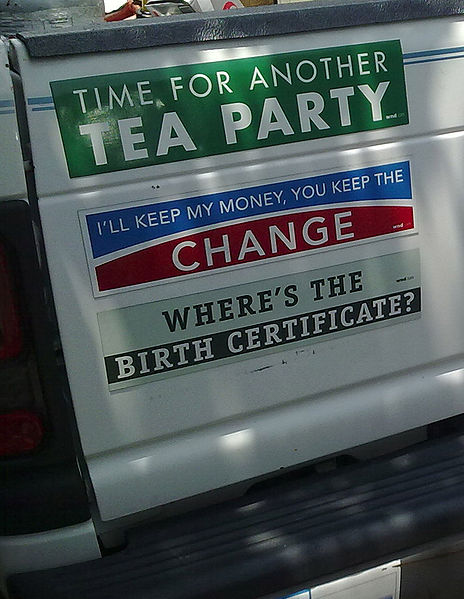
A birth certificate-related bumper sticker.
Although claims about Obama's citizenship were evaluated in 2008 by the McCain Campaign and ultimately rejected, they became a significant issue among sections of the political right. By mid-2009, the citizenship issue was one of the hottest and most lucrative sources of fundraising for organizations on the right that raise funds through direct mail and telemarketing. Online petition sites such as that of Alan Keyes, who has been collecting signatures on the birth certificate issue, are a major source for generating mailing lists of movement conservatives. The web site WorldNetDaily published more than 200 articles on the subject by July 2009 and has sold billboards, bumper stickers and postcards asking "Where's the birth certificate?" and similar slogans in an effort which has "already raised tens of thousands of dollars."
Moderate conservatives have found themselves "bombarded with birther stuff". Protesters at the Tea Party protests in 2009 carried signs about the birth certificate issue, some of which were recommended by protest organizers. In an incident that attracted widespread media coverage, moderate Republican Representative Michael Castle was booed and heckled during a July 2009 town hall meeting in Georgetown, Delaware, when he told a woman protesting about Obama's birth certificate: "if you’re referring to the president there, he is a citizen of the United States."NBC Nightly News reported that other members of Congress often hear the issue too; an anonymous congressman told the program that he was reluctant to advertise his own town hall meetings for fear of this issue drowning out everything else.
Here is what the Republican party needs to do, we have to say that's crazy. So I'm here to tell you that those who think the president was born somewhere other than Hawaii you’re crazy ... let's knock this crap off and talk about the real differences we have.
Republican U.S. Senator Lindsey Graham, October 1, 2009
A number of Republican legislators have, proposed legislation and constitutional amendments at the state and federal levels to address issues raised by the birth certificate campaigners. Some Republicans are said to "want the issue to go away", seeing it as a distraction. Democratic commentators have criticized the reluctance of some Republicans to distance themselves from the proponents of the conspiracy theories, suggesting that "Republican officials are reluctant to denounce the birthers for fear of alienating an energetic part of their party's base". NBC News' "First Read" team commented: "the real story in all of this is that Republican Party has a HUGE problem with its base right now." Republican National Committee Chairman, Michael Steele released a statement through his spokesperson saying, "Chairman Steele believes that this is an unnecessary distraction and believes that the president is a U.S. citizen."
Conservative Joel Pollak, writing for The American Thinker, has stated that the reason the "Birther theory" has caught on particularly among conservatives, is the weakness of the Republican opposition, stating:
In the absence of strong Republican leadership, some find the Birther theory a compelling, if desperate, solution. Yet it is ultimately a self-destructive one — not just because it is almost certainly false, but because it contradicts the essential spirit of the conservative movement.
Political analyst Marc Ambinder of The Atlantic and CBS News, suggests that the birther phenomenon goes to the heart of the dilemma now facing the Republican Party, positing that
Republican presidential candidates need to figure out how to diffuse angry birthers who are bound to show up and demand their attention. If they give credence to the birthers, they're not only advancing ignorance but also betraying the narrowness of their base. If they dismiss this growing movement, they might drive birthers to find more extreme candidates, which will fragment a Republican political coalition.
Political analyst Andrew Sullivan, writing in The Sunday Times, stated
The demographics tell the basic story: a black man is president and a large majority of white southerners cannot accept that, even in 2009. They grasp conspiracy theories to wish Obama — and the America he represents — away. Since white southerners comprise an increasing proportion of the 22% of Americans who still describe themselves as Republican, the GOP can neither dismiss the crankery nor move past it. The fringe defines what’s left of the Republican centre.
Opinion surveys
In October 2008, the Orange County Register's OC Political Pulse poll found that a third of responding Republicans believed that Obama had been born outside the United States. As a result of the widespread publicity given to the citizenship controversy, 60% of respondents in an Ohio State University survey carried out in November 2008 had heard of the issue. However, only 10% believed the claims that Obama was not a citizen.
An opinion poll carried out for Daily Kos by Research 2000 in July 2009 found that 77% of Americans believed that Obama was born in the U.S., while 11% didn't, and 12% were unsure. However, Republicans and Southerners were far more likely than other political or demographic groups to doubt that Obama was born in the United States. 58% of Republicans either believed that Obama was not born in the U.S. (28%) or were not sure (30%), with 42% believing that he was. An overwhelming majority of Democrats (93%) and independents (83%) believed that he was born in the U.S. Support for the belief that Obama was born outside the U.S. was strongest in the South, where only 47% of those polled believed he was born in the U.S., compared with an average of 90% of residents of the Northeast, Midwest and West. A marked racial disparity in the South was also apparent. The Politico's congressional reporter, Glenn Thrush, commented that the Research 2000 poll "explains why Republicans, including Roy Blunt, are playing footsie with the Birther fringe".Writing on National Journal's Pollster.com blog, Brendan Nyhan observed that the poll "suggests that the encouragement of the birth certificate myth by conservative pundits and Republican politicians has begun to activate the GOP base on this issue".
A Public Policy Polling survey carried out in August 2009 found that only 32% of Republicans in Virginia thought that Obama was born in the U.S., 41% thought he was foreign-born and the remaining 27% were unsure. In Utah, an August 2009 poll carried out for the Deseret News and KSL-TV found that 67% of Utahns accepted the evidence that Obama was born in the U.S. The poll found that those who do not believe that Obama was born in the United States, or do not know, are predominantly middle-aged, lower-income Republican-leaning individuals without a college education.
A Pew Research Center poll found that 80% of Americans had heard about the Obama citizenship claims by August 2009. The poll found a significant partisan divide in views of the news coverage, with 58% of Democrats saying that the allegations had received too much attention from the media. Republicans were more inclined to say that the allegations had received too little attention, with 39% expressing this view against only 26% saying that the controversy had received too much attention.
In a Harris Poll online survey of 2,320 adults conducted in March 2010, 25% of the respondents said they believed that Obama was "not born in the United States and so is not eligible to be president". In a July 2010 CNN poll of adult Americans, 16% said had doubts that Obama was born in the United States, and a further 11% were certain that he was not.
Legislative initiatives and responses
The controversy over Obama's citizenship and eligibility for the presidency has prompted a number of Republican state and federal legislators to propose legislation aimed at requiring future presidential candidates to release copies of their birth certificates. Some legislators also lent their support to birth certificate-related litigation against Obama, joining as co-plaintiffs. State legislatures have also gone in the opposite direction, to limit the lengths that proponents can go in pursuit of this issue.
State legislatures
Bills to mitigate future questions
Oklahoma
Oklahoma Republican state Representative Mike Ritze proposed a bill in December 2008, requiring any candidate for public office in Oklahoma to show proof of citizenship. Ritze declared that he "does not believe Obama submitted an authentic copy of his birth certificate". He also unsuccessfully approached Oklahoma Republican Senators Tom Coburn and James Inhofe to persuade them to mount a challenge to Obama's confirmation by Congress.The bill, House Bill 1329, was criticized by The Norman Transcript newspaper as "an outright attempt to embarrass President Barack Obama whose own citizenship was questioned, mostly by those pajama guerrillas trolling on the Internet". The bill gained a 23–20 vote in favor, but failed to meet the 25-vote threshold required to pass.
Tennessee
In Tennessee, four Republican state Representatives—Stacey Campfield, Glen Casada, Frank S. Niceley and Eric H. Swafford—announced in February 2009 that they would be joining a legal action to force Obama to release his birth certificate and prove his citizenship. Casada, the Tennessee House Republican caucus chairman, said that he believes Obama has further proof of eligibility, and would like him to make it available: "Yes, people may say, you're just chasing some conspiracy theory ... [but] it's a simple act on his part to just do, and we're done—move on." The alternative newspaper Nashville Scene described Swafford as joining a "wacky legal action" and quoted Tennessee house Democrat Larry Miller as saying: "What is the mentality of these kind of people who continuously make these kind of goofy statements? It's embarrassing." Attorney Orly Taitz of California said she planned to file the suit, representing the Defend Our Freedoms Foundation.
Missouri
Fifteen Republican members of the Missouri House of Representatives sponsored an amendment to the Missouri Constitution in March 2009 that would require "candidates who are required by the Constitution of the United States to be natural born citizens" to provide a birth certificate to the Missouri Secretary of State to confirm their eligibility. A certificate of live birth would not be accepted. Failure to comply would result in the candidate being deemed ineligible to stand. The only political offices to be affected would be the President and Vice President, which are the only two positions for which there is a specific constitutional citizenship requirement. The proposed amendment is part of a "voter’s bill of rights", which would serve "as a defense against corruption, fraud, and tyranny". Political commentators interpreted the proposal as being "aimed at advancing the claims of the fringe movement that doubts President Barack Obama's eligibility to serve as president". The proposed amendment, House Joint Resolution No. 34, was subsequently withdrawn.
A number of Missouri Republican politicians have continued to support claims and litigation on the citizenship issue. State Representatives Cynthia L. Davis, Timothy W. Jones and Casey Guernsey have committed to participating as plaintiffs in a lawsuit filed in Missouri challenging Obama's citizenship. State Representative Edgar G. H. Emery told reporters in July 2009 that he "questions Obama’s citizenship and ... believes his alleged lack of a legitimate birth certificate ignores the Constitution."
Arizona
On April 19, 2010, the Arizona House of Representatives voted in favor of a rider to require presidential candidates "to submit documents proving they meet the constitutional requirements to be president".If enacted, the law would give the Arizona Secretary of State the power to omit a candidate's name on the state ballot if there is "reasonable cause" to believe that the documents are not adequate proof of the requirements for office. The rider passed the Arizona House of Representatives on a 31-29 vote, with only Republicans voting in favor and some Republicans joining with Democrats to oppose. The bill then went to the Arizona State Senate, which declined to vote on the bill before the April 2010 end of legislative session, the deadline for the bill's passage.
In reaction to the proposed legislation, The Arizona Republic referred to it as a "nutty birther bill" that would make Arizona seem to be a place where "any crackpot whim can be enshrined in law". Arizona Republican State Representative Cecil Ash, who supported the bill, appeared on CNN's Anderson Cooper 360° to discuss the bill. Ash stated that he believed President Obama was an American citizen, but there has been "a lot of controversy over the issue". Cooper then likened the people who believe there is a birth certificate controversy to people who believe the moon is made of cheese and asked Ash if he knew the moon was not made of cheese without investigation. Ash responded in the affirmative.
Bill to relieve county employees
On May 12, 2010, Governor Linda Lingle of Hawaii signed a bill that allows the state to ignore requests for information if deemed "duplicative or substantially similar" to a prior query.
Congress
Some activists lobbied members of Congress to reject the Electoral College vote and block Obama's election as president in its sitting on January 8, 2009 to certify and tally the results of the election. Two Republican members of the House of Representatives, John Linder and Ron Paul, were heavily lobbied by activists who believed that the two lawmakers would be more willing than other members of Congress to raise objections to Obama's confirmation. The lobbying was unsuccessful and Congress unanimously declared Obama to be the winner of the election.
In March 2009, Representative Bill Posey, a newly elected Republican from Florida's 15th congressional district, introduced a bill, H.R. 1503, in the U.S. House of Representatives. It would amend the Federal Election Campaign Act of 1971 to require candidates for the Presidency "to include with the [campaign] committee's statement of organization a copy of the candidate's birth certificate" plus supporting documentation. The bill did not initially have any co-sponsors and was introduced without the Republican leadership being informed. Florida Today, the newspaper serving his constituency, commented that the bill "stems from fringe opponents of President Barack Obama who, during the 2008 election campaign, questioned whether Obama was born in Hawaii," but added that Posey's office "does not question Obama's citizenship." Posey explained his motivation as being to "prevent something like this [controversy] from happening in the future" by requiring "the birth certificate up front and take [the issue] off the table". His initiative was strongly criticized by Florida Democrats, who accused Posey of trying to "fan the rumors on the extreme fringe of the Republican Party" and "pandering to the right wing". The satirist Stephen Colbert also mocked Posey for not addressing rumors that he was "part alligator";Posey responded by commenting that there was "no reason to say that I'm the illegitimate grandson of an alligator". He also stated that there was now "no reason to question" that Obama is a U.S. citizen. Despite the criticism, Posey's bill has gained the support of twelve Republican co-sponsors - Representatives John R. Carter, Kenny Marchant, Louie Gohmert, John Culberson, Randy Neugebauer, Mike Conaway and Ted Poe (all from Texas), Rep. John Campbell (California), Rep. Bob Goodlatte (Virginia), Rep. Dan Burton (Indiana), Rep. Marsha Blackburn (Tennessee), and Rep. Trent Franks (Arizona).
Republican Senator Tom Coburn (Oklahoma) also stated that he would "likely support it" if the bill reached the Senate, saying that Obama "meets the constitutional requirement to be president," and that "It is each state's responsibility to determine the eligibility of those running for federal office."
On July 27, the House of Representatives passed a resolution commemorating the 50th anniversary of Hawaii's statehood. The resolution, containing language recognizing Hawaii as President Obama's birth state, passed by a vote of 378 to zero. Some of the cosponsors of the Posey bill, namely Campbell, Carter, and Marchant, did not cast a vote.
In November 2009, Representative Nathan Deal (Georgia), a Republican candidate for governor of Georgia, replied to a question about whether he believed that Obama "is a native-born American citizen who is eligible to serve as president" with a statement that "I am joining several of my colleagues in the House in writing a letter to the President asking that he release a copy of his birth certificate so we can have an answer to this question."
Official White House response
Those who believe that President Obama was not born in Hawaii claim that if Obama released his "long form" birth certificate it will end all speculations. Commentators, however, noted that it would not be advantageous for him to do that for several reasons. First, it would raise questions as to why it took him so long to release the "long form". Second, it would hand his political adversaries a victory as it would show that he caved in to their demand. Finally, it would open the door to demands for many other records from his life that have nothing to do with his birth.
Nonetheless, Obama's press secretary, Robert Gibbs, has addressed the issue. At the end of the May 27, 2009 press briefing, WorldNetDaily reporter Lester Kinsolving asked about Obama's birth certificate. White House press secretary Robert Gibbs replied, "It's on the Internet", to which Kinsolving responded "No, no, no – the long form listing his hospital and physician." Gibbs responded as follows:
Lester, this question in many ways continues to astound me. The state of Hawaii provided a copy with the seal of the President's birth. I know there are apparently at least 400,000 people (laughter) that continue to doubt the existence of and the certification by the state of Hawaii of the President's birth there, but it's on the Internet because we put it on the Internet for each of those 400,000 to download.
At a July 27, 2009 press briefing, radio talk show host Bill Press asked Gibbs if there was anything he could say to make the issue go away. Gibbs answered, "No. I mean, the God's honest truth is no," because "nothing will assuage" those who continue to pursue what he called "made-up, fictional nonsense" despite the evidence that Obama had already provided.
On August 6, 2009 Gibbs commented, "You couldn't sell this script in Hollywood," and summarized the contentions that he considered "totally crazy":
A pregnant woman leaves her home to go overseas to have a child — who there’s not a passport for — so is in cahoots with someone…to smuggle that child, that previously doesn’t exist on a government roll somewhere back into the country and has the amazing foresight to place birth announcements in the Hawaii newspapers? All while this is transpiring in cahoots with those in the border, all so some kid named Barack Obama could run for President 46 and a half years later.
(source:wikipedia)



 ,
,