Judaism History,
Judaica (clockwise from top): Shabbatcandlesticks, handwashing cup, Chumash andTanakh, Torah pointer, shofar, and etrog box
| Part of a series on |
|---|
|
| Judaism |
|---|
|
| Jewish religious movements |
|---|
| Orthodox (Haredi · Hasidic · Modern) |
| Conservative · Reform |
| Reconstructionist · Renewal · Humanistic |
|
|---|
Judaism is the "religion, philosophy, and way of life" of the Jewish people. Judaism, originating in the Hebrew Bible (also known as the Tanakh) and explored in later texts such as the Talmud, is considered by Jews to be the expression of the covenantal relationship God developed with the Children of Israel. According to traditional Rabbinic Judaism, God revealed his laws and commandments to Moses on Mount Sinai in the form of both the Written and Oral Torah.This was historically challenged by the Karaites who maintain that only the Written Torah was revealed, and, in modern times, liberal movements such as Humanistic Judaism may be nontheistic. The Hebrews / Israelites were called (referred to) as Jews, already, as early as in the Book of Esther. The term Jews replaced the title "Children of Israel.".
Judaism claims a historical continuity spanning more than 3000 years. It is one of the oldest monotheistic religions, and the oldest to survive into the present day. Its texts, traditions and values have inspired later Abrahamic religions, including Christianity, Islam and the Baha'i Faith. Many aspects of Judaism have also directly or indirectly influenced secular Western ethics and civil law.
Jews are an ethnoreligious group that includes those born Jewish and converts to Judaism. In 2007, the world Jewish population was estimated at 13 million, of whom about 40% reside in Israel and 40% in the United States. The largest Jewish religious movements are Orthodox Judaism, Conservative Judaism and Reform Judaism. A major source of difference between these groups is their approach to Jewish law. Orthodox Judaism maintains that the Torah and Jewish law are divine in origin, they are eternal and unalterable, and should be adhered to. Conservative and Reform Judaism are more liberal, with Conservative Judaism promoting a more "traditional" interpretation of its requirements than Reform Judaism. Their typical position is that Jewish law should be viewed as a set of general guidelines rather than a set of restrictions and obligations whose observance is required of all Jews. Historically, special courts enforced Jewish law; today, these courts still exist but the practice of Judaism is mostly voluntary.Authority on theological and legal matters is not vested in any one person or organization, but in the sacred texts and the many rabbis and scholars who interpret these texts.
Defining character and principles of faith
Defining character
Unlike other ancient Near Eastern gods, the Hebrew God is portrayed as unitary and solitary; consequently, the Hebrew God's principal relationships are not with other gods, but with the world, and more specifically, with the people He created. Judaism thus begins with an ethical monotheism: the belief that God is one, and concerned with the actions of humankind.According to the Hebrew Bible, God promised Abraham to make of his offspring a great nation. Many generations later, he commanded the nation of Israel to love and worship only one God; that is, the Jewish nation is to reciprocate God's concern for the world. He also commanded the Jewish people to love one another; that is, Jews are to imitate God's love for people. These commandments are but two of a large corpus of commandments and laws that constitute this covenant, which is the substance of Judaism.
Thus, although there is an esoteric tradition in Judaism (Kabbalah), Rabbinic scholar Max Kadushin has characterized normative Judaism as "normal mysticism," because it involves every-day personal experiences of God through ways or modes that are common to all Jews. This is played out through the observance of the halakhot and given verbal expression in the Birkat Ha-Mizvot, the short blessings that are spoken every time a positive commandment is to be fulfilled.
The ordinary, familiar, everyday things and occurrences, we have constitute occasions for the experience of God. Such things as one's daily sustenance, the very day itself, are felt as manifestations of God's loving-kindness, calling for the Berakhot. Kedushah, holiness, which is nothing else than the imitation of God, is concerned with daily conduct, with being gracious and merciful, with keeping oneself from defilement by idolatry, adultery, and the shedding of blood. The Birkat Ha-Mitzwot evokes the consciousness of holiness at a rabbinic rite, but the objects employed in the majority of these rites are non-holy and of general character, while the several holy objects are non-theurgic. And not only do ordinary things and occurrences bring with them the experience of God. Everything that happens to a man evokes that experience, evil as well as good, for a Berakah is said also at evil tidings. Hence, although the experience of God is like none other, the occasions for experiencing Him, for having a consciousness of Him, are manifold, even if we consider only those that call for Berakot.
Whereas Jewish philosophers often debate whether God is imminent or transcendent, and whether people have free will or their lives are determined, Halakha is a system through which any Jew acts to bring God into the world.
Ethical monotheism is central in all sacred or normative texts of Judaism. However, monotheism has not always been followed in practice. The Jewish Bible (Tanakh) records and repeatedly condemns the widespread worship of other gods in ancient Israel. In the Greco-Roman era, many different interpretations of monotheism existed in Judaism, including the interpretations that gave rise to Christianity.
Moreover, as a non-creedal religion, some have argued that Judaism does not require one to believe in God. For some, observance of Jewish law is more important than belief in God per se. In modern times, some liberal Jewish movements do not accept the existence of a personified deity active in history.
Core tenets
Jewish principles of faith
13 Principles of Faith:
I believe with perfect faith that the Creator, Blessed be His Name, is the Creator and Guide of everything that has been created; He alone has made, does make, and will make all things.
I believe with perfect faith that the Creator, Blessed be His Name, is One, and that there is no unity in any manner like His, and that He alone is our God, who was, and is, and will be.
I believe with perfect faith that the Creator, Blessed be His Name, has no body, and that He is free from all the properties of matter, and that there can be no (physical) comparison to Him whatsoever.
I believe with perfect faith that the Creator, Blessed be His Name, is the first and the last.
I believe with perfect faith that to the Creator, Blessed be His Name, and to Him alone, it is right to pray, and that it is not right to pray to any being besides Him.
I believe with perfect faith that all the words of the prophets are true.
I believe with perfect faith that the prophecy of Moses our teacher, peace be upon him, was true, and that he was the chief of the prophets, both those who preceded him and those who followed him.
I believe with perfect faith that the entire Torah that is now in our possession is the same that was given to Moses our teacher, peace be upon him.
I believe with perfect faith that this Torah will not be exchanged, and that there will never be any other Torah from the Creator, Blessed be His Name.
I believe with perfect faith that the Creator, Blessed be His Name, knows all the deeds of human beings and all their thoughts, as it is written, "Who fashioned the hearts of them all, Who comprehends all their actions" (Psalms 33:15).
I believe with perfect faith that the Creator, Blessed be His Name, rewards those who keep His commandments and punishes those that transgress them.
I believe with perfect faith in the coming of the Messiah; and even though he may tarry, nonetheless, I wait every day for his coming.
I believe with perfect faith that there will be a revival of the dead at the time when it shall please the Creator, Blessed be His name, and His mention shall be exalted for ever and ever.
-Maimonides
Scholars throughout Jewish history have proposed numerous formulations of Judaism's core tenets, all of which have met with criticism. The most popular formulation is Maimonides' thirteen principles of faith, developed in the 12th century. According to Maimonides, any Jew to reject even one of these principles would be considered an apostate and a heretic. However, neither Maimonides nor his contemporaries viewed these principles as encompassing all of Jewish belief, but rather representing the core theological underpinnings of Judaism. Other Jewish scholars have held points of view diverging in minor ways from Maimonides' principles.
In Maimonides' time, his list of tenets was criticized by Hasdai Crescas and Joseph Albo. Albo and the Raavad argued that Maimonides' principles contained too many items that, while true, were not fundamentals of the faith. Thus, they claimed Maimonides categorized too many Jews who were simply in error as heretics.[citation needed] Others[who?] opposed any simplified formulation of Judaism's core tenets, on the grounds that reducing Judaism to a short list of beliefs would minimize acceptance of the entire Torah.
Along these lines, the ancient historian Josephus emphasized practices and observances rather than religious beliefs, associating apostasy with a failure to observe Jewish law and maintaining that the requirements for conversion to Judaism included circumcision and adherence to traditional customs. Maimonides' principles were largely ignored over the next few centuries. Later, two poetic restatements of these principles ("Ani Ma'amin" and "Yigdal") became integrated into many Jewish leading to their eventual near-universal acceptance.
In modern times, Judaism lacks a centralized authority that would dictate an exact religious dogma. Because of this, many different variations on the basic beliefs are considered within the scope of Judaism. Even so, all Jewish religious movements are, to a greater or lesser extent, based on the principles of the Hebrew Bible and various commentaries such as the Talmud and Midrash. Judaism also universally recognizes the Biblical Covenant between God and the Patriarch Abraham as well as the additional aspects of the Covenant revealed to Moses, who is considered Judaism's greatest prophet. In the Mishnah, a core text of Rabbinic Judaism, acceptance of the Divine origins of this covenant is considered an essential aspect of Judaism and those who reject the Covenant supposedly forfeit their share in the World to Come.
Jewish religious texts
Rabbinic literature
Judaism has at all times valued Torah study, as well as other religious texts. The following is a basic, structured list of the central works of Jewish practice and thought. For more detail, see Rabbinic literature.
Tanakh (Hebrew Bible) and commentaries
Mesorah
Targum
Jewish Biblical exegesis (also see Midrash below)
Works of the Talmudic Era (classic rabbinic literature)
Mishnah and commentaries
Tosefta and the minor tractates
Talmud:
The Babylonian Talmud and commentaries
Jerusalem Talmud and commentaries
Midrashic literature:
Halakhic Midrash
Aggadic Midrash
Halakhic literature
Major Codes of Jewish Law and Custom
Mishneh Torah and commentaries
Tur and commentaries
Shulchan Aruch and commentaries
Responsa literature
Jewish Thought and Ethics
Jewish philosophy
Kabbalah
Hasidic works
Musar literature and other works of Jewish ethics
Siddur and Jewish liturgy
Piyyut (Classical Jewish poetry)
Jewish legal literature
Halakha
The basis of Jewish law and tradition (halakha) is the Torah (also known as the Pentateuch or the Five Books of Moses). According to rabbinic tradition there are 613 commandments in the Torah. Some of these laws are directed only to men or to women, some only to the ancient priestly groups, the Kohanim and Leviyim (members of the tribe of Levi), some only to farmers within the Land of Israel. Many laws were only applicable when the Temple in Jerusalem existed, and fewer than 300 of these commandments are still applicable today.
While there have been Jewish groups whose beliefs were claimed to be based on the written text of the Torah alone (e.g., the Sadducees, and the Karaites), most Jews believed in what they call the oral law. These oral traditions were transmitted by the Pharisee sect of ancient Judaism, and were later recorded in written form and expanded upon by the rabbis.
Rabbinic Judaism (which derives from the Pharisees) has always held that the books of the Torah (called the written law) have always been transmitted in parallel with an oral tradition. To justify this viewpoint, Jews point to the text of the Torah, where many words are left undefined, and many procedures mentioned without explanation or instructions; this, they argue, means that the reader is assumed to be familiar with the details from other, i.e., oral, sources. This parallel set of material was originally transmitted orally, and came to be known as "the oral law".
By the time of Rabbi Judah haNasi (200 CE), after the destruction of Jerusalem, much of this material was edited together into the Mishnah. Over the next four centuries this law underwent discussion and debate in both of the world's major Jewish communities (in Israel and Babylonia), and the commentaries on the Mishnah from each of these communities eventually came to be edited together into compilations known as the two Talmuds. These have been expounded by commentaries of various Torah scholars during the ages.
Halakha, the rabbinic Jewish way of life, then, is based on a combined reading of the Torah, and the oral tradition - the Mishnah, the halakhic Midrash, the Talmud and its commentaries. The Halakha has developed slowly, through a precedent-based system. The literature of questions to rabbis, and their considered answers, is referred to as responsa (in Hebrew, Sheelot U-Teshuvot.) Over time, as practices develop, codes of Jewish law are written that are based on the responsa; the most important code, the Shulchan Aruch, largely determines Orthodox religious practice today.
Jewish philosophy
Jewish philosophy refers to the conjunction between serious study of philosophy and Jewish theology. Major Jewish philosophers include Solomon ibn Gabirol, Saadia Gaon, Judah Halevi, Maimonides, and Gersonides. Major changes occurred in response to the Enlightenment (late 18th to early 19th century) leading to the post-Enlightenment Jewish philosophers. Modern Jewish philosophy consists of both Orthodox and non-Orthodox oriented philosophy. Notable among Orthodox Jewish philosophers are Eliyahu Eliezer Dessler, Joseph B. Soloveitchik, and Yitzchok Hutner. Well-known non-Orthodox Jewish philosophers include Martin Buber, Franz Rosenzweig, Mordecai Kaplan, Abraham Joshua Heschel, Will Herberg, and Emmanuel Lévinas.
Related Topics
Torah databases (electronic versions of the Traditional Jewish Bookshelf)
List of Jewish prayers and blessings
Rabbinic hermeneutics
13 Principles of Hermeneutics:
A law that operates under certain conditions will surely be operative in other situations where the same conditions are present in a more acute form
A law operating in one situation will also be operative in another situation, if the text characterizes both situations in identical terms.
A law that clearly expresses the purpose it was meant to serve will also apply to other situations where the identical purpose may be served.
When a general rule is followed by illustrative particulars, only those particulars are to be embraced by it.
A law that begins with specifying particular cases, and then proceeds to an all-embracing generalization, is to be applied to particulars cases not specified but logically falling into the same generalization.
A law that begins with a generalization as to its intended applications, then continues with the specification of particular cases, and then concludes with a restatement of the generalization, can be applied only to the particular cases specified.
The rules about a generalization being followed or preceded by specifying particulars (rules 4 and 5) will not apply if it is apparent that the specification of the particular cases or the statement of the generalization is meant purely for achieving a greater clarity of language.
A particular case already covered in a generalization that is nevertheless treated separately suggests that the same particularized treatment be applied to all other cases which are covered in that generalization.
A penalty specified for a general category of wrong-doing is not to be automatically applied to a particular case that is withdrawn from the general rule to be specifically prohibited, but without any mention of the penalty.
A general prohibition followed by a specified penalty may be followed by a particular case, normally included in the generalization, with a modification in penalty, either toward easing it or making it more severe.
A case logically falling into a general law but treated separately remains outside the provisions of the general law except in those instances where it is specifically included in them.
Obscurities in Biblical texts may be cleared up from the immediate context or from subsequently occurring passages
Contradictions in Biblical passages may be removed through the mediation of other passages.
-R. Ishmael
Orthodox and many other Jews do not believe that the revealed Torah consists solely of its written contents, but of its interpretations as well. The study of Torah (in its widest sense, to include both poetry, narrative, and law, and both the Hebrew Bible and the Talmud) is in Judaism itself a sacred act of central importance. For the sages of the Mishnah and Talmud, and for their successors today, the study of Torah was therefore not merely a means to learn the contents of God's revelation, but an end in itself. According to the Talmud,
These are the things for which a person enjoys the dividends in this world while the principal remains for the person to enjoy in the world to come; they are: honoring parents, loving deeds of kindness, and making peace between one person and another. But the study of the Torah is equal to them all" (Talmud Shabbat 127a).
In Judaism, "the study of Torah can be a means of experiencing God".Reflecting on the contribution of the Amoraim and tanaim to contemporary Judaism, Professor Jacob Neusner observed:
The rabbi's logical and rational inquiry is not mere logic-chopping. It is a most serious and substantive effort to locate in trivialities the fundamental principles of the revealed will of God to guide and sanctify the most specific and concrete actions in the workaday world .... Here is the mystery of Talmudic Judaism: the alien and remote conviction that the intellect is an instrument not of unbelief and desacralization but of sanctification."
To study the Written Torah and the Oral Torah in light of each other is thus also to study how to study the word of God.
In the study of Torah, the sages formulated and followed various logical and hermeneutical principles. According to David Stern, all Rabbinic hermeneutics rest on two basic axia:
first, the belief in the omnisignificance of Scripture, in the meaningfulness of its every word, letter, even (according to one famous report) scribal flourish; second, the claim of the essential unity of Scripture as the expression of the single divine will.
These two principles make possible a great variety of interpretations. According to the Talmud,
A single verse has several meanings, but no two verses hold the same meaning. It was taught in the school of R. Ishmael: 'Behold, My word is like fire—declares the Lord—and like a hammer that shatters rock' (Jer 23:29). Just as this hammer produces many sparks (when it strikes the rock), so a single verse has several meanings." (Talmud Sanhedrin 34a).
Observant Jews thus view the Torah as dynamic, because it contains within it a host of interpretations
According to Rabbinic tradition, all valid interpretations of the written Torah were revealed to Moses at Sinai in oral form, and handed down from teacher to pupil (The oral revelation is in effect coextensive with the Talmud itself). When different rabbis forwarded conflicting interpretations, they sometimes appealed to hermeneutic principles to legitimize their arguments; some rabbis claim that these principles were themselves revealed by God to Moses at Sinai.
Thus, Hillel called attention to seven commonly used in the interpretation of laws (baraita at the beginning of Sifra); R. Ishmael, thirteen (baraita at the beginning of Sifra; this collection is largely an amplification of that of Hillel). Eliezer b. Jose ha-Gelili listed 32, largely used for the exegesis of narrative elements of Torah. All the hermeneutic rules scattered through the Talmudim and Midrashim have been collected by Malbim in Ayyelet ha-Shachar, the introduction to his commentary on the Sifra. Nevertheless, R. Ishmael's 13 principles are perhaps the ones most widely known; they constitute an important, and one of Judaism's earliest, contributions to logic, hermeneutics, and jurisprudence. Judah Hadassi incorporated Ishmael's principles into Karaite Judaism in the 12th century. Today R. Ishmael's 13 principles are incorporated into the Jewish prayer book to be read by observant Jews on a daily basis.
Jewish identity
]Origin of the term "Judaism"
The term Judaism derives from the Latin Iudaismus, derived from the Greek Ιουδαϊσμός Ioudaïsmos, and ultimately from the Hebrew יהודה, Yehudah, "Judah"; in Hebrew: יַהֲדוּת, Yahadut. It first appears as the Hellenistic Greek iudaismos in 2nd Maccabees in the 2nd century BCE. In the context of the age and period it held the meaning of seeking or forming part of a cultural entity, that of iudea, the Greek derivative of Persian Yehud, and can be compared with hellenismos, meaning acceptance of Hellenic cultural norms (the conflict between iudaismos and hellenismos lay behind the Maccabeean revolt and hence the invention of the term iudaismos).The earliest instance of the term in English, used to mean "the profession or practice of the Jewish religion; the religious system or polity of the Jews," is Robert Fabyan's The newe cronycles of Englande and of Fraunce a 1513. As an English translation of the Latin, the first instance in English is a 1611 translation of the Apocrypha, 2 Macc. ii. 21 "Those that behaved themselues manfully to their honour for Iudaisme."
Distinction between Jews as a people and Judaism
According to Daniel Boyarin, the underlying distinction between religion and ethnicity is foreign to Judaism itself, and is one form of the dualism between spirit and flesh that has its origin in Platonic philosophy and that permeated Hellenistic Judaism.[ Consequently, in his view, Judaism does not fit easily into conventional Western categories, such as religion, ethnicity, or culture. Boyarin suggests that this in part reflects the fact that much of Judaism's 4,000-year history predates the rise of Western culture and occurred outside the West (that is, Europe, particularly medieval and modern Europe). During this time, Jews have experienced slavery, anarchic and theocratic self-government, conquest, occupation, and exile; in the Diasporas, they have been in contact with and have been influenced by ancient Egyptian, Babylonian, Persian, and Hellenic cultures, as well as modern movements such as the Enlightenment (see Haskalah) and the rise of nationalism, which would bear fruit in the form of a Jewish state in the Levant. They also saw an elite convert to Judaism (the Khazars), only to disappear as the centers of power in the lands once occupied by that elite fell to the people of Rus and then the Mongols. Thus, Boyarin has argued that "Jewishness disrupts the very categories of identity, because it is not national, not genealogical, not religious, but all of these, in dialectical tension."
In contrast to this point of view, practices such as Humanistic Judaism reject the religious aspects of Judaism, while retaining certain cultural traditions.
Who is a Jew?
According to traditional Jewish Law, a Jew is anyone born of a Jewish mother or converted to Judaism in accord with Jewish Law. American Reform Judaism and British Liberal Judaism accept the child of one Jewish parent (father or mother) as Jewish if the parents raise the child with a Jewish identity. All mainstream forms of Judaism today are open to sincere converts, although conversion has traditionally been discouraged since the time of the Talmud. The conversion process is evaluated by an authority, and the convert is examined on his or her sincerity and knowledge. Converts are given the name "ben Abraham" or "bat Abraham", (son or daughter of Abraham).
Traditional Judaism maintains that a Jew, whether by birth or conversion, is a Jew forever. Thus a Jew who claims to be an atheist or converts to another religion is still considered by traditional Judaism to be Jewish. However, the Reform movement maintains that a Jew who has converted to another religion is no longer a Jew,[66][67] and the Israeli Government has also taken that stance after Supreme Court cases and statutes.
The question of what determines Jewish identity in the State of Israel was given new impetus when, in the 1950s, David Ben-Gurion requested opinions on mihu Yehudi ("who is a Jew") from Jewish religious authorities and intellectuals worldwide in order to settle citizenship questions. This is still not settled, and occasionally resurfaces in Israeli politics.
Jewish demographics
Jewish population
The total number of Jews worldwide is difficult to assess because the definition of "who is a Jew" is problematic; not all Jews identify themselves as Jewish, and some who identify as Jewish are not considered so by other Jews. According to the Jewish Year Book (1901), the global Jewish population in 1900 was around 11 million. The latest available data is from the World Jewish Population Survey of 2002 and the Jewish Year Calendar (2005). In 2002, according to the Jewish Population Survey, there were 13.3 million Jews around the world. The Jewish Year Calendar cites 14.6 million. Jewish population growth is currently near zero percent, with 0.3% growth from 2000 to 2001. Intermarriage and the declining birthrate have influenced Jewish population figures, although conversion to Judaism may help to offset this slightly.
Jewish religious movements
Rabbinic Judaism
Rabbinic Judaism or Rabbinism (Hebrew: "Yahadut Rabanit" - יהדות רבנית) has been the mainstream form of Judaism since the 6th century CE, after the codification of the Talmud. It is characterised by the belief that the Written Torah (Law) cannot be correctly interpreted without reference to the Oral Torah and by the voluminous literature specifying what behavior is sanctioned by the law (called halakha, "the way").
The Jewish Enlightenment of the late 18th century resulted in the division of Ashkenazi (Western) Jewry into religious movements or denominations, especially in North America and Anglophone countries. The main denominations today outside Israel (where the situation is rather different) are Orthodox, Conservative, and Reform.
Orthodox Judaism holds that both the Written and Oral Torah were divinely revealed to Moses, and that the laws within it are binding and unchanging. Orthodox Jews generally consider commentaries on the Shulchan Aruch (a condensed codification of halakha that largely favored Sephardic traditions) to be the definitive codification of Jewish law. Orthodoxy places a high importance on Maimonides' 13 principles as a definition of Jewish faith.
Orthodoxy shades into Modern Orthodox Judaism and Haredi Judaism. The distinction is generally around accommodation to modernity and weight placed on non-Jewish disciplines, though in practical terms the differences are often reflected in styles of dress and rigor in practice. Hasidic Judaism is a stream of Haredi Judaism rooted in the Kabbalah, and distinguished by a variety of special customs and practices including reliance on a Rebbe or religious teacher, and a special dress code particular to each Hasidic group. Sephardic Haredi Judaism is a relatively recent stream of Haredi which emerged among Sephardic (Oriental, meaning Asian and North African) Jews in Israel and is centered around the leadership of Rabbi Ovadia Yosef. Sephardic Haredim have adopted many aspects of Haredi lifestyle but differ from Litvish of Hassidic Jews in that they follow the Halakhic rulings and traditions of Sephardic and Mizrahi Jewry.
Conservative Judaism, known as Masorti outside the United States and Canada, is characterized by a commitment to traditional Jewish laws and customs, including observance of Shabbat and kashrut, a deliberately non-fundamentalist teaching of Jewish principles of faith, a positive attitude toward modern culture, and an acceptance of both traditional rabbinic and modern scholarship when considering Jewish religious texts. Conservative Judaism teaches that Jewish law is not static, but has always developed in response to changing conditions. It holds that the Torah is a divine document written by prophets inspired by God and reflecting his will, but rejects the Orthodox position that it was dictated by God to Moses.[69][70] Conservative Judaism holds that the Oral Law is divine and normative, but holds that both the Written and Oral Law may be interpreted by the rabbis to reflect modern sensibilities and suit modern conditions.
Reform Judaism, called Liberal or Progressive Judaism in many countries, defines Judaism as a religion rather than as a race or culture, rejects most of the ritual and ceremonial laws of the Torah while observing moral laws, and emphasizes the ethical call of the Prophets. Reform Judaism has developed an egalitarian prayer service in the vernacular (along with Hebrew in many cases) and emphasizes personal connection to Jewish tradition.
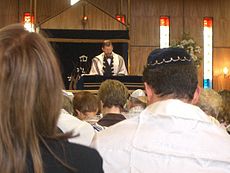
A Reform synagogue with mixed seating and equal participation of men and women
Reconstructionist Judaism, like Reform Judaism, does not hold that Jewish law, as such, requires observance, but unlike Reform, Reconstructionist thought emphasizes the role of the community in deciding what observances to follow.
Jewish Renewal is a recent North American movement which focuses on spirituality and social justice, but does not address issues of Jewish law. Men and women participate equally in prayer.
Humanistic Judaism is a small non-theistic movement centered in North America and Israel that emphasizes Jewish culture and history as the sources of Jewish identity.
Jewish movements in Israel
Religion in Israel
Most Jewish Israelis classify themselves as "secular" (hiloni), "traditional" (masorti), "religious" (dati) or Haredi. The term "secular" is more popular as a self-description among Israeli families of western (European) origin, whose Jewish identity may be a very powerful force in their lives, but who see it as largely independent of traditional religious belief and practice. This portion of the population largely ignores organized religious life, be it of the official Israeli rabbinate (Orthodox) or of the liberal movements common to diaspora Judaism (Reform, Conservative).
The term "traditional" (masorti) is most common as a self-description among Israeli families of "eastern" origin (i.e., the Middle East, Central Asia, and North Africa). This term, as commonly used, has nothing to do with the official Masorti (Conservative) movement. There is a great deal of ambiguity in the ways "secular" and "traditional" are used in Israel: they often overlap, and they cover an extremely wide range in terms of ideology and religious observance. The term "Orthodox" is not popular in Israeli discourse, although the percentage of Jews who come under that category is far greater than in the diaspora. What would be called "Orthodox" in the diaspora includes what is commonly called dati (religious) or haredi (ultra-Orthodox) in Israel. The former term includes what is called "Religious Zionism" or the "National Religious" community, as well as what has become known over the past decade or so as haredi-leumi (nationalist haredi), or "Hardal", which combines a largely haredi lifestyle with nationalist ideology. (Some people, in Yiddish, also refer to observant Orthodox Jews as frum, as opposed to frei (more liberal Jews)).
Haredi applies to a populace that can be roughly divided into three separate groups along both ethnic and ideological lines: (1) "Lithuanian" (non-hasidic) haredim of Ashkenazic origin; (2) Hasidic haredim of Ashkenazic origin; and (3) Sephardic haredim. The third group is the largest, and has been the most politically active since the early 1990s.
Alternative Judaism
Karaite Judaism defines itself as the remnants of the non-Rabbinic Jewish sects of the Second Temple period, such as the Sadducees. The Karaites ("Scripturalists") accept only the Hebrew Bible and what they view as the Peshat ("simple" meaning); they do not accept non-biblical writings as authoritative. Some European Karaites do not see themselves as part of the Jewish community at all, although most do. The Samaritans, a very small community located entirely around Mount Gerizim in the Nablus/Shechem region of the West Bank and in Holon, near Tel Aviv in Israel, regard themselves as the descendants of the Israelites of the Iron Age kingdom of Israel. Their religious practices are those of Judaism, but they regard only the written Torah as authoritative scripture (with a special regard also for the Book of Joshua).
Jewish observances
Religious clothing
A kippah (Hebrew: כִּפָּה, plural kippot; Yiddish: יאַרמלקע, yarmulke) is a slightly rounded brimless skullcap worn by many Jewish men while praying, eating, reciting blessings, or studying Jewish religious texts, and at all times by some Jewish men. In non-Orthodox communities, some women have also begun to wear kippot. Kippot range in size from a small round beanie that covers only the back of the head, to a large, snug cap that covers the whole crown.
Tzitzit (Hebrew: צִיציִת) (Ashkenazi pronunciation: tzitzis) are special knotted "fringes" or "tassels" found on the four corners of the tallit (Hebrew: טַלִּית) (Ashkenazi pronunciation: tallis), or prayer shawl. The tallit is worn by Jewish men and some Jewish women during the prayer service. Customs vary regarding when a Jew begins wearing a tallit. In the Sephardi community, boys wear a tallit from bar mitzvah age. In some Ashkenazi communities it is customary to wear one only after marriage. A tallit katan (small tallit) is a fringed garment worn under the clothing throughout the day. In some Orthodox circles, the fringes are allowed to hang freely outside the clothing.
Tefillin (Hebrew: תְפִלִּין), known in English as phylacteries (from the Greek word φιλακτέριον, meaning fortress or protection), are two square leather boxes containing biblical verses, attached to the forehead and wound around the left arm by leather straps. They are worn during weekday morning prayer by observant Jewish men and some Jewish women.
A kittel (Yiddish: קיטל), a white knee-length overgarment, is worn by prayer leaders and some observant traditional Jews on the High Holidays. It is traditional for the head of the household to wear a kittel at the Passover seder, and some grooms wear one under the wedding canopy. Jewish males are buried in a tallit and sometimes also a kittel which are part of the tachrichim (burial garments).
Prayer Jewish services
A Yemenite Jew at morning prayers, wearing a kippah skullcap, prayer shawl and tefillin.
Traditionally, Jews recite prayers three times daily, with a fourth prayer added on Shabbat and holidays. At the heart of each service is the Amidah or Shemoneh Esrei. Another key prayer in many services is the declaration of faith, the Shema Yisrael (or Shema). The Shema is the recitation of a verse from the Torah (Deuteronomy 6:4): Shema Yisrael Adonai Eloheinu Adonai Echad—"Hear, O Israel! The Lord is our God! The Lord is One!"
Most of the prayers in a traditional Jewish service can be recited in solitary prayer, although communal prayer is preferred. Communal prayer requires a quorum of ten adult Jews, called a minyan. In nearly all Orthodox and a few Conservative circles, only male Jews are counted toward a minyan; most Conservative Jews and members of other Jewish denominations count female Jews as well.
In addition to prayer services, observant traditional Jews recite prayers and benedictions throughout the day when performing various acts. Prayers are recited upon waking up in the morning, before eating or drinking different foods, after eating a meal, and so on.
The approach to prayer varies among the Jewish denominations. Differences can include the texts of prayers, the frequency of prayer, the number of prayers recited at various religious events, the use of musical instruments and choral music, and whether prayers are recited in the traditional liturgical languages or the vernacular. In general, Orthodox and Conservative congregations adhere most closely to tradition, and Reform and Reconstructionist synagogues are more likely to incorporate translations and contemporary writings in their services. Also, in most Conservative synagogues, and all Reform and Reconstructionist congregations, women participate in prayer services on an equal basis with men, including roles traditionally filled only by men, such as reading from the Torah. In addition, many Reform temples use musical accompaniment such as organs and mixed choirs.
Jewish holiday
Jewish holidays are special days in the Jewish calendar, which celebrate moments in Jewish history, as well as central themes in the relationship between God and the world, such as creation, revelation, and redemption.
Shabbat
Two braided Shabbat challahs placed under an embroidered challah cover at the start of the Shabbat meal.
Shabbat, the weekly day of rest lasting from shortly before sundown on Friday night to nightfall Saturday night, commemorates God's day of rest after six days of creation. It plays a pivotal role in Jewish practice and is governed by a large corpus of religious law. At sundown on Friday, the woman of the house welcomes the Shabbat by lighting two or more candles and reciting a blessing. The evening meal begins with the Kiddush, a blessing recited aloud over a cup of wine, and the Mohtzi, a blessing recited over the bread. It is customary to have challah, two braided loaves of bread, on the table. During Shabbat Jews are forbidden to engage in any activity that falls under 39 categories of melakhah, translated literally as "work". In fact the activities banned on the Sabbath are not "work" in the usual sense: They include such actions as lighting a fire, writing, using money and carrying in the public domain. The prohibition of lighting a fire has been extended in the modern era to driving a car, which involves burning fuel, and using electricity.
Three pilgrimage festivals
Shalosh regalim
Sukkahs in Jerusalem.
Jewish holy days (chaggim), celebrate landmark events in Jewish history, such as the Exodus from Egypt and the giving of the Torah, and sometimes mark the change of seasons and transitions in the agricultural cycle. The three major festivals, Sukkot, Passover and Shavuot, are called "regalim" (derived from the Hebrew word "regel", or foot). On the three regalim, it was customary for the Israelites to make pilgrimages to Jerusalem to offer sacrifices in the Temple.
Passover (Pesach) is a week-long holiday beginning on the evening of the 14th day of Nisan (the first month in the Hebrew calendar), that commemorates the Exodus from Egypt. Outside Israel, Passover is celebrated for eight days. In ancient times, it coincided with the barley harvest. It is the only holiday that centers on home-service, the Seder. Leavened products (chametz) are removed from the house prior to the holiday, and are not consumed throughout the week. Homes are thoroughly cleaned to ensure no bread or bread by-products remain, and a symbolic burning of the last vestiges of chametz is conducted on the morning of the Seder. Matzo is eaten instead of bread.
Shavuot ("Pentecost" or "Feast of Weeks") celebrates the revelation of the Torah to the Israelites on Mount Sinai. Also known as the Festival of Bikurim, or first fruits, it coincided in biblical times with the wheat harvest. Shavuot customs include all-night study marathons known as Tikkun Leil Shavuot, eating dairy foods (cheesecake and blintzes are special favorites), reading the Book of Ruth, decorating homes and synagogues with greenery, and wearing white clothing, symbolizing purity.
Sukkot ("Tabernacles" or "The Festival of Booths") commemorates the Israelites' forty years of wandering through the desert on their way to the Promised Land. It is celebrated through the construction of temporary booths called sukkot (sing. sukkah) that represent the temporary shelters of the Israelites during their wandering. It coincides with the fruit harvest, and marks the end of the agricultural cycle. Jews around the world eat in sukkot for seven days and nights. Sukkot concludes with Shemini Atzeret, where Jews begin to pray for rain and Simchat Torah, "Rejoicing of the Torah", a holiday which marks reaching the end of the Torah reading cycle and beginning all over again. The occasion is celebrated with singing and dancing with the Torah scrolls.
High Holy Days
Jews praying in a synagogue on Yom Kippur, from an 1878 painting by Maurycy Gottlieb
The High Holidays (Yamim Noraim or "Days of Awe") revolve around judgment and forgiveness.
Rosh Hashanah, (also Yom Ha-Zikkaron or "Day of Remembrance", and Yom Teruah, or "Day of the Sounding of the Shofar"). Rosh Hashanah is the Jewish New Year (literally, "head of the year"), although it falls on the first day of the seventh month of the Hebrew calendar, Tishri. Rosh Hashanah marks the beginning of the 10-day period of atonement leading up to Yom Kippur, during which Jews are commanded to search their souls and make amends for sins committed, intentionally or not, throughout the year. Holiday customs include blowing the shofar, or ram's horn, in the synagogue, eating apples and honey, and saying blessings over a variety of symbolic foods, such as pomegranates.
Yom Kippur, ("Day of Atonement") is the most solemn day of the Jewish year. It is a day of communal fasting and praying for forgiveness for one's sins. Observant Jews spend the entire day in the synagogue, sometimes with a short break in the afternoon, reciting prayers from a special holiday prayerbook called a "Mahzor". Many non-religious Jews make a point of attending synagogue services and fasting on Yom Kippur. On the eve of Yom Kippur, before candles are lit, a prefast meal, the "seuda mafseket", is eaten. Synagogue services on the eve of Yom Kippur begin with the Kol Nidre prayer. It is customary to wear white on Yom Kippur, especially for Kol Nidre, and leather shoes are not worn. The following day, prayers are held from morning to evening. The final prayer service, called "Ne'ilah", ends with a long blast of the shofar.
Other holidays
Hanukkah
Hanukkah (Hebrew: חֲנֻכָּה, "dedication") also known as the Festival of Lights, is an eight day Jewish holiday that starts on the 25th day of Kislev (Hebrew calendar). The festival is observed in Jewish homes by the kindling of lights on each of the festival's eight nights, one on the first night, two on the second night and so on.
The holiday was called Hanukkah (meaning "dedication") because it marks the re-dedication of the Temple after its desecration by Antiochus IV Epiphanes. Spiritually, Hanukkah commemorates the "Miracle of the Oil". According to the Talmud, at the re-dedication of the Temple in Jerusalem following the victory of the Maccabees over the Seleucid Empire, there was only enough consecrated oil to fuel the eternal flame in the Temple for one day. Miraculously, the oil burned for eight days - which was the length of time it took to press, prepare and consecrate new oil.
Hanukkah is not mentioned in the Bible and was never considered a major holiday in Judaism, but it has become much more visible and widely celebrated in modern times, mainly because it falls around the same time as Christmas and has national Jewish overtones that have been emphasized since the establishment of the State of Israel.
Purim
Purim street scene in Jerusalem.
Purim (Hebrew: פורים (help·info) Pûrîm "lots") is a joyous Jewish holiday that commemorates the deliverance of the Persian Jews from the plot of the evil Haman, who sought to exterminate them, as recorded in the biblical Book of Esther. It is characterized by public recitation of the Book of Esther, mutual gifts of food and drink, charity to the poor, and a celebratory meal (Esther 9:22). Other customs include drinking wine, eating special pastries called hamantashen, dressing up in masks and costumes, and organizing carnivals and parties.
Purim is celebrated annually on the 14th of the Hebrew month of Adar, which occurs in February or March of the Gregorian calendar.
Tisha B'Av
Tisha B'Av (Hebrew: תשעה באב or ט׳ באב, "the Ninth of Av,") is a holiday of mourning and fasting commemorating the destruction of the First and Second Temples and the expulsion of the Jews from Spain.
Yom Hashoah and Yom Ha'atzmaut
Holocaust Rememberance Day and Israeli Independence Day, respectively, commemorating events of the 1940s. Those are not traditional holidays, but they help Jews commemorate recent events.
Torah readings
Torah reading
The core of festival and Shabbat prayer services is the public reading of the Torah, along with connected readings from the other books of the Tanakh, called Haftarah. Over the course of a year, the whole Torah is read, with the cycle starting over in the autumn, on Simchat Torah.
Synagogues and religious buildings
Interior of the Esnoga synagogue in Amsterdam
Synagogues are Jewish houses of prayer and study. They usually contain separate rooms for prayer (the main sanctuary), smaller rooms for study, and often an area for community or educational use. There is no set blueprint for synagogues and the architectural shapes and interior designs of synagogues vary greatly. The Reform movement mostly refer to their synagogues as temples. Some traditional features of a synagogue are:
The ark (called aron ha-kodesh by Ashkenazim and hekhal by Sephardim) where the Torah scrolls are kept (the ark is often closed with an ornate curtain (parochet) outside or inside the ark doors);
The elevated reader's platform (called bimah by Ashkenazim and tebah by Sephardim), where the Torah is read (and services are conducted in Sephardi synagogues);
The eternal light (ner tamid), a continually lit lamp or lantern used as a reminder of the constantly lit menorah of the Temple in Jerusalem
The pulpit, or amud (Hebrew, a lecturn facing the Ark where the hazzan or prayer leader stands while praying.
In addition to synagogues, other buildings of significance in Judaism include yeshivas, or institutions of Jewish learning, and mikvahs, which are ritual baths.
Dietary laws: Kashrut
The Jewish dietary laws are known as kashrut. Food prepared in accordance with them is termed kosher, and food that is not kosher is also known as treifah or treif. People who observe these laws are colloquially said to be "keeping kosher".
Many of the laws apply to animal-based foods. For example, in order to be considered kosher, mammals must have split hooves and chew their cud. The pig is arguably the most well-known example of a non-kosher animal.[74] Although it has split hooves, it does not chew its cud. For seafood to be kosher, the animal must have fins and scales. Certain types of seafood, such as shellfish, crustaceans, and eels, are therefore considered non-kosher. Concerning birds, a list of non-kosher species is given in the Torah. The exact translations of many of the species have not survived, and some non-kosher birds' identities are no longer certain. However, traditions exist about the kashrut status of a few birds. For example, both chickens and turkeys are permitted in most communities. Other types of animals, such as amphibians, reptiles, and most insects, are prohibited altogether.
In addition to the requirement that the species be considered kosher, meat and poultry (but not fish) must come from a healthy animal slaughtered in a process known as shechitah. Without the proper slaughtering practices even an otherwise kosher animal will be rendered treif. The slaughtering process is intended to be quick and relatively painless to the animal. Forbidden parts of animals include the blood, some fats, and the area in and around the sciatic nerve.
Jewish law also forbids the consumption of meat and dairy products together. The waiting period between eating meat and eating dairy varies by the order in which they are consumed and by community, and can extend for up to six hours. Based on the Biblical injunction against cooking a kid in its mother's milk, this rule is mostly derived from the Oral Torah, the Talmud and Rabbinic law. Chicken and other kosher birds are considered the same as meat under the laws of kashrut, but the prohibition is Rabbinic, not Biblical.
The use of dishes, serving utensils, and ovens may make food treif that would otherwise be kosher. Utensils that have been used to prepare non-kosher food, or dishes that have held meat and are now used for dairy products, render the food treif under certain conditions.
Furthermore, all Orthodox and some Conservative authorities forbid the consumption of processed grape products made by non-Jews, due to ancient pagan practices of using wine in rituals. Some Conservative authorities permit wine and grape juice made without rabbinic supervision.
The Torah does not give specific reasons for most of the laws of kashrut. However, a number of explanations have been offered, including maintaining ritual purity, teaching impulse control, encouraging obedience to God, improving health, reducing cruelty to animals and preserving the distinctness of the Jewish community. The various categories of dietary laws may have developed for different reasons, and some may exist for multiple reasons. For example, people are forbidden from consuming the blood of birds and mammals because, according to the Torah, this is where animal souls are contained. In contrast, the Torah forbids Israelites from eating non-kosher species because "they are unclean." The Kabbalah describes sparks of holiness that are released by the act of eating kosher foods, but are too tightly bound in non-kosher foods to be released by eating.
Survival concerns supersede all the laws of kashrut, as they do for most halakhot.
Laws of ritual purity Tumah
The Tanakh describes circumstances in which a person who is tahor or ritually pure may become tamei or ritually impure. Some of these circumstances are contact with human corpses or graves, seminal flux, vaginal flux, menstruation, and contact with people who have become impure from any of these. In Rabbinic Judaism, Kohanim, members of the hereditary caste that served as priests in the time of the Temple, are mostly restricted from entering grave sites and touching dead bodies.
Family purity
Niddah
An important subcategory of the ritual purity laws relates to the segregation of menstruating women. These laws are also known as niddah, literally "separation", or family purity. Vital aspects of halakha for traditionally observant Jews, they are not usually followed by Jews in liberal denominations.
Especially in Orthodox Judaism, the Biblical laws are augmented by Rabbinical injunctions. For example, the Torah mandates that a woman in her normal menstrual period must abstain from sexual intercourse for seven days. A woman whose menstruation is prolonged must continue to abstain for seven more days after bleeding has stopped. The Rabbis conflated ordinary niddah with this extended menstrual period, known in the Torah as zavah, and mandated that a woman may not have sexual intercourse with her husband from the time she begins her menstrual flow until seven days after it ends. In addition, Rabbinical law forbids the husband from touching or sharing a bed with his wife during this period. Afterwards, purification can occur in a ritual bath called a mikveh.
Traditional Ethiopian Jews keep menstruating women in separate huts and, similar to Karaite practice, do not allow menstruating women into their temples because of a temple's special sanctity. Emigration to Israel and the influence of other Jewish denominations have led to Ethopian Jews adopting more normative Jewish practices.
Life-cycle events
Life-cycle events, or rites of passage, occur throughout a Jew's life that serve to strengthen Jewish identity and bind him/her to the entire community.
Brit milah - Welcoming male babies into the covenant through the rite of circumcision on their eighth day of life. The baby boy is also given his Hebrew name in the ceremony. A naming ceremony intended as a parallel ritual for girls, named zeved habat or brit bat, enjoys limited popularity.
Bar mitzvah and Bat mitzvah - This passage from childhood to adulthood takes place when a female Jew is twelve and a male Jew is thirteen years old among Orthodox and some Conservative congregations. In the Reform movement, both girls and boys have their bat/bar mitzvah at age thirteen. This is often commemorated by having the new adults, male only in the Orthodox tradition, lead the congregation in prayer and publicly read a "portion" of the Torah.
Marriage - Marriage is an extremely important lifecycle event. A wedding takes place under a chupah, or wedding canopy, which symbolizes a happy house. At the end of the ceremony, the groom breaks a glass with his foot, symbolizing the continuous mourning for the destruction of the Temple, and the scattering of the Jewish people.
Death and Mourning - Judaism has a multi-staged mourning practice. The first stage is called the shiva (literally "seven", observed for one week) during which it is traditional to sit at home and be comforted by friends and family, the second is the shloshim (observed for one month) and for those who have lost one of their parents, there is a third stage, avelut yud bet chodesh, which is observed for eleven months.
Community leadership
Classical priesthood
The role of the priesthood in Judaism has significantly diminished since the destruction of the Second Temple in 70 CE, when priests attended to the Temple and sacrifices. The priesthood is an inherited position, and although priests no longer have any but ceremonial duties, they are still honored in many Jewish communities. Many Orthodox Jewish communities believe that they will be needed again for a future Third Temple and need to remain in readiness for future duty.
Kohen (priest) - patrilineal descendant of Aaron, brother of Moses. In the Temple, the kohanim were charged with performing the sacrifices. Today, a Kohen is the first one called up at the reading of the Torah, performs the Priestly Blessing, as well as complying with other unique laws and ceremonies, including the ceremony of redemption of the first-born.
Levi (Levite) - Patrilineal descendant of Levi the son of Jacob. In the Temple in Jerusalem, the levites sang Psalms, performed construction, maintenance, janitorial, and guard duties, assisted the priests, and sometimes interpreted the law and Temple ritual to the public. Today, a Levite is called up second to the reading of the Torah.
Prayer leaders
From the time of the Mishnah and Talmud to the present, Judaism has required specialists or authorities for the practice of very few rituals or ceremonies. A Jew can fulfill most requirements for prayer by himself. Some activities—reading the Torah and haftarah (a supplementary portion from the Prophets or Writings), the prayer for mourners, the blessings for bridegroom and bride, the complete grace after meals—require a minyan, the presence of ten Jews.
The most common professional clergy in a synagogue are:
Rabbi of a congregation - Jewish scholar who is charged with answering the legal questions of a congregation. This role requires ordination by the congregation's preferred authority (i.e. from a respected Orthodox rabbi or, if the congregation is Conservative or Reform, from academic seminaries). A congregation does not necessarily require a rabbi. Some congregations have a rabbi but also allow members of the congregation to act as shatz or baal kriyah (see below).
Hassidic Rebbe - rabbi who is the head of a Hasidic dynasty.
Hazzan (note: the "h" denotes voiceless pharyngeal fricative) (cantor) - a trained vocalist who acts as shatz. Chosen for a good voice, knowledge of traditional tunes, understanding of the meaning of the prayers and sincerity in reciting them. A congregation does not need to have a dedicated hazzan.
Jewish prayer services do involve two specified roles, which are sometimes, but not always, filled by a rabbi and/or hazzan in many congregations. In other congregations these roles are filled on an ad-hoc basis by members of the congregation who lead portions of services on a rotating basis:
Shaliach tzibur or Shatz (leader—literally "agent" or "representative"—of the congregation) leads those assembled in prayer, and sometimes prays on behalf of the community. When a shatz recites a prayer on behalf of the congregation, he is not acting as an intermediary but rather as a facilitator. The entire congregation participates in the recital of such prayers by saying amen at their conclusion; it is with this act that the shatz's prayer becomes the prayer of the congregation. Any adult capable of reciting the prayers clearly may act as shatz. In Orthodox congregations and some Conservative congregations, only men can be prayer leaders, but all Progressive communities now allow women to serve in this function.
The Baal kriyah or baal koreh (master of the reading) reads the weekly Torah portion. The requirements for being the baal kriyah are the same as those for the shatz. These roles are not mutually exclusive. The same person is often qualified to fill more than one role, and often does. Often there are several people capable of filling these roles and different services (or parts of services) will be led by each.
Many congregations, especially larger ones, also rely on a:
Gabbai (sexton) - Calls people up to the Torah, appoints the shatz for each prayer session if there is no standard shatz, and makes certain that the synagogue is kept clean and supplied.
The three preceding positions are usually voluntary and considered an honor. Since the Enlightenment large synagogues have often adopted the practice of hiring rabbis and hazzans to act as shatz and baal kriyah, and this is still typically the case in many Conservative and Reform congregations. However, in most Orthodox synagogues these positions are filled by laypeople on a rotating or ad-hoc basis. Although most congregations hire one or more Rabbis, the use of a professional hazzan is generally declining in American congregations, and the use of professionals for other offices is rarer still.
Specialized religious roles
Dayan (judge) - An ordained rabbi with special legal training who belongs to a beth din (rabbinical court). In Israel, religious courts handle marriage and divorce cases, conversion and financial disputes in the Jewish community.
Mohel (circumciser) - An expert in the laws of circumcision who has received training from a previously qualified mohel and performs the brit milah (circumcision).
Shochet (ritual slaughterer) - In order for meat to be kosher, it must be slaughtered by a shochet who is an expert in the laws of kashrut and has been trained by another shochet.
Sofer (scribe) - Torah scrolls, tefillin (phylacteries), mezuzot (scrolls put on doorposts), and gittin (bills of divorce) must be written by a sofer who is an expert in Hebrew calligraphy and has undergone rigorous training in the laws of writing sacred texts.
Rosh yeshiva - A Torah scholar who runs a yeshiva.
Mashgiach of a yeshiva - Depending on which yeshiva, might either be the person responsible for ensuring attendance and proper conduct, or even supervise the emotional and spiritual welfare of the students and give lectures on mussar (Jewish ethics).
Mashgiach - Supervises manufacturers of kosher food, importers, caterers and restaurants to ensure that the food is kosher. Must be an expert in the laws of kashrut and trained by a rabbi, if not a rabbi himself.
Jewish history
Origins
Scenes from the Book of Esther decorate the Dura-Europos synagogue dating from 244 CE
At its core, the Tanakh is an account of the Israelites' relationship with God from their earliest history until the building of the Second Temple (c. 535 BCE). Abraham is hailed as the first Hebrew and the father of the Jewish people. As a reward for his act of faith in one God, he was promised that Isaac, his second son, would inherit the Land of Israel (then called Canaan). Later, Jacob and his children were enslaved in Egypt, and God commanded Moses to lead the Exodus from Egypt. At Mount Sinai they received the Torah - the five books of Moses. These books, together with Nevi'im and Ketuvim are known as Torah Shebikhtav as opposed to the Oral Torah, which refers to the Mishna and the Talmud. Eventually, God led them to the land of Israel where the tabernacle was planted in the city of Shiloh for over 300 years to rally the nation against attacking enemies. As time went on, the spiritual level of the nation declined to the point that God allowed the Philistines to capture the tabernacle. The people of Israel then told Samuel the prophet that they needed to be governed by a permanent king, and Samuel appointed Saul to be their King. When the people pressured Saul into going against a command conveyed to him by Samuel, God told Samuel to appoint David in his stead.

The Western Wall in Jerusalem is a remnant of the wall encircling the Second Temple. The Temple Mount is the holiest site in Judaism.
Once King David was established, he told the prophet Nathan that he would like to build a permanent temple, and as a reward for his actions, God promised David that he would allow his son, Solomon, to build first permanent temple and the throne would never depart from his children.
Rabbinic tradition holds that the details and interpretation of the law, which are called the Oral Torah or oral law, were originally an unwritten tradition based upon what God told Moses on Mount Sinai. However, as the persecutions of the Jews increased and the details were in danger of being forgotten, these oral laws were recorded by Rabbi Judah haNasi (Judah the Prince) in the Mishnah, redacted circa 200 CE. The Talmud was a compilation of both the Mishnah and the Gemara, rabbinic commentaries redacted over the next three centuries. The Gemara originated in two major centers of Jewish scholarship, Palestine and Babylonia. Correspondingly, two bodies of analysis developed, and two works of Talmud were created. The older compilation is called the Jerusalem Talmud. It was compiled sometime during the 4th century in Israel. The Babylonian Talmud was compiled from discussions in the houses of study by the scholars Ravina I, Ravina II, and Rav Ashi by 500 C.E., although it continued to be edited later.
Some critical scholars oppose the view that the sacred texts, including the Hebrew Bible, were divinely inspired. Many of these scholars accept the general principles of the documentary hypothesis and suggest that the Torah consists of inconsistent texts edited together in a way that calls attention to divergent accounts.Many suggest that during the First Temple period, the people of Israel believed that each nation had its own god, but that their god was superior to other gods. Some suggest that strict monotheism developed during the Babylonian Exile, perhaps in reaction to Zoroastrian dualism.In this view, it was only by the Hellenic period that most Jews came to believe that their god was the only god, and that the notion of a clearly bounded Jewish nation identical with the Jewish religion formed.
John Day argues that the origins of biblical Yahweh, El, Asherah, and Ba'al, may be rooted in earlier Canaanite religion, which was centered on a pantheon of gods much like the Greek Pantheon.
Antiquity
The United Monarchy was established under Saul and continued under King David and Solomon with its capital in Jerusalem. After Solomon's reign the nation split into two kingdoms, the Kingdom of Israel (in the north) and the Kingdom of Judah (in the south). The Kingdom of Israel was conquered by the Assyrian ruler Sargon II in the late 8th century BCE with many people from the capital Samaria being taken captive to Media and the Habor valley. The Kingdom of Judah continued as an independent state until it was conquered by a Babylonian army in the early 6th century BCE, destroying the First Temple that was at the center of ancient Jewish worship. The Judean elite were exiled to Babylonia and this is regarded as the first Jewish Diaspora. Later many of them returned to their homeland after the subsequent conquest of Babylonia by the Persians seventy years later, a period known as the Babylonian Captivity. A new Second Temple was constructed, and old religious practices were resumed.
During the early years of the Second Temple, the highest religious authority was a council known as the Great Assembly, led by Ezra of the Book of Ezra. Among other accomplishments of the Great Assembly, the last books of the Bible were written at this time and the canon sealed.
Hellenistic Judaism spread to Ptolemaic Egypt from the 3rd century BCE, and became a notable religio licita throughout the Roman Empire, until its decline in the 3rd century parallel to the rise of Gnosticism and Early Christianity.
After a Jewish revolt against Roman rule in 66 CE, the Romans all but destroyed Jerusalem. Following a second revolt, Jews were not allowed to enter the city of Jerusalem and most Jewish worship was forbidden by Rome. Following the destruction of Jerusalem and the expulsion of the Jews, Jewish worship stopped being centrally organized around the Temple, prayer took the place of sacrifice, and worship was rebuilt around rabbis who acted as teachers and leaders of individual communities (see Jewish diaspora).
Historical Jewish groupings (to 1700)
Around the 1st century CE there were several small Jewish sects: the Pharisees, Sadducees, Zealots, Essenes, and Christians. After the destruction of the Second Temple in 70 CE, these sects vanished. Christianity survived, but by breaking with Judaism and becoming a separate religion; the Pharisees survived but in the form of Rabbinic Judaism (today, known simply as "Judaism"). The Sadducees rejected the divine inspiration of the Prophets and the Writings, relying only on the Torah as divinely inspired. Consequently, a number of other core tenets of the Pharisees' belief system (which became the basis for modern Judaism), were also dismissed by the Sadducees. (The Samaritans practiced a similar religion, which is traditionally considered separate from Judaism.)
Like the Sadducees who relied only on the Torah, some Jews in the 8th and 9th centuries rejected the authority and divine inspiration of the oral law as recorded in the Mishnah (and developed by later rabbis in the two Talmuds), relying instead only upon the Tanakh. These included the Isunians, the Yudganites, the Malikites, and others. They soon developed oral traditions of their own, which differed from the rabbinic traditions, and eventually formed the Karaite sect. Karaites exist in small numbers today, mostly living in Israel. Rabbinical and Karaite Jews each hold that the others are Jews, but that the other faith is erroneous.
Over a long time, Jews formed distinct ethnic groups in several different geographic areas — amongst others, the Ashkenazi Jews (of central and Eastern Europe), the Sephardi Jews (of Spain, Portugal, and North Africa), the Beta Israel of Ethiopia, and the Yemenite Jews from the southern tip of the Arabian Peninsula. Many of these groups have developed differences in their prayers, traditions and accepted canons; however these distinctions are mainly the result of their being formed at some cultural distance from normative (rabbinic) Judaism, rather than based on any doctrinal dispute.
Persecutions
Antisemitism arose during the Middle Ages, in the form of persecutions, pogroms, forced conversion, expulsions, social restrictions and ghettoization.
This was different in quality to any repressions of Jews in ancient times. Ancient repression was politically motivated and Jews were treated no differently than any other ethnic group would have been. With the rise of the Churches, attacks on Jews became motivated instead by theological considerations specifically deriving from Christian views about Jews and Judaism.
Hasidism
Hasidic Judaism was founded by Yisroel ben Eliezer (1700–1760), also known as the Ba'al Shem Tov (or Besht). It originated in a time of persecution of the Jewish people, when European Jews had turned inward to Talmud study; many felt that most expressions of Jewish life had become too "academic", and that they no longer had any emphasis on spirituality or joy. His disciples attracted many followers; they themselves established numerous Hasidic sects across Europe. Hasidic Judaism eventually became the way of life for many Jews in Europe. Waves of Jewish immigration in the 1880s carried it to the United States. The movement itself claims to be nothing new, but a refreshment of original Judaism. Or as some have put it: "they merely re-emphasized that which the generations had lost".Nevertheless, early on there was a serious schism between Hasidic and non-Hasidic Jews. European Jews who rejected the Hasidic movement were dubbed by the Hasidim as Misnagdim, (lit. "opponents"). Some of the reasons for the rejection of Hasidic Judaism were the overwhelming exuberance of Hasidic worship, its untraditional ascriptions of infallibility and alleged miracle-working to their leaders, and the concern that it might become a messianic sect. Since then differences between the Hasidim and their opponents have slowly diminished and both groups are now considered part of Haredi Judaism.
The Enlightenment and Reform Judaism
Haskalah and Reform Judaism
In the late 18th century CE, Europe was swept by a group of intellectual, social and political movements known as the Enlightenment. The Enlightenment led to reductions in the European laws that prohibited Jews to interact with the wider secular world, thus allowing Jews access to secular education and experience. A parallel Jewish movement, Haskalah or the "Jewish Enlightenment", began, especially in Central Europe, in response to both the Enlightenment and these new freedoms. It placed an emphasis on integration with secular society and a pursuit of non-religious knowledge such as reason. The thrust and counter-thrust between supporters of Haskalah and more traditional Jewish concepts eventually led to the formation of a number of different branches of Judaism: Haskalah supporters founded Reform Judaism and Liberal Judaism, while traditionalists founded what is called Orthodox Judaism, and Jews seeking a balance between the two sides founded Masorti and Conservative Judaism. A number of smaller groups came into being as well.
Spectrum of observance
Judaism has spread to all corners of the world. Seen here is a synagogue in downtown Mumbai.
Countries such as the United States, Israel, Canada, United Kingdom, Argentina and South Africa contain large Jewish populations. Jewish religious practice varies widely through all levels of observance. According to the 2001 edition of the National Jewish Population Survey, in the United States' Jewish community—the world's second largest—4.3 million Jews out of 5.1 million had some sort of connection to the religion. Of that population of connected Jews, 80% participated in some sort of Jewish religious observance, but only 48% belonged to a synagogue, and fewer than 16% attend regularly.
Birth rates for American Jews have dropped from 2.0 to 1.7. (Replacement rate is 2.1.) Intermarriage rates range from 40-50% in the US, and only about a third of children of intermarried couples are raised as Jews. Due to intermarriage and low birth rates, the Jewish population in the US shrank from 5.5 million in 1990 to 5.1 million in 2001. This is indicative of the general population trends among the Jewish community in the Diaspora, but a focus on total population obscures growth trends in some denominations and communities, such as Haredi Judaism. The Baal teshuva movement is a movement of Jews who have "returned" to religion or become more observant.
Judaism and other religions
Christianity and Judaism
See also: Judeo-Christian, Christianity and antisemitism, Judaism's view of Jesus, Cultural and historical background of Jesus, and Christian-Jewish reconciliation
This section requires expansion.
Historians and theologians regularly review the changing relationship between some Christian groups and the Jewish people; the article on Christian-Jewish reconciliation studies one recent issue.
Islam and Judaism
The relationship between Islam and Judaism is special and close. Both religions claim to arise from the patriarch Abraham, and are therefore considered Abrahamic religions. As fellow monotheists, Muslims view Jews as "people of the book", a term that Jews have subsequently adopted as a way of describing their own connection to the Torah and other holy texts In turn, many Jews maintain that Muslims adhere to the Seven Laws of Noah. Thus, Judaism views Muslims as righteous people of God. Jews have interacted with Muslims since the 7th century C.E., when Islam originated and spread in the Arabian peninsula, and many aspects of Islam's core values, structure, jurisprudence and practice are based on Judaism Muslim culture and philosophy have heavily influenced practitioners of Judaism in the Islamic world.
In premodern Muslim countries, Jews rarely faced martyrdom, exile or forcible conversion, and were mostly free in their choice of residence and profession. Indeed, the years 712 to 1066 C.E. under the Ummayad and the Abbasid rulers have been called the Golden age of Jewish culture in Spain.[citation needed] Non-Muslim monotheists living in these countries, including Jews, were known as dhimmis. Dhimmis were allowed to practice their religion and to administer their internal affairs, but subject to certain restrictions that were not imposed on Muslims. For example, they had to pay the jizya, a per capita tax imposed on free adult non-Muslim males, and were also forbidden from bearing arms or testifying in court cases involving Muslims. Many of the laws regarding dhimmis were highly symbolic. For example, dhimmis in some countries were required to wear distinctive clothing, a practice not found in the Qur'an or hadiths but invented in early medieval Baghdad and inconsistently enforced.Jews in Muslim countries were not entirely free from persecution—for example, many were killed, exiled or forcibly converted in the 12th century, in Persia and by the rulers of the Almohad dynasty in North Africa and Al-Andalus. The leading rabbi, philosopher and physician Moses Maimonides was one of the Jews who chose to flee from Spain to Egypt during this period.[citation needed] At times, Jews were also restricted in their choice of residence—in Morocco, Jews were confined to walled quarters (mellahs) beginning in the 15th century and increasingly since the early 19th century.
In the late 20th century, Jews were expelled from nearly all the Arab countries. Most have chosen to live in Israel. Today, antisemitic themes have become commonplace in the propaganda of Arab Islamic movements such as Hizbullah and Hamas, in the pronouncements of various agencies of the Islamic Republic of Iran, and even in the newspapers and other publications of Refah Partisi.
Syncretic movements incorporating Judaism
There are some organizations that combine elements of Judaism with those of other religions. The most well-known of these is the Messianic Judaism, a movement that adds to Evangelical Christian theology some elements of Jewish terminology and ritual.The movement states that Jesus is part of the Trinity, and salvation is only achieved through acceptance of Jesus as one's savior. Many members of the movement are ethnically Jewish, and some of them argue that Messianic Judaism is a sect of Judaism. Jewish organizations and religious movements reject this, stating that Messianic Judaism is a Christian sect. The most controversial of these groups is the American Jews for Jesus, which actively proselytizes ethnic Jews through numerous missionary campaigns in major American cities.
Other examples of syncretism include Judeo-Paganists, a loosely organized set of Jews who incorporate pagan or Wiccan beliefs with some Jewish religious practices, like Messianic Judaism; Jewish Buddhists, another loosely organized group that incorporates elements of Asian spirituality in their faith; and some Renewal Jews who borrow freely and openly from Buddhism, Sufism, Native American religion, and other faiths.
The Kabbalah Centre, which employs teachers from multiple religions, is a New Age movement that claims to popularize the kabbalah, the Jewish esoteric tradition.
(source:wikipedia)