

Nelson Rolihlahla Mandela (Xhosa pronunciation: [xoˈliːɬaɬa manˈdeːla]; born 18 July 1918) served as President of South Africa from 1994 to 1999, and was the first South African president to be elected in a fully representative democratic election. Before his presidency, Mandela was an anti-apartheid activist, and the leader of Umkhonto we Sizwe, the armed wing of the African National Congress (ANC). In 1962 he was arrested and convicted of sabotage and other charges, and sentenced to life in prison. Mandela served 27 years in prison, spending many of these years on Robben Island. Following his release from prison on 11 February 1990, Mandela led his party in the negotiations that led to multi-racial democracy in 1994. As president from 1994 to 1999, he frequently gave priority to reconciliation.
In South Africa, Mandela is often known as uTata Madiba, an honorary title adopted by elders of Mandela's clan.
Mandela has received more than 250 awards over four decades, including the 1993 Nobel Peace Prize.
Early life
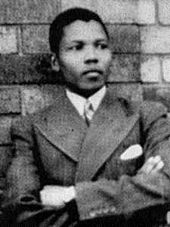
Nelson Mandela circa 1937
Nelson Mandela belongs to a cadet branch of the Thembu dynasty, which reigns in the Transkeian Territories of South Africa's Cape Province. He was born in Mvezo, a small village located in the district of Umtata, the Transkei capital. He has Khoisan ancestry on his mother's side. His patrilineal great-grandfather Ngubengcuka (who died in 1832), ruled as the Inkosi Enkhulu, or king, of the Thembu people. One of the king's sons, named Mandela, became Nelson's grandfather and the source of his surname. However, because he was only the Inkosi's child by a wife of the Ixhiba clan (the so-called "Left-Hand House"), the descendants of his branch of the royal family were not eligible to succeed to the Thembu throne.
Mandela's father, Gadla Henry Mphakanyiswa, served as chief of the town of Mvezo. However, upon alienating the colonial authorities, they deprived Mphakanyiswa of his position, and moved his family to Qunu. Despite this, Mphakanyiswa remained a member of the Inkosi's Privy Council, and served an instrumental role in Jongintaba Dalindyebo's ascension to the Thembu throne. Dalindyebo would later return the favour by informally adopting Mandela upon Mphakanyiswa's death.[ Mandela's father had four wives, with whom he fathered thirteen children (four boys and nine girls). Mandela was born to his third wife ('third' by a complex royal ranking system), Nosekeni Fanny. Fanny was a daughter of Nkedama of the Mpemvu Xhosa clan, the dynastic Right Hand House, in whose umzi or homestead Mandela spent much of his childhood. His given name Rolihlahla means "to pull a branch of a tree", or more colloquially, "troublemaker".
Rolihlahla Mandela became the first member of his family to attend a school, where his teacher Miss Mdingane gave him the English name "Nelson".
When Mandela was nine, his father died of tuberculosis, and the regent, Jongintaba, became his guardian. Mandela attended a Wesleyan mission school located next to the palace of the regent. Following Thembu custom, he was initiated at age sixteen, and attended Clarkebury Boarding Institute. Mandela completed his Junior Certificate in two years, instead of the usual three. Designated to inherit his father's position as a privy councillor, in 1937 Mandela moved to Healdtown, the Wesleyan college in Fort Beaufort which most Thembu royalty attended. At nineteen, he took an interest in boxing and running at the school.
After enrolling, Mandela began to study for a Bachelor of Arts at the Fort Hare University, where he met Oliver Tambo. Tambo and Mandela became lifelong friends and colleagues. Mandela also became close friends with his kinsman, Kaiser ("K.D.") Matanzima who, as royal scion of the Thembu Right Hand House, was in line for the throne of Transkei, a role that would later lead him to embrace Bantustan policies. His support of these policies would place him and Mandela on opposing political sides. At the end of Nelson's first year, he became involved in a Students' Representative Council boycott against university policies, and was told to leave Fort Hare and not return unless he accepted election to the SRC. Later in his life, while in prison, Mandela studied for a Bachelor of Laws from the University of London External Programme.
Shortly after leaving Fort Hare, Jongintaba announced to Mandela and Justice (the regent's son and heir to the throne) that he had arranged marriages for both of them. The young men, displeased by the arrangement, elected to relocate to Johannesburg. Upon his arrival, Mandela initially found employment as a guard at a mine.However, the employer quickly terminated Mandela after learning that he was the Regent's runaway ward. Mandela later started work as an articled clerk at a Johannesburg law firm, Witkin, Sidelsky and Edelman, through connections with his friend and mentor, realtor Walter Sisulu. While working at Witkin, Sidelsky and Edelman, Mandela completed his B.A. degree at the University of South Africa via correspondence, after which he began law studies at the University of Witwatersrand, where he first befriended fellow students and future anti-apartheid political activists Joe Slovo, Harry Schwarz and Ruth First. Slovo would eventually become Mandela's Minister of Housing, while Schwarz would become his Ambassador to Washington. During this time, Mandela lived in Alexandra township, north of Johannesburg.
Political activity
After the 1948 election victory of the Afrikaner-dominated National Party, which supported the apartheid policy of racial segregation, Mandela began actively participating in politics. He led prominently in the ANC's 1952 Defiance Campaign and the 1955 Congress of the People, whose adoption of the Freedom Charter provided the fundamental basis of the anti-apartheid cause. During this time, Mandela and fellow lawyer Oliver Tambo operated the law firm of Mandela and Tambo, providing free or low-cost legal counsel to many blacks who lacked attorney representation.
Mahatma Gandhi influenced Mandela's approach, and subsequently the methods of succeeding generations of South African anti-apartheid activists. (Mandela later took part in the 29–30 January 2007 conference in New Delhi marking the 100th anniversary of Gandhi's introduction of satyagraha (non-violent resistance) in South Africa).
Initially committed to nonviolent resistance, Mandela and 150 others were arrested on 5 December 1956 and charged with treason. The marathon Treason Trial of 1956–1961 followed, with all defendants receiving acquittals. From 1952–1959, a new class of black activists known as the Africanists disrupted ANC activities in the townships, demanding more drastic steps against the National Party regime. The ANC leadership under Albert Luthuli, Oliver Tambo and Walter Sisulu felt not only that the Africanists were moving too fast but also that they challenged their leadership. The ANC leadership consequently bolstered their position through alliances with small White, Coloured, and Indian political parties in an attempt to give the appearance of wider appeal than the Africanists. The Africanists ridiculed the 1955 Freedom Charter Kliptown Conference for the concession of the 100,000-strong ANC to just a single vote in a Congressional alliance. Four secretaries-general of the five participating parties secretly belonged to the reconstituted South African Communist Party (SACP). In 2003 Blade Nzimande, the SACP General Secretary, revealed that Walter Sisulu, the ANC Secretary-General, secretly joined the SACP in 1955which meant all five Secretaries General were SACP and thus explains why Sisulu relegated the ANC from a dominant role to one of five equals.
In 1959, the ANC lost its most militant support when most of the Africanists, with financial support from Ghana and significant political support from the Transvaal-based Basotho, broke away to form the Pan Africanist Congress (PAC) under the direction of Robert Sobukwe and Potlako Leballo.
Anti-apartheid activities
In 1961, Mandela became leader of the ANC's armed wing, Umkhonto we Sizwe (translated Spear of the Nation, and also abbreviated MK), which he co-founded. He coordinated sabotage campaigns against military and government targets, making plans for a possible guerrilla war if the sabotage failed to end apartheid. Mandela also raised funds for MK abroad and arranged for paramilitary training of the group.
Fellow ANC member Wolfie Kadesh explains the bombing campaign led by Mandela: "When we knew that we going to start on 16 December 1961, to blast the symbolic places of apartheid, like pass offices, native magistrates courts, and things like that ... post offices and ... the government offices. But we were to do it in such a way that nobody would be hurt, nobody would get killed." Mandela said of Wolfie: "His knowledge of warfare and his first hand battle experience were extremely helpful to me."
Mandela described the move to armed struggle as a last resort; years of increasing repression and violence from the state convinced him that many years of non-violent protest against apartheid had not and could not achieve any progress.
Later, mostly in the 1980s, MK waged a guerrilla war against the apartheid regime in which many civilians became casualties.[ Mandela later admitted that the ANC, in its struggle against apartheid, also violated human rights, sharply criticising those in his own party who attempted to remove statements supporting this fact from the reports of the Truth and Reconciliation Commission.
Up until July 2008, Mandela and ANC party members were barred from entering the United States — except the United Nations headquarters in Manhattan — without a special waiver from the US Secretary of State, because of their South African apartheid regime era designation as terrorists.
Arrest and Rivonia trial
On 5 August 1962 Mandela was arrested after living on the run for seventeen months, and was imprisoned in the Johannesburg Fort. The arrest was made possible because the U.S. Central Intelligence Agency (CIA) tipped off the security police as to Mandela's whereabouts and disguise. Three days later, the charges of leading workers to strike in 1961 and leaving the country illegally were read to him during a court appearance. On 25 October 1962, Mandela was sentenced to five years in prison. Two years later on 11 June 1964, a verdict had been reached concerning his previous engagement in the African National Congress (ANC).
While Mandela was imprisoned, police arrested prominent ANC leaders on 11 July 1963, at Liliesleaf Farm, Rivonia, north of Johannesburg. Mandela was brought in, and at the Rivonia Trial they were charged by the chief prosecutor Dr. Percy Yutar with the capital crimes of sabotage (which Mandela admitted) and crimes which were equivalent to treason, but easier for the government to prove. The second charge accused the defendants of plotting a foreign invasion of South Africa, which Mandela denied.
In his statement from the dock at the opening of the defence case in the trial on 20 April 1964 at Pretoria Supreme Court, Mandela laid out the reasoning in the ANC's choice to use violence as a tactic. His statement described how the ANC had used peaceful means to resist apartheid for years until the Sharpeville Massacre. That event coupled with the referendum establishing the Republic of South Africa and the declaration of a state of emergency along with the banning of the ANC made it clear to Mandela and his compatriots that their only choice was to resist through acts of sabotage and that doing otherwise would have been tantamount to unconditional surrender. Mandela went on to explain how they developed the Manifesto of Umkhonto we Sizwe on 16 December 1961 intent on exposing the failure of the National Party's policies after the economy would be threatened by foreigners' unwillingness to risk investing in the country. He closed his statement with these words: "During my lifetime I have dedicated myself to the struggle of the African people. I have fought against white domination, and I have fought against black domination. I have cherished the ideal of a democratic and free society in which all persons live together in harmony and with equal opportunities. It is an ideal which I hope to live for and to achieve. But if needs be, it is an ideal for which I am prepared to die."
Bram Fischer, Vernon Berrange, Harry Schwarz, Joel Joffe, Arthur Chaskalson and George Bizos were part of the defence team that represented the accused. Harold Hanson was brought in at the end of the case to plead mitigation. All except Rusty Bernstein were found guilty, but they escaped the gallows and were sentenced to life imprisonment on 12 June 1964. Charges included involvement in planning armed action, in particular four charges of sabotage, which Mandela admitted to, and a conspiracy to help other countries invade South Africa, which Mandela denied.
Imprisonment

Robben Island prison yard

Nelson Mandela's prison cell on Robben Island
Nelson Mandela was imprisoned on Robben Island where he remained for the next eighteen of his twenty-seven years in prison. While in jail, his reputation grew and he became widely known as the most significant black leader in South Africa. On the island, he and others performed hard labour in a lime quarry. Prison conditions were very basic. Prisoners were segregated by race, with black prisoners receiving the fewest rations. Political prisoners were kept separate from ordinary criminals and received fewer privileges. Mandela describes how, as a D-group prisoner (the lowest classification) he was allowed one visitor and one letter every six months.Letters, when they came, were often delayed for long periods and made unreadable by the prison censors.
Whilst in prison Mandela undertook study with the University of London by correspondence through its External Programme and received the degree of Bachelor of Laws. He was subsequently nominated for the position of Chancellor of the University of London in the 1981 election, but lost to Princess Anne.
In his 1981 memoir Inside BOSS secret agent Gordon Winter describes his involvement in a plot to rescue Mandela from prison in 1969: this plot was infiltrated by Winter on behalf of South African intelligence, who wanted Mandela to escape so they could shoot him during recapture. The plot was foiled by British Intelligence.
In March 1982 Mandela was transferred from Robben Island to Pollsmoor Prison, along with other senior ANC leaders Walter Sisulu, Andrew Mlangeni, Ahmed Kathrada and Raymond Mhlaba. It was speculated that this was to remove the influence of these senior leaders on the new generation of young black activists imprisoned on Robben Island, the so-called "Mandela University". However, National Party minister Kobie Coetsee says that the move was to enable discreet contact between them and the South African government.
In February 1985 President P.W. Botha offered Mandela his freedom on condition that he 'unconditionally rejected violence as a political weapon'.Coetsee and other ministers had advised Botha against this, saying that Mandela would never commit his organisation to giving up the armed struggle in exchange for personal freedom.Mandela indeed spurned the offer, releasing a statement via his daughter Zindzi saying "What freedom am I being offered while the organisation of the people remains banned? Only free men can negotiate. A prisoner cannot enter into contracts."
The first meeting between Mandela and the National Party government came in November 1985 when Kobie Coetsee met Mandela in Volks Hospital in Cape Town where Mandela was recovering from prostate surgery. Over the next four years, a series of tentative meetings took place, laying the groundwork for further contact and future negotiations, but little real progress was made.
In 1988 Mandela was moved to Victor Verster Prison and would remain there until his release. Various restrictions were lifted and people such as Harry Schwarz were able to visit him. Schwarz, a friend of Mandela, had known him since university when they were in the same law class. He was also a defence barrister at the Rivonia Trial and would become Mandela's ambassador to Washington during his presidency.
Throughout Mandela's imprisonment, local and international pressure mounted on the South African government to release him, under the resounding slogan Free Nelson Mandela![] In 1989, South Africa reached a crossroads when Botha suffered a stroke and was replaced as president by Frederik Willem de Klerk. De Klerk announced Mandela's release in February 1990.
Mandela was visited several times by delegates of the International Committee of the Red Cross, while at Robben Island and later at Pollsmoor prison. Mandela had this to say about the visits: "to me personally, and those who shared the experience of being political prisoners, the Red Cross was a beacon of humanity within the dark inhumane world of political imprisonment."
Release

Mandela with Cuban leader Fidel Castro on July 27, 1991, in Matanzas, Cuba. Their combined anti-apartheid speeches from the event were published as the book How Far We Slaves Have Come!
On 2 February 1990, State President F.W. de Klerk reversed the ban on the ANC and other anti-apartheid organisations, and announced that Mandela would shortly be released from prison. Mandela was released from Victor Verster Prison in Paarl on 11 February 1990. The event was broadcast live all over the world.
On the day of his release, Mandela made a speech to the nation. He declared his commitment to peace and reconciliation with the country's white minority, but made it clear that the ANC's armed struggle was not yet over when he said "our resort to the armed struggle in 1960 with the formation of the military wing of the ANC (Umkhonto we Sizwe) was a purely defensive action against the violence of apartheid. The factors which necessitated the armed struggle still exist today. We have no option but to continue. We express the hope that a climate conducive to a negotiated settlement would be created soon, so that there may no longer be the need for the armed struggle."
He also said his main focus was to bring peace to the black majority and give them the right to vote in both national and local elections.
Negotiations
Main article: Negotiations to end apartheid in South Africa
Following his release from prison, Mandela returned to the leadership of the ANC and, between 1990 and 1994, led the party in the multi-party negotiations that led to the country's first multi-racial elections.
In 1991, the ANC held its first national conference in South Africa after its unbanning, electing Mandela as President of the organisation. His old friend and colleague Oliver Tambo, who had led the organisation in exile during Mandela's imprisonment, became National Chairperson.
Mandela's leadership through the negotiations, as well as his relationship with President F.W. de Klerk, was recognised when they were jointly awarded the Nobel Peace Prize in 1993. However, the relationship was sometimes strained, particularly so in a sharp exchange in 1991 when he furiously referred to De Klerk as the head of "an illegitimate, discredited, minority regime". The talks broke down following the Boipatong massacre in June 1992 when Mandela took the ANC out of the negotiations, accusing De Klerk's government of complicity in the killings. However, talks resumed following the Bisho massacre in September 1992, when the spectre of violent confrontation made it clear that negotiations were the only way forward.
Mandela meeting with US President Bill Clinton in 1993
Following the assassination of ANC leader Chris Hani in April 1993, there were renewed fears that the country would erupt in violence.[74] Mandela addressed the nation appealing for calm, in a speech regarded as 'presidential' even though he was not yet president of the country at that time. Mandela said "tonight I am reaching out to every single South African, black and white, from the very depths of my being. A white man, full of prejudice and hate, came to our country and committed a deed so foul that our whole nation now teeters on the brink of disaster. A white woman, of Afrikaner origin, risked her life so that we may know, and bring to justice, this assassin. The cold-blooded murder of Chris Hani has sent shock waves throughout the country and the world. ...Now is the time for all South Africans to stand together against those who, from any quarter, wish to destroy what Chris Hani gave his life for – the freedom of all of us". While some riots did follow the assassination, the negotiators were galvanised into action, and soon agreed that democratic elections should take place on 27 April 1994, just over a year after Hani's assassination.
Presidency of South Africa
South Africa's first multi-racial elections in which full enfranchisement was granted were held on 27 April 1994. The ANC won 62% of the votes in the election, and Mandela, as leader of the ANC, was inaugurated on 10 May 1994 as the country's first black President, with the National Party's de Klerk as his first deputy and Thabo Mbeki as the second in the Government of National Unity.[ As President from May 1994 until June 1999, Mandela presided over the transition from minority rule and apartheid, winning international respect for his advocacy of national and international reconciliation. Mandela encouraged black South Africans to get behind the previously hated Springboks (the South African national rugby team) as South Africa hosted the 1995 Rugby World Cup. (This is the theme of the 2009 film Invictus.) After the Springboks won an epic final over New Zealand, Mandela presented the trophy to captain Francois Pienaar, an Afrikaner, wearing a Springbok shirt with Pienaar's own number 6 on the back. This was widely seen as a major step in the reconciliation of white and black South Africans.
After assuming the presidency, one of Mandela's trademarks was his use of Batik shirts, known as "Madiba shirts", even on formal occasions. In South Africa's first post-apartheid military operation, Mandela ordered troops into Lesotho in September 1998 to protect the government of Prime Minister Pakalitha Mosisili. This came after a disputed election prompted fierce opposition threatening the unstable government.Commentators and critics including AIDS activists such as Edwin Cameron have criticised Mandela for his government's ineffectiveness in stemming the AIDS crisis. After his retirement, Mandela admitted that he may have failed his country by not paying more attention to the HIV/AIDS epidemic. Mandela has since spoken out on several occasions against the AIDS epidemic.
Lockerbie trial
President Mandela took a particular interest in helping to resolve the long-running dispute between Gaddafi's Libya, on the one hand, and the United States and Britain on the other, over bringing to trial the two Libyans who were indicted in November 1991 and accused of sabotaging Pan Am Flight 103, which crashed at the Scottish town of Lockerbie on 21 December 1988, with the loss of 270 lives. As early as 1992, Mandela informally approached President George H.W. Bush with a proposal to have the two indicted Libyans tried in a third country. Bush reacted favourably to the proposal, as did President François Mitterrand of France and King Juan Carlos I of Spain. In November 1994 – six months after his election as president – Mandela formally proposed that South Africa should be the venue for the Pan Am Flight 103 bombing trial.
However, British Prime Minister John Major flatly rejected the idea saying the British government did not have confidence in foreign courts.[ A further three years elapsed until Mandela's offer was repeated to Major's successor, Tony Blair, when the president visited London in July 1997. Later the same year, at the 1997 Commonwealth Heads of Government Meeting (CHOGM) at Edinburgh in October 1997, Mandela warned:
"No one nation should be complainant, prosecutor and judge."
A compromise solution was then agreed for a trial to be held at Camp Zeist in the Netherlands, governed by Scots law, and President Mandela began negotiations with Colonel Gaddafi for the handover of the two accused (Megrahi and Fhimah) in April 1999. At the end of their nine-month trial, the verdict was announced on 31 January 2001. Fhimah was found not guilty, but Megrahi was convicted and sentenced to 27 years in a Scottish jail. Megrahi's initial appeal was turned down in March 2002, and former president Mandela went to visit him in Barlinnie prison on 10 June 2002.
'Megrahi is all alone', Mandela told a packed press conference in the prison's visitors room. 'He has nobody he can talk to. It is psychological persecution that a man must stay for the length of his long sentence all alone. It would be fair if he were transferred to a Muslim country — and there are Muslim countries which are trusted by the West. It will make it easier for his family to visit him if he is in a place like the kingdom of Morocco, Tunisia or Egypt.'
Megrahi was subsequently moved to Greenock jail and out of solitary confinement. In August 2009 Megrahi, suffering from cancer and expected to have only 3 months left to live, was released on compassionate grounds and allowed to return to Libya. The Nelson Mandela Foundation expressed its support for the decision to release Megrahi in a letter sent to the Scottish Government on behalf of Mandela.
Marriage and family
Mandela has been married three times, has fathered six children, has twenty grandchildren, and a growing number of great-grandchildren. He is grandfather to Chief Mandla Mandela.
First marriage
Mandela's first marriage was to Evelyn Ntoko Mase who, like Mandela, was also from what later became the Transkei area of South Africa, although they actually met in Johannesburg. The couple broke up in 1957 after 13 years, divorcing under the multiple strains of his constant absences, devotion to revolutionary agitation, and the fact she was a Jehovah's Witness, a religion which requires political neutrality. Evelyn Mase died in 2004. The couple had two sons, Madiba Thembekile (Thembi) (1946–1969) and Makgatho Mandela (1950–2005), and two daughters, both named Makaziwe Mandela (known as Maki; born 1947 and 1953). Their first daughter died aged nine months, and they named their second daughter in her honour. All their children were educated at the United World College of Waterford Kamhlaba. Thembi was killed in a car crash in 1969 at the age of twenty-five, while Mandela was imprisoned on Robben Island, and Mandela was not allowed to attend the funeral. Makgatho died of AIDS in 2005, aged 54.
Second marriage
Mandela's second wife, Winnie Madikizela-Mandela, also came from the Transkei area, although they, too, met in Johannesburg, where she was the city's first black social worker. They had two daughters, Zenani (Zeni), born 4 February 1958, and Zindziswa (Zindzi) Mandela-Hlongwane, born 1960. Zindzi was only 18 months old when her father was sent to Robben island. Later, Winnie would be deeply torn by family discord which mirrored the country's political strife; while her husband was serving a life sentence on the Robben Island prison, her father became the agriculture minister in the Transkei. The marriage ended in separation (April 1992) and divorce (March 1996), fuelled by political estrangement.
Mandela still languished in prison when his daughter Zenani was married to Prince Thumbumuzi Dlamini in 1973, elder brother of King Mswati III of Swaziland.Although she had vivid memories of her father, from the age of four up until sixteen, South African authorities did not permit her to visit him. The Dlamini couple live and run a business in Boston. One of their sons, Prince Cedza Dlamini (born 1976), educated in the United States, has followed in his grandfather's footsteps as an international advocate for human rights and humanitarian aid.
Zindzi Mandela-Hlongwane made history worldwide when she read out Mandela's speech refusing his conditional pardon in 1985. She is a businesswoman in South Africa with three children, the eldest of whom is a son, Zondwa Gadaffi Mandela.
Third marriage
Mandela was remarried, on his 80th birthday in 1998, to Graça Machel née Simbine, widow of Samora Machel, the former Mozambican president and ANC ally who was killed in an air crash 12 years earlier. The wedding followed months of international negotiations to set the unprecedented bride-price to be remitted to Machel's clan. Said negotiations were conducted on Mandela's behalf by his traditional sovereign, King Buyelekhaya Zwelibanzi Dalindyebo. The paramount chief's grandfather was the regent Jongintaba Dalindyebo, who had arranged a marriage for Mandela, which he eluded by fleeing to Johannesburg in 1940.
Mandela still maintains a home at Qunu in the realm of his royal nephew (second cousin thrice-removed in Western reckoning), whose university expenses he defrayed and whose privy councillor he remains.
Retirement
Mandela became the oldest elected President of South Africa when he took office at the age of 75 in 1994. He decided not to stand for a second term and retired in 1999, to be succeeded by Thabo Mbeki.
After his retirement as President, Mandela went on to become an advocate for a variety of social and human rights organisations. He has expressed his support for the international Make Poverty History movement of which the ONE Campaign is a part. The Nelson Mandela Invitational charity golf tournament, hosted by Gary Player, has raised over twenty million rand for children's charities since its inception in 2000. This annual special event has become South Africa's most successful charitable sports gathering and benefits both the Nelson Mandela Children's Fund and Gary Player Foundation equally for various children's causes around the world.
Mandela is a vocal supporter of SOS Children's Villages, the world's largest organisation dedicated to raising orphaned and abandoned children. Mandela appeared in a televised advertisement for the 2006 Winter Olympics, and was quoted for the International Olympic Committee's Celebrate Humanity campaign:
For seventeen days, they are roommates. For seventeen days, they are soulmates. And for twenty-two seconds, they are competitors. Seventeen days as equals. Twenty-two seconds as adversaries. What a wonderful world that would be. That's the hope I see in the Olympic Games.
Health
In July 2001 Mandela was diagnosed and treated for prostate cancer. He was treated with a seven-week course of radiation. In 2003 Mandela's death was incorrectly announced by CNN when his pre-written obituary (along with those of several other famous figures) was inadvertently published on CNN's web site due to a fault in password protection. In 2007 a fringe right-wing group distributed hoax email and SMS messages claiming that the authorities had covered up Mandela's death and that white South Africans would be massacred after his funeral. Mandela was on holiday in Mozambique at the time.
In June 2004, at age 85, Mandela announced that he would be retiring from public life. His health had been declining, and he wanted to enjoy more time with his family. Mandela said that he did not intend to hide away totally from the public, but wanted to be in a position "of calling you to ask whether I would be welcome, rather than being called upon to do things and participate in events. My appeal therefore is: Don't call me, I will call you." Since 2003, he has appeared in public less often and has been less vocal on topical issues. He is white-haired and walks slowly with the support of a stick. There are reports that he may be suffering from age-related dementia.
Mandela's 90th birthday was marked across the country on 18 July 2008, with the main celebrations held at his home town of Qunu. A concert in his honour was also held in Hyde Park, London. In a speech to mark his birthday, Mandela called for the rich people to help poor people across the world.] Despite maintaining a low-profile during the 2010 FIFA World Cup in South Africa, Mandela made a rare public appearance during the closing ceremony, where he received a "rapturous reception."
Elders
On 18 July 2007, Nelson Mandela, Graça Machel, and Desmond Tutu convened a group of world leaders in Johannesburg to contribute their wisdom and independent leadership to address the world's toughest problems. Nelson Mandela announced the formation of this new group, The Elders, in a speech he delivered on the occasion of his 89th birthday.
Archbishop Tutu serves as the chair of The Elders. The founding members of this group also include Graça Machel, Kofi Annan, Ela Bhatt, Gro Harlem Brundtland, Jimmy Carter, Li Zhaoxing, Mary Robinson and Muhammad Yunus.
"This group can speak freely and boldly, working both publicly and behind the scenes on whatever actions need to be taken", Mandela commented. "Together we will work to support courage where there is fear, foster agreement where there is conflict, and inspire hope where there is despair."
AIDS engagement
Since his retirement, one of Mandela's primary commitments has been to the fight against AIDS. He gave the closing address at the XIII International AIDS Conference in 2000, in Durban, South Africa. In 2003, he had already lent his support to the 46664 AIDS fundraising campaign, named after his prison number. In July 2004, he flew to Bangkok to speak at the XV International AIDS Conference. His son, Makgatho Mandela, died of AIDS on 6 January 2005. Mandela's AIDS activism is chronicled in Stephanie Nolen's book, 28: Stories of AIDS in Africa.
Criticism of U.S. and U.K. foreign policy
Nelson Mandela had strongly opposed the 1999 NATO intervention in Kosovo and called it an attempt by the world's powerful nations to police the entire world. In 2002 and 2003, Mandela criticised the foreign policy of the administration of U.S. president George W. Bush in a number of speeches. Criticising the lack of UN involvement in the decision to begin the War in Iraq, he said, "It is a tragedy, what is happening, what Bush is doing. But Bush is now undermining the United Nations." Mandela stated he would support action against Iraq only if it is ordered by the UN. Mandela also insinuated that the United States may have been motivated by racism in not following the UN and its secretary-general Kofi Annan on the issue of the war. "Is it because the secretary-general of the United Nations is now a black man? They never did that when secretary-generals were white".
He urged the people of the U.S. to join massive protests against Bush and called on world leaders, especially those with vetoes in the UN Security Council, to oppose him. "What I am condemning is that one power, with a president who has no foresight, who cannot think properly, is now wanting to plunge the world into a holocaust." He attacked the United States for its record on human rights and for dropping atomic bombs on Japan during World War II. "If there is a country that has committed unspeakable atrocities in the world, it is the United States of America. They don't care." Nelson Mandela also harshly condemned British Prime Minister Tony Blair and referred to him as the "foreign minister of the United States".
Ismail Ayob controversy
Further information: Ismail Ayob
Ismail Ayob was a trusted friend and personal attorney of Mandela for over 30 years. In May 2005, Ayob was asked by Mandela to stop selling prints signed by Mandela and to account for the proceeds of their sale. This bitter dispute led to an extensive application to the High Court of South Africa by Mandela that year. Ayob denied any wrongdoing,] and claimed that he was the victim of a smear campaign orchestrated by Mandela's advisors, in particular, lawyer George Bizos.
In 2005, and 2006 Ayob, his wife, and son were subjected to a verbal attack by Mandela's advisors. The dispute was widely reported in the media, with Ayob being portrayed in a negative light, culminating in the action by Mandela to the High Court. There were public meetings at which Mandela associates attacked Ayob and there were calls for Ayob and his family to be ostracised by society. The defence of Ismail and Zamila Ayob (his wife, and a fellow respondent) included documents signed by Mandela and witnessed by his secretaries, that, they claimed, refuted many of the allegations made by Nelson Mandela and his advisors.
The dispute again made headlines in February 2007 when, during a hearing in the Johannesburg High Court, Ayob promised to pay R700 000 to Mandela, which Ayob had transferred into trusts for Mandela's children, and apologised, although he later claimed that he was the victim of a "vendetta", by Mandela. Some media commentators expressed sympathy for Ayob's position, pointing out that Mandela's iconic status would make it difficult for Ayob to be treated fairly.
Allegations
Ayob, George Bizos and Wim Trengove were trustees of the Nelson Mandela Trust, which was set up to hold millions of rands donated to Nelson Mandela by prominent business figures, including the Oppenheimer family, for the benefit of his children and grandchildren. Ayob later resigned from the Trust. In 2006, the two remaining trustees of the Nelson Mandela Trust launched an application against Ayob for disbursing money from the trust without their consent. Ayob claimed that this money was paid to the South African Revenue Service, to Mandela's children and grandchildren, to Mandela himself, and to an accounting company for four years of accounting work.[
Bizos and Trengrove refused to ratify the payments to the children and grandchildren of Nelson Mandela and the payments to the accounting firm. A court settlement was reached in which this money, totalling over R700,000 was paid by Ismail Ayob to the trust on the grounds that Ayob had not sought the express consent of the other two trustees before disbursing the money. It was alleged that Ayob made defamatory remarks about Mandela in his affidavit, for which the court order stated that Ayob should apologise.[ It was pointed out that these remarks, which centred on Nelson Mandela holding foreign bank accounts and not paying tax on these, had not originated from Ayob's affidavit but from Nelson Mandela's and George Bizos's own affidavits.
Blood Diamond controversy
In a The New Republic article in December 2006, Nelson Mandela was criticised for a number of positive comments he had made about the diamond industry. There were concerns that this would benefit suppliers of blood diamonds. In a letter to Edward Zwick, the director of the motion picture Blood Diamond, Mandela had noted that:
...it would be deeply regrettable if the making of the film inadvertently obscured the truth, and, as a result, led the world to believe that an appropriate response might be to cease buying mined diamonds from Africa. ... We hope that the desire to tell a gripping and important real life historical story will not result in the destabilisation of African diamond producing countries, and ultimately their peoples.
The New Republic article claims that this comment, as well as various pro-diamond-industry initiatives and statements during his life and during his time as a president of South Africa, were influenced by both his friendship with Harry Oppenheimer, former chairman of De Beers, as well as an outlook for 'narrow national interests' of South Africa (which is a major diamond producer).
Zimbabwe and Robert Mugabe
Robert Mugabe, the president of Zimbabwe who has led the country since independence in 1980, has been widely criticised internationally for the 1980s fighting which killed about 3000 people as well as corruption, incompetent administration, political oppression and cronyism that has ultimately led to the economic collapse of the country.
Despite their common background as national liberators, Mandela and Mugabe were seldom seen as close. Mandela criticised Mugabe in 2000, referring to African leaders who had liberated their countries but had then overstayed their welcome. In his retirement, Mandela spoke out less often on Zimbabwe and other international and domestic issues, sometimes leading to criticism for not using his influence to greater effect to persuade Mugabe to moderate his policies. His lawyer George Bizos revealed that Mandela has been advised on medical grounds to avoid engaging in stressful activity such as political controversy. Nonetheless, in 2007, Mandela attempted to persuade Mugabe to leave office "sooner than later", with "a modicum of dignity", before he was hounded out like Augusto Pinochet. Mugabe did not respond to this approach. In June 2008, at the height of the crisis over the Zimbabwean presidential election, Mandela condemned the "tragic failure of leadership" in Zimbabwe.
Acclaim
Fighter for liberation of South Africa Nelson Mandela on a 1988 USSR commemorative stamp
According to an article in Newsweek magazine, "Mandela rightly occupies an untouched place in the South African imagination. He's the national liberator, the saviour, its Washington and Lincoln rolled into one".
In November 2009, the United Nations General Assembly announced that Mandela's birthday, 18 July, is to be known as "Mandela Day" to mark his contribution to world freedom.
Orders and decorations
Main article: List of Nelson Mandela awards and honours
Mandela has received many South African, foreign and international honours, including the Nobel Peace Prize in 1993 (which was shared with Frederik Willem de Klerk), the Order of Merit from, and creation as a Baliff Grand Cross of the Order of St. John by, Queen Elizabeth II and the Presidential Medal of Freedom from George W. Bush. In July 2004, the city of Johannesburg bestowed its highest honour on Mandela by granting him the freedom of the city at a ceremony in Orlando, Soweto.
As an example of his popular foreign acclaim, during his tour of Canada in 1998, 45,000 school children greeted him with adulation at a speaking engagement in the SkyDome in the city of Toronto. In 2001, he was the first living person to be made an honorary Canadian citizen (the only previous recipient, Raoul Wallenberg, was awarded honorary citizenship posthumously). While in Canada, he was also made an honorary Companion of the Order of Canada, one of the few foreigners to receive the honour.
In 1990 he received the Bharat Ratna Award from the government of India and also received the last ever Lenin Peace Prize from the Soviet Union. In 1992 he was awarded the Atatürk Peace Award by Turkey. He refused the award citing human rights violations committed by Turkey at the time, but later accepted the award in 1999. In 1992 he received of Nishan-e-Pakistan, the highest civil service award of Pakistan.
Musical tributes
Many artists have dedicated songs to Mandela. One of the most popular was from The Specials who recorded the song "Free Nelson Mandela" in 1983. Stevie Wonder dedicated his 1985 Oscar for the song "I Just Called to Say I Love You" to Mandela, resulting in his music being banned by the South African Broadcasting Corporation. In 1985, Youssou N'Dour's album Nelson Mandela was the Senegalese artist's first United States release.
In 1988, the Nelson Mandela 70th Birthday Tribute concert at London's Wembley Stadium was a focal point of the anti-apartheid movement, with many musicians voicing their support for Mandela. Jerry Dammers, the author of Nelson Mandela, was one of the organisers. Simple Minds recorded the song "Mandela Day" for the concert, Santana recorded the instrumental "Mandela", Tracy Chapman performed "Freedom Now", dedicated to Mandela and released on her album Crossroads, Salif Keita from Mali, who played at the concert, later visited South Africa and in 1995 recorded the song "Mandela" on his album Folon. and Whitney Houston performed and dedicated the gospel song "He I Believe".
In South Africa, "Asimbonanga (Mandela)" ("We Have Not Seen Him") became one of Johnny Clegg's most famous songs, appearing on his Third World Child album in 1987. Hugh Masekela, in exile in the UK, sang "Bring Him Back Home (Nelson Mandela)" in 1987.Brenda Fassie's 1989 song "Black President", a tribute to Mandela, was hugely popular even though it was banned in South Africa. Nigerian reggae musician Majek Fashek released the single, "Free Mandela", in 1992, making him one of many Nigerian recording artists who had released songs related to the anti-apartheid movement and to Mandela himself.
In 1990, Hong Kong rock band Beyond released a popular Cantonese song, "Days of Glory". The anti-apartheid song featured lyrics referring to Mandela's heroic struggle for racial equality. The group Ladysmith Black Mambazo accompanied Mandela to the Nobel Peace Prize ceremony in Oslo, Norway in 1993, and performed for his inaugaration in 1994. In 2003, Mandela lent his weight to the 46664 campaign against AIDS, named after his prison number. Many prominent musicians performed in concerts as part of this campaign.
A summary of Mandela's life story is featured in the 2006 music video "If Everyone Cared" by Nickelback. Raffi's song "Turn This World Around" is based on a speech given by Mandela where he explained the world needs to be "turned around, for the children". A tribute concert for Mandela's 90th birthday took place in Hyde Park, London on 27 June 2008.
Musician Ampie du Preez and cricketer AB de Villiers wrote a song called "Madibaland" in honor of Mandela. It is featured as the 4th and 14th tracks on their album, "Maak Jou Drome Waar".
Published biographies
Mandela's autobiography, Long Walk to Freedom, was published in 1994, an extended version of No Easy Walk to Freedom, published by Heinemann in 1965. Mandela had begun work on it secretly while in prison. In that book Mandela did not reveal anything about the alleged complicity of F. W. de Klerk in the violence of the eighties and nineties, or the role of his ex-wife Winnie Mandela in that bloodshed. However, he later co-operated with his friend, journalist Anthony Sampson who discussed those issues in Mandela: The Authorised Biography. Another detail that Mandela omitted was the allegedly fraudulent book, Goodbye Bafana. Its author, Robben Island warder James Gregory, claimed to have been Mandela's confidant in prison and published details of the prisoner's family affairs. Sampson maintained that Mandela had not known Gregory well, but that Gregory censored the letters sent to the future president and thus discovered the details of Mandela's personal life. Sampson also averred that other warders suspected Gregory of spying for the government and that Mandela considered suing Gregory.
Cinema and television
The film Mandela and De Klerk told the story of Mandela's release from prison. Mandela was played by Sidney Poitier. Goodbye Bafana, a feature film that focuses on Mandela's life, had its world premiere at the Berlin film festival on 11 February 2007. The film starred Dennis Haysbert as Mandela and chronicled Mandela's relationship with prison guard James Gregory.
On the American television series The Cosby Show Cliff and Claire Huxtable's grandchildren were named Nelson and Winnie in honour of Mandela and his then wife Winnie.
In the final scene of the 1992 movie Malcolm X, Mandela – recently released after 27 years of political imprisonment – appears as a schoolteacher in a Soweto classroom. He recites a portion of one of Malcolm X's most famous speeches, including the following sentence: "We declare our right on this earth to be a human being, to be respected as a human being, to be given the rights of a human being in this society, on this earth, in this day, which we intend to bring into existence..." The famous final phrase of that sentence is "by any means necessary." Mandela informed director Spike Lee that he could not utter the phrase on camera fearing that the apartheid government would use it against him if he did. Lee obliged, and the final seconds of the film feature black-and-white footage of Malcolm X himself delivering the phrase.
Mandela and Springboks captain, François Pienaar, are the focus of a 2008 book by John Carlin, Playing the Enemy: Nelson Mandela and the Game that Made a Nation, that spotlights the role of the 1995 Rugby World Cup win in post-apartheid South Africa. Carlin sold the film rights to Morgan Freeman. The film, entitled Invictus,was directed by Clint Eastwood, and featured Freeman as Nelson Mandela and Matt Damon as Pienaar.
In the BBC television one-off drama Mrs Mandela, Nelson Mandela was portrayed by David Harewood and Sophie Okonedo played his former wife Winnie Mandela.
Statues and civic tributes
Tributes to Nelson Mandela
The statue of Mandela in Parliament Square, London.
6 meter statue at Nelson Mandela Square, Sandton, Johannesburg
Nelson Mandela Gardens in Leeds
Nelson Mandela Bridge in Johannesburg
On 30 April 2001, Nelson Mandela Gardens in Millenium Square, Leeds was officially opened and Nelson Mandela was awarded the freedom of the city and awarded a commemorative 'golden owl' (the heraldric symbol of Leeds). In a speech outside Leeds Civic Hall in front of 5000 people, mistakenly Mandela famously thanked 'the people of Liverpool for their generosity'.
On 31 March 2004, Sandton Square in Johannesburg was renamed Nelson Mandela Square, after a 6-metre statue of Nelson Mandela was installed on the square to honour the famous South African statesman.
On 29 August 2007, a statue of Nelson Mandela was unveiled at Parliament Square in London by Richard Attenborough, Ken Livingstone, Wendy Woods (widow of Donald Woods), and Gordon Brown. The campaign to erect the statue was started in 2000 by the late Donald Woods, a South African journalist driven into exile because of his anti-apartheid activities. Mandela stated that it represented not just him, but all those who have resisted oppression, especially those in South Africa. He added: "The history of the struggle in South Africa is rich with the stories of heroes and heroines, some of them leaders, some of them followers. All of them deserve to be remembered." An earlier London statue resides on the South Bank of The Thames, dating from 1985.
On 27 August 2008, a statue of Nelson Mandela was unveiled at Groot Drakenstein Correctional Centre between Paarl and Franshhoek on the R301 road, near Cape Town. Formerly known as Victor Verster, this was where Mandela spent the last few years of his 27 years in jail in relative comfort, as he and other ANC stalwarts negotiated with the apartheid government on the terms of his release and the nature of the new South Africa. It stands on the very spot where Mandela took his first steps as a free man. Just outside the prison gates – the culmination of the Long Walk to Freedom – the title of Mandela's autobiography.
After 1989's Loma Prieta Earthquake demolished the Cypress Street Viaduct portion of the Nimitz Freeway in Oakland, California, the city renamed the street-level boulevard that replaced it Mandela Parkway in his honour.
In Leicester, England there is a Nelson Mandela Park with the slogan "South Africa belongs to all those who live there, Black and White". It is opposite Leicester Tigers ground Welford Road.
Nelson Mandela Day
Mandela Day on 18 July is an annual international day adopted by the United Nations. Individuals, communities and organisations are asked to donate 67 minutes to doing something for others, commemorating the 67 years that Nelson Mandela gave to the struggle for social justice.
Other
In 2004, zoologists Brent E. Hendrixson and Jason E. Bond named a South African species of trapdoor spider in the family Ctenizidae as Stasimopus mandelai, "honouring Nelson Mandela, the former president of South Africa and one of the great moral leaders of our time."
See also
(source:wikipedia)


