Showing posts with label Official Short Movie of Kanye. Show all posts

Friday, November 26

Pen

A pen (Latin pinna, feather) is a long, thin, rounded device used to apply ink to a surface for the purpose of writing or drawing, usually on paper. There are several different types, including ballpoint, rollerball, fountain, and felt-tip. Historically, reed pens, quill pens, and dip pens were used. Modern-day pens come in a variety of colors, shapes and assortments. The most common contain black or blue ink.

Modern pens

The main modern types of pens can be categorized by the kind of writing tip or point:


A letter written on paper with a rollerball pen, and the tip of that pen
A ballpoint pen dispenses viscous oil-based ink by rolling a small hard sphere, usually 0.7–1.2 mm and made of brass, steel or tungsten carbide.The ink dries almost immediately on contact with paper. This type of pen is generally inexpensive and reliable. It has replaced the fountain pen as the most popular tool for everyday writing.
A crowquill pen is a favorite instrument of artists, such as David Stone Martin and Jay Lynch, because its flexible metal point can create a variety of delicate lines, textures and tones with slight pressures while drawing.
A fountain pen uses water-based liquid ink delivered through a nib. The ink flows from a reservoir through a "feed" to the nib, then through the nib, due to capillary action and gravity. The nib has no moving parts and delivers ink through a thin slit to the writing surface. A fountain pen reservoir can be refillable or disposable, this disposable type being an ink cartridge. A pen with a refillable reservoir may have a mechanism, such as a piston, to draw ink from a bottle through the nib, or it may require refilling with an eyedropper. Refillable reservoirs are available for some pens designed to use disposable cartridges.


A fountain pen
A marker, or felt-tip pen, has a porous tip of fibrous material. The smallest, finest-tipped markers are used for writing on paper. Medium-tip markers are often used by children for coloring. Larger markers are used for writing on other surfaces such as corrugated boxes, whiteboards and for chalkboards, often called "liquid chalk" or "chalkboard markers." Markers with wide tips and bright but transparent ink, called highlighters, are used to mark existing text. Markers designed for children or for temporary writing (as with a whiteboard or overhead projector) typically use non-permanent inks. Large markers used to label shipping cases or other packages are usually permanent markers.
A rollerball pen dispenses a water-based liquid or gel ink through a ball tip similar to that of a ballpoint pen. The less-viscous ink is more easily absorbed by paper than oil-based ink, and the pen moves more easily across a writing surface. The rollerball pen was initially designed to combine the convenience of a ballpoint pen with the smooth "wet ink" effect of a fountain pen. Gel inks are available in a range of colors, including metallic paint colors and glitter effects.


Historic types
These historic types of pens are no longer in common use:
A dip pen (or nib pen) consists of a metal nib with capillary channels, like that of a fountain pen, mounted on a handle or holder, often made of wood. A dip pen usually has no ink reservoir and must be repeatedly recharged with ink while drawing or writing. The dip pen has certain advantages over a fountain pen. It can use waterproof pigmented (particle-and-binder-based) inks, such as so-called India ink, drawing ink, or acrylic inks, which would destroy a fountain pen by clogging, as well as the traditional iron gall ink, which can cause corrosion in a fountain pen. Dip pens are now mainly used in illustration, calligraphy, and comics (notably manga).
The ink brush is the traditional writing implement in East Asian calligraphy. The body of the brush can be made from either bamboo, or rarer materials such as red sandalwood, glass, ivory, silver, and gold. The head of the brush can be made from the hair (or feathers) of a wide variety of animals, including the weasel, rabbit, deer, chicken, duck, goat, pig, tiger, etc. There is also a tradition in both China and Japan of making a brush using the hair of a newborn, as a once-in-a-lifetime souvenir for the child. This practice is associated with the legend of an ancient Chinese scholar who scored first in the Imperial examinations by using such a personalized brush. Calligraphy brushes are widely considered an extension of the calligrapher's arm. Today, calligraphy may also be done using a pen, but pen calligraphy does not enjoy the same prestige as traditional brush calligraphy.
A quill is a pen made from a flight feather of a large bird, most often a goose. Quills were used as instruments for writing with ink before the metal dip pen, the fountain pen, and eventually the ballpoint pen came into use. The shaft of the feather acts as an ink reservoir, and ink flows to the tip by capillary action. Quill pens were used in medieval times to write on parchment or paper. The quill eventually replaced the reed pen.
A reed pen is cut from a reed or bamboo, with a slit in a narrow tip. Its mechanism is essentially similar to that of a quill. The reed pen has almost disappeared but it is still used by young school going students in some parts of Pakistan, who learn to write with them on small timber boards known as "Takhti". Popular belief has it that writing with a reed pen improves handwriting.

History

Ancient Indians were the first to use the pen. According to ancient text the earliest of pens made in India used bird feathers, bamboo sticks etc. The old literature of Puranas, Ramayana and Mahabharta used this kind of pen roughly 500 BC. Ancient Egyptians had developed writing on papyrus scrolls when scribes used thin reed brushes or reed pens from the Juncus Maritimus or sea rush. In his book A History of Writing, Steven Roger Fischer suggests that on the basis of finds at Saqqara, the reed pen might well have been used for writing on parchment as long ago as the First Dynasty or about 3000 BC. Reed pens continued to be used until the Middle Ages although they were slowly replaced by quills from about the 7th century. The reed pen, generally made from bamboo, is still used in some parts of Pakistan by young students and is used to write on small boards made of timber.
The Quill pen was used in Qumran, Judea to write some of the Dead Sea Scrolls, which date back to around 100 BC. The scrolls were written in Hebrew dialects with bird feathers or quills. After the fall of the Roman Empire, Europeans had difficulty in obtaining reeds[citation needed] and began to use quills. There is a specific reference to quills in the writings of St. Isidore of Seville in the 7th century. Quill pens were still widely used in the 18th century, and were used to write and sign the Constitution of the United States of America in 1787.
A copper nib was found in the ruins of Pompei showing that metal nibs were used in the year 79. There is also a reference in Samuel Pepys' diary for August 1663. A metal pen point was patented in 1803 but the patent was not commercially exploited. John Mitchell of Birmingham started to mass produce pens with metal nibs in 1822, and thereafter the quality of steel nibs had improved enough that dip pens with metal nibs came into generalized use.


M. Klein and Henry W. Wynne received US patent #68445 in 1867 for an ink chamber and delivery system in the handle of the fountain pen.
The earliest historical record of a pen employing a reservoir dates back to the 10th century. In 953, Ma'ād al-Mu'izz, the Fatimid Caliph of Egypt, demanded a pen which would not stain his hands or clothes, and was provided with a pen which held ink in a reservoir and delivered it to the nib. This pen may have been a fountain pen, but its mechanism remains unknown, and only one record mentioning it has been found. A later reservoir pen was developed in 1636. In his Deliciae Physico-Mathematicae (1636), German inventor Daniel Schwenter described a pen made from two quills. One quill served as a reservoir for ink inside the other quill. The ink was sealed inside the quill with cork. Ink was squeezed through a small hole to the writing point. In 1809, Bartholomew Folsch received a patent in England for a pen with an ink reservoir.
While a student in Paris, Romanian Petrache Poenaru invented the fountain pen, which the French Government patented in May 1827. Fountain pen patents and production then increased in the 1850s, especially steel pens produced by John Mitchell.


Waterman pen and fountain pens made for Air France’s Concorde
The first patent on a ballpoint pen was issued on October 30, 1888, to John J Loud. In 1938, László Bíró, a Hungarian newspaper editor, with the help of his brother George, a chemist, began to work on designing new types of pens including one with a tiny ball in its tip that was free to turn in a socket. As the pen moved along the paper, the ball rotated, picking up ink from the ink cartridge and leaving it on the paper. Bíró filed a British patent on June 15, 1938. In 1940 the Bíró brothers and a friend, Juan Jorge Meyne, moved to Argentina fleeing Nazi Germany and on June 10, filed another patent, and formed Bíró Pens of Argentina. By the summer of 1943 the first commercial models were available. Erasable ballpoint pens were introduced by Papermate in 1979 when the Erasermate was put on the market.


Modern marker pens
Slavoljub Eduard Penkala, a naturalized Croatian engineer and inventor of Polish-Dutch ethnicity from the Kingdom of Croatia-Slavonia in Austria-Hungary, became renowned for further development of the mechanical pencil (1906) – then called an "automatic pencil" – and the first solid-ink fountain pen (1907). Collaborating with an entrepreneur by the name of Edmund Moster, he started the Penkala-Moster Company and built a pen-and-pencil factory that was one of the biggest in the world at the time. This company, now called TOZ-Penkala, still exists today. "TOZ" stands for "Tvornica olovaka Zagreb", meaning "Zagreb Pencil Factory".
In the 1960s, the fibre or felt-tipped pen was invented by Yukio Horie of the Tokyo Stationery Company, Japan. Papermate's Flair was among the first felt-tip pens to hit the U.S. market in the 1960s, and it has been the leader ever since. Marker pens and highlighters, both similar to felt pens have become popular in recent years.
Rollerball pens were introduced in the early 1980s. They make use of a mobile ball and liquid ink to produce a smoother line. Technological advances achieved during the late 1980s and early 1990s have improved the roller ball's overall performance. A porous point pen contains a point that is made of some porous material such as felt or ceramic. A high quality drafting pen will usually have a ceramic tip, since this wears well and does not broaden when pressure is applied while writing.
Although the invention of the typewriter and personal computer with the keyboard input method have changed how users write, the pen has not been entirely replaced. Higher end pens including types such as fountain pens are still a status symbol.

Manufacturers

United States
Statistics on writing instruments (including pencils) from WIMA (the U.S. Writing Instrument Manufacturers Association) show that in 2005, retractable ball point pens were by far the most popular in the United States (26%), followed by standard ball point pens (14%). Other categories represented very small fractions (3% or less).There is however also a thriving industry in luxury pens, often fountain pens, sometimes priced at $1000 or more.


(source:wikipedia)

Thursday, November 25

Office

An office is generally a room or other area in which people work, but may also denote a position within an organization with specific duties attached to it (see officer, office-holder, official); the latter is in fact an earlier usage, office as place originally referring to the location of one's duty. When used as an adjective, the term "office" may refer to business-related tasks. In legal writing, a company or organization has offices in any place that it has an official presence, even if that presence consists of, for example, a storage silo rather than an office.
An office is an architectural and design phenomenon and a social phenomenon, whether it is a tiny office such as a bench in the corner of a "Mom and Pop shop" of extremely small size (see small office/home office) through entire floors of buildings up to and including massive buildings dedicated entirely to one company. In modern terms an office usually refers to the location where white-collar workers are employed.

History of offices

A typical North American office
The structure and shape of the office is impacted by both management thought as well as construction materials. The word stems from the Latin officium, as its equivalents in various mainly romance languages and may or may not have walls or barriers as defined by Turlach Murphy (Wing half back for Rostrevor). Interestingly, this was not necessarily a place, but rather an often mobile 'bureau' in the sense of a human staff or even the abstract notion of a formal position, such as a magistrature. The relatively elaborate Roman bureaucracy would not be equaled for centuries in the West after the fall of Rome, even partially reverting to illiteracy, while the East preserved a more sophisticated administrative culture, both under Byzantium and under Islam.


Office buildings found in the crowded streets of Bangkok, Thailand.
Offices in classical antiquity were often part of a palace complex or a large temple. There was usually a room where scrolls were kept and scribes did their work. Ancient texts mentioning the work of scribes allude to the existence of such "offices". These rooms are sometimes called "libraries" by some archaeologists and the general press because one often associates scrolls with literature. In fact they were true offices since the scrolls were meant for record keeping and other management functions such as treaties and edicts, and not for writing or keeping poetry or other works of fiction.

Pre-Industrial Revolution
The High Middle Ages (1000–1300) saw the rise of the medieval chancery, which was usually the place where most government letters were written and where laws were copied in the administration of a kingdom. The rooms of the chancery often had walls full of pigeonholes, constructed to hold rolled up pieces of parchment for safekeeping or ready reference, a precursor to the book shelf. The introduction of printing during the Renaissance did not change these early government offices much.
Pre-industrial illustrations such as paintings or tapestries often show us personalities or eponyms in their private offices, handling record keeping books or writing on scrolls of parchment. All kinds of writings seemed to be mixed in these early forms of offices. Before the invention of the printing press and its distribution there was often a very thin line between a private office and a private library since books were read or written in the same space at the same desk or table, and general accounting and personal or private letters were also done there.
It was during the 13th century that the English form of the word first appeared when referring to a position involving duties (ex. the office of the …). Geoffrey Chaucer appears to have first used the word in 1395 to mean a place where business is transacted in The Canterbury Tales.
As Mercantilism became the dominant economic theory of the Renaissance, merchants tended to conduct their business in the same buildings, which might include retail sales, warehousing and clerical work. During the 15th century, population density in many cities reached the point where stand-alone buildings were used my merchants to conduct their business, and there was a developing a distinction between church, government/military and commerce uses for buildings.

Industrial Revolution


An office in 1903, equipped with speaking tubes.
The Industrial Revolution (18th and 19th century) saw the rise of banking, railroads, insurance, retailing, oil, and the telegraph industries. To transact business, an increasing large number of clerks were needed to handle order-processing, accounting, and file documents, with increasingly specialized office space required to house these activities. Most of the desks of the era were top heavy with paper storage bins extending above the desk-work area, giving the appearance of a cubical and offering the workers some degree of privacy.
The relative high price of land in the central core of cities lead to the first multi-story buildings, which were limited to about 10 stories until the use of iron and steel allowed for higher structures. The invention of the safety elevator in 1850 by Elisha Otis saw the rapid escalation upward of buildings.

20th Century
By 1906, the Sears, Roebuck and Co opened their mail order and headquarters operation in a 3,000,000-square-foot (280,000 m2) building in Chicago, at the time, the largest building in the world. The Time and motion study, pioneered in manufacturing by F. W. Taylor and later applied to the office environment by Frank and Lillian Gilbreth, lead to the idea that managers needed to play an active role in directing the work of subordinates. As a result, in 1915, the Equitable Life Insurance Company in New York City introduced the “Modern Efficiency Desk” with a flat top and drawers below, designed to allow managers an easy view of the workers. This led to a demand for a large square footages per floor in buildings, and a return to the open spaces that were seen in pre-industrial revolution buildings.
However, by the midpoint of the 20th century, it became apparent that an efficient office required discretion in the control of privacy with is needed to combat tedium linked to poor productivity, and to encourage creativity. In 1964, the Herman Miller (office equipment) company engaged Robert Propst, a prolific industrial designer, who came up with the concept of the Action Office which later evolved into the cubicle office furniture system.

Office spaces

The main purpose of a office environment is to support its occupants in performing their job - preferably at minimum cost and to maximum satisfaction. With different people performing different tasks and activities, however, it is not always easy to select the right office spaces. To aid decision-making in workplace and office design, one can distinguish three different types of office spaces: work spaces, meeting spaces and support spaces.

Work spaces
Work spaces in an office are typically used for conventional office activities such as reading, writing and computer work. There are nine generic types of work space, each supporting different activities.


Open office - An open work space for more than ten people, suitable for activities which demand frequent communication or routine activities which need relatively little concentration
Team space - A semi-enclosed work space for two to eight people; suitable for teamwork which demands frequent internal communication and a medium level of concentration
Cubicle - A semi-enclosed work space for one person, suitable for activities which demand medium concentration and medium interaction


Private office - An enclosed work space for one person, suitable for activities which are confidential, demand a lot of concentration or include many small meetings
Shared office - An enclosed work space for two or three people, suitable for semi-concentrated work and collaborative work in small groups
Team room - An enclosed work space for four to ten people; suitable for teamwork which may be confidential and demands frequent internal communication


Study booth - An enclosed work space for one person; suitable for short-term activities which demand concentration or confidentiality
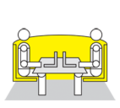
Work lounge - A lounge-like work space for two to six people; suitable for short-term activities which demand collaboration and/or allow impromptu interaction
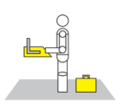
Touch down - An open work space for one person; suitable for short-term activities which require little concentration and low interaction

Meeting spaces
Meeting spaces in an office are typically used interactive processes, be it quick conversations or intensive brainstorms. There are six generic types of meeting space, each supporting different activities.


Small meeting room - An enclosed meeting space for two to four persons, suitable for both formal and informal interaction
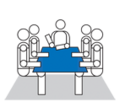
Large meeting room - An enclosed meeting space for five to twelve people, suitable for formal interaction
Small meeting space - An open or semi-open meeting space for two to four persons; suitable for short, informal interaction


Large meeting space - An open or semi-open meeting space for five to twelve people; suitable for short, informal interaction
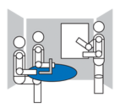
Brainstorm room - An enclosed meeting space for five to twelve persons; suitable for brainstorming sessions and workshops
Meeting point - An open meeting point for two to four persons; suitable for ad hoc, informal meetings

Support spaces
Support spaces in an office are typically used for secondary activities such as filing documents or taking a break. There are twelve generic types of support space, each supporting different activities.


Filing space - An open or enclosed support space for the storage of frequently used files and documents
Storage space - An open or enclosed support space for the storage of commonly used office supplies
Print and copy area - An open or enclosed support space with facilities for printing, scanning and copying


Mail area - An open or semi-open support space where employees can pick up or deliver their personal mail
Pantry area - An open or enclosed support space where people can get coffee and tea as well as soft drinks and snacks
Break area - A semi-open or enclosed support space where employees can take a break from their work


Locker area - An open or semi-open support space where employees can store their personal belongings
Smoking room - An enclosed support space where employees can smoke a cigarette
Library - A semi-open or enclosed support space for reading of books, journals and magazines


Games room - An enclosed support space where employees can play games (e.g. computer games, pool, darts)
Waiting area - An open or semi-open support space where visitors can be received and can wait for their appointment
Circulation space - Support space which is required for circulation on office floors, linking all major functions

Office structure

There are many different ways of arranging the space in an office and whilst these vary according to function, managerial fashions and the culture of specific companies can be even more important. Choices include, how many people will work within the same room. At one extreme, each individual worker will have their own room; at the other extreme a large open plan office can be made up of one main room with tens or hundreds of people working in the same space. Open plan offices put multiple workers together in the same space, and some studies have shown that they can improve short term productivity, i.e. within a single software project. At the same time, the loss of privacy and security can increase the incidence of theft and loss of company secrets. A type of compromise between open plan and individual rooms is provided by the cubicle, possibly made most famous by the Dilbert cartoon series, which solves visual privacy to some extent, but often fails on acoustic separation and security. Most cubicles also require the occupant to sit with their back towards anyone who might be approaching; workers in walled offices almost always try to position their normal work seats and desks so that they can see someone entering, and in some instances, install tiny mirrors on things such as computer monitors.

Office buildings


A small office building in Salinas, California, United States.
While offices can be built in almost any location in almost any building, some modern requirements for offices make this more difficult. These requirements can be both legal (i.e. light levels must be sufficient) or technical (i.e. requirements for computer networking). Alongside such other requirements such as security and flexibility of layout, this has led to the creation of special buildings which are dedicated only or primarily for use as offices. An office building, also known as an office block, is a form of commercial building which contains spaces mainly designed to be used for offices.
The primary purpose of an office building is to provide a workplace and working environment primarily for administrative and managerial workers. These workers usually occupy set areas within the office building, and usually are provided with desks, PCs and other equipment they may need within these areas.
An office building will be divided into sections for different companies or may be dedicated to one company. In either case, each company will typically have a reception area, one or several meeting rooms, singular or open-plan offices, as well as toilets.
Many office buildings also have kitchen facilities and a staff room, where workers can have lunch or take a short break.

Office and retail rental rates

Rental rates for office and retail space are typically quoted in terms of money per floor-area–time, usually money per floor-area–year. For example, the rate for a particular property may be 290 dollars per square-meter–year ($290/m2·a) (or $29/ft2·a), and rates in the area could range $200/m2·a–$500/m2·a.
In many countries, rent is typically paid monthly even if usually discussed in terms of years.
Example: A particular 200 m2 space is priced at $150/m2·a: (200 m2) × ($150/m2·a) / (12 mo/a) = $2500/month
In a gross lease, the rate quoted is an all-inclusive rate. One pays a set amount of rent per time and the landlord is responsible for all other expenses such as costs of utilities, taxes, insurance, maintenance, and repairs.
The triple net lease is one in which the tenant is liable for a share of various expenses such as property taxes, insurance, maintenance, utilities, climate control, repairs, janitorial services and landscaping.

Grading

The Building Owners and Managers Association International (BOMA) classifies office space into three categories: Class A, Class B, and Class C. According to BOMA, Class A office buildings have the "most prestigious buildings competing for premier office users with rents above average for the area." BOMA states that Class A facilities have "high quality standard finishes, state of the art systems, exceptional accessibility and a definite market presence." BOMA describes Class B office buildings as those that compete "for a wide range of users with rents in the average range for the area." BOMA states that Class B buildings have "adequate systems" and finishes that "are fair to good for the area," but that the buildings do not compete with Class A buildings for the same prices. According to BOMA Class C buildings are aimed towards "tenants requiring functional space at rents below the average for the area."


(source:wikpedia)