Showing posts with label Paper clip. Show all posts

Saturday, November 27

Pulp mill

International Paper Company, pulp mill
 A pulp mill is a manufacturing facility that converts wood chips or other plant fibre source into a thick fibre board which can be shipped to a paper mill for further processing. Pulp can be manufactured using mechanical, semi-chemical or fully chemical methods (kraft and sulfite processes). The finished product may be either bleached or non-bleached, depending on the customer requirements.
Wood and other plant materials used to make pulp contain three main components (apart from water): cellulose fibres (desired for papermaking), lignin (a three-dimensional polymer that binds the cellulose fibres together) and hemicelluloses, (shorter branched carbohydrate polymers). The aim of pulping is to break down the bulk structure of the fibre source, be it chips, stems or other plant parts, into the constituent fibres.
Chemical pulping achieves this by degrading the lignin and hemicellulose into small, water-soluble molecules which can be washed away from the cellulose fibers without depolymerizing the cellulose fibres (chemically depolymerizing the cellulose weakens the fibres). The various mechanical pulping methods, such as groundwood (GW) and refiner mechanical (RMP) pulping, physically tear the cellulose fibres one from another. Much of the lignin remains adhering to the fibres. Strength is impaired because the fibres may be cut. There are a number of related hybrid pulping methods that use a combination of chemical and thermal treatment to begin an abbreviated chemical pulping process, followed immediately by a mechanical treatment to separate the fibres. These hybrid methods include thermomechanical pulping (TMP) and chemithermomechanical pulping (CTMP). The chemical and thermal treatments reduce the amount of energy subsequently required by the mechanical treatment, and also reduce the amount of strength loss suffered by the fibres.
See also
The mill

Much of the information about the technology in following subsections is from the book by C.J. Biermann.. The chemistry of the various pulping processes can be found in Sjöström's book.

Preparation of fibre source
The most common fibre source for pulp mills is pulpwood. Other common sources are bagasse and fibre crops. The first step in all mills using wood (trees) as the fibre source is to remove the bark. Bark contains relatively few usable fibers and darkens the pulp. The removed bark is burned, along with other unusable plant material, to generate steam to run the mill. Almost all wood is then chipped before it processed further to free the fibers.
Removal of the bark is done in a barker (or debarker). The bark adhesion is about 3-5 kg/cm2 in the growing season (summer) and 2-3 times higher in the dormant season (winter). The bark of frozen logs is even more difficult to remove.
In chemical pulp mills the bark is introducing unwanted contaminants as calcium, silica and aluminum that are causing scaling and gives an extra load for the chemical recovery system. Birch bark contains betulin, a terpenoid that easily makes deposits in a pulp mill.

Mechanical pulp mills
The earliest mills used sandstone grinding rollers to break up small wood logs called "bolts", but the use of natural stone ended in the 1940s with the introduction of manufactured stones with embedded silicon carbide or aluminum oxide. The pulp made by this process is known as "stone groundwood" pulp (SGW). If the wood is ground in a pressurized,sealed grinder the pulp is classified as "pressure groundwood" (PGW) pulp. Most modern mills use chips rather than logs and ridged metal discs called refiner plates instead of grindstones. If the chips are just ground up with the plates, the pulp is called "refiner mechanical" pulp (RMP), if the chips are steamed while being refined the pulp is called "thermomechanical" pulp (TMP). Steam treatment significantly reduces the total energy needed to make the pulp and decreases the damage (cutting) to fibers. Mechanical pulp mills use large amounts of energy, mostly electricity to power motors which turn the grinders. A rough estimate of the electrical energy needed is 10,000 megajoules (MJ) per tonne of pulp (2,750 kW·h per tonne)

Chemical pulp mills


Pulp mill at Blankenstein (Germany)
: Kraft process, Sulfite process, and Soda pulping
Chemical pulping processes such as the kraft (or sulfate) process and the sulfite process remove much of the hemicelluloses and lignin. The kraft process does less damage to the cellulose fibers than the sulphite process, thereby producing stronger fibers, but the sulfite process makes pulp that is easier to bleach. The chemical pulping processes use a combination of high temperature and alkaline (kraft) or acidic (sulphite) chemicals to break the chemical bonds of the lignin.
The material fed into the digester must be small enough to allow the pulping liquor to penetrate the pieces completely. In the case of wood, the logs are chipped and the chips screened so that what is fed to the digester is a uniform size. The oversize chips are rechipped or used as fuel, sawdust is burned. The screened chips or cut plant material (bamboo, kenaf, etc) goes to the digester where it is mixed an aqueous solution of the pulping chemicals, then heated with steam. In the kraft process the pulping chemicals are sodium hydroxide and sodium sulfide and the solution is known as white liquor. In the sulfite process the pulping chemical is a mixture of metal (sodium, magnesium, potassium or calcium) or ammonium sulfite or bisulfite.
After several hours in the digester, the chips or cut plant material breaks down into a thick porridge-like consistency and is "blown" or squeezed from the outlet of the digester through an airlock. The sudden change in pressure results in a rapid expansion of the fibers, separating the fibres even more. The resulting fiber suspension in water solution is called "brown stock".
Brown stock washers, using countercurrent flow, remove the spent cooking chemicals and degraded lignin and hemicellulose. The extracted liquid, known as black liquor in the kraft process, and red or brown liquor in the sulfite processes, is concentrated, burned and the sodium and sulfur compounds recycled in the recovery process. Lignosulfonates are a useful byproduct recovered from the spent liquor in the sulfite process. The clean pulp (stock) can be bleached in the bleach plant or left unbleached, depending on the end use. The stock is sprayed onto the pulp machine wire, water drains off, more water is removed by pressing the sheet of fibers, and the sheet is then dried. At this point the sheets of pulp are several millimeters thick and have a coarse surface: it is not yet paper. The dried pulp is cut, stacked, bailed and shipped to another facility for whatever further process is needed.
Bleached kraft pulp and bleached sulfite pulp are used to make high quality, white printing paper. One of the most visible uses for unbleached kraft pulp is to make brown paper shopping bags and wrapping paper where strength is particularly important. A special grade of bleached sulfite pulp, known as dissolving pulp, is used to make cellulose derivatives such as methylcellulose which are used in a wide range of everyday products from laxatives to baked goods to wallpaper paste.

Chemi-mechanical pulp mills
Some mills pretreat wood chips or other plant material like straw with sodium carbonate, sodium hydroxide, sodium sulfite and other chemical prior to refining with equipment similar to a mechanical mill. The conditions of the chemical treatment are much less vigorous (lower temperature, shorter time, less extreme pH) than in a chemical pulping process, since the goal is to make the fibers easier to refine, not to remove lignin as in a fully chemical process. Pulps made using these hybrid processes are known as chemi-thermomechanical pulps (CTMP). Sometimes a CTMP mill is located on the same site as a kraft mill so that the effluent from the CTMP mill can be treated in the kraft recovery process to regenerate the inorganic pulping chemicals.

Environmental issues

The United Nations Environmental Program (UNEP) has approved only two processes for making the chemical bleach chlorine dioxide, which produce 99.8% chlorine dioxide and contain only 0.2% elemental chlorine. Contamination of the chlorine dioxide with elemental chlorine is considered undesirable, and may lead to environmental pollution. While properly treated effluent may be safe to discharge into water catchment areas, mills which discharge untreated effluent pollute water ways with persistent organic pollutants (organochlorides and dioxins), and may breach the Stockholm Convention.

(source:wikipedia)

Friday, November 26

History of paper

Five gigantic steps in ancient Chinese papermaking,
outlined by Cai Lun in 105 AD,
The history of paper began in Ancient Egypt approx. 3,700 BC – 3,200 BC with the use of papyrus as a medium for written records, a considerable advance over the technique employed by the Sumerians of writing on clay tablets. The word "paper" is etymologically derived from papyros, Ancient Greek for the Cyperus papyrus. Most western books in the middle ages were made of parchment, derived from animal hides.
Paper was invented by the Chinese by 105 AD in the Han Dynasty and spread slowly to the west via Samarkand and Baghdad. Papermaking and manufacturing in Europe started in Italy and Germany by 1400.

Papyrus and parchment

The word paper derives from the Greek term for the ancient Egyptian writing material called papyrus, which was formed from beaten strips of papyrus plants, while biblos, a Greek term signifying the bark of the plant, is in the derivation of various words relating to books, such as Bible and bibliography. The Greek writer Theophrastus used the word papyros to refer to plant as a foodstuff whereas bublos signified any derived processed product, such as cordage or as a writing surface. It was smoothed on one side by rubbing it against a flat stone surface. Papyrus was produced as early as 3700 BC in Egypt, and later exported to both ancient Greece and Rome.
The establishment of the Library of Alexandria in the 3rd century BC put a drain on the supply of papyrus. As a result, according to the Roman historian Pliny the Elder (Natural History records, xiii.21), parchment was invented under the patronage of Eumenes of Pergamum to build his rival library at Pergamum. Outside Egypt, parchment or vellum, made of processed sheepskin or calfskin, replaced papyrus, as the papyrus plant requires subtropical conditions to grow. These materials are technically not true paper, which is made from pulp, rags, and fibers of plants and cellulose. As paper was introduced, it replaced parchment.

Papermaking


Hemp wrapping paper, China, circa 100 BC


The world's earliest known printed book (using woodblock printing), the Diamond Sutra of 868 CE, shows the widespread availability and practicality of paper in China.
Papermaking has traditionally been traced to China about 105 AD, when Cai Lun, an official attached to the Imperial court during the Han Dynasty (202 BC-220 AD), created a sheet of paper using mulberry and other bast fibres along with fishnets, old rags, and hemp waste.

Early papermaking in China
Papermaking is considered to be one of the Four Great Inventions of Ancient China, since the first papermaking process was developed in China during the early 2nd century. During the Shang (1600–1050 BC) and Zhou (1050 BC – 256 AD) dynasties of ancient China, documents were ordinarily written on bone or bamboo (on tablets or on bamboo strips sewn and rolled together into scrolls), making them very heavy and awkward to transport. The light material of silk was sometimes used, but was normally too expensive to consider. While the Han Dynasty Chinese court official Cai Lun is widely regarded to have invented the modern method of papermaking (inspired from wasps and bees) from rags and other plant fibers in 105 CE, the discovery of specimens bearing written Chinese characters in 2006 at north-east China's Gansu province suggest that paper was in use by the ancient Chinese military more than 100 years before Cai, in 8 BC. It therefore would appear that "Cai Lun's contribution was to improve this skill systematically and scientifically, fixing a recipe for papermaking". Archeologically however, ground paper without writing has been excavated in China dating to the reign of Emperor Wu of Han from the 2nd century BC, used for purposes of wrapping or padding protection for delicate bronze mirrors. It was also used for safety, such as the padding of poisonous 'medicine' as mentioned in the official history of the period. Although paper used for writing became widespread by the 3rd century, paper continued to be used for wrapping (and other) purposes.
Toilet paper was used in China by at least the 6th century CE. In 589 AD, the Chinese scholar-official Yan Zhitui (531-591 AD) wrote: "Paper on which there are quotations or commentaries from Five Classics or the names of sages, I dare not use for toilet purposes". An Arab traveler to China once wrote of the curious Chinese tradition of toilet paper in AD 851, writing: "[The Chinese] are not careful about cleanliness, and they do not wash themselves with water when they have done their necessities; but they only wipe themselves with paper". Toilet paper continued to be a valued necessity in China, since it was during the Hongwu Emperor's reign in 1393 that the Bureau of Imperial Supplies (Bao Chao Si) manufactured 720,000 sheets of toilet paper for the entire court (produced of the cheap rice–straw paper). For the emperor's family alone, 15,000 special sheets of paper were made, in light yellow tint and even perfumed. Even at the beginning of the 14th century, during the middle of the Yuan Dynasty, the amount of toilet paper manufactured for modern-day Zhejiang province alone amounted to ten million packages holding 1,000 to 10,000 sheets of toilet paper each.


The Bencao on traditional Chinese medicine; printed with woodblock in 1249, Song Dynasty
During the Tang Dynasty (618–907 AD) paper was folded and sewn into square bags to preserve the flavor of tea. During the same period, it was written that tea was served from baskets with multi-colored paper cups and paper napkins of different size and shape. During the Chinese Song Dynasty (960–1279 AD) not only did the government produce the world's first known paper-printed money, or banknote (see Jiaozi and Huizi), but paper money bestowed as gifts to deserving government officials were wrapped in special paper envelopes.

Diffusion of paper

Paper spread slowly outside of China; other East Asian cultures, even after seeing paper, could not make it themselves. Instruction in the manufacturing process was required, and the Chinese were reluctant to share their secrets. The paper was thin and translucent, not like modern western paper, and thus only written on one side. The technology was first transferred to Goguryeo in 604 and then imported to Japan by Buddhist priests, around 610, where fibres (called bast) from the mulberry tree were used.

Islamic world
After the defeat of the Chinese in the Battle of Talas in 751 (present day Kyrgyzstan), the invention spread to the Middle East. The rudimentary and laborious process of paper making was refined and machinery was designed for bulk manufacturing of paper by Muslims. Production began in Baghdad, where the Arab Muslims invented a method to make a thicker sheet of paper, which helped transform papermaking from an art into a major industry. The use of pulp mills, which are water-powered mills used for preparing the pulp material used in papermaking, dates back to Samarkand in the 8th century, though this should not be confused with paper mills (see Paper mills section below). The Muslims also introduced the use of trip hammers (powered by humans and animals) in the production of paper, replacing the traditional Chinese mortar and pestle method. In turn, the trip hammer method was later employed by the Chinese.
The Arabs also made advances in book production soon after they learnt papermaking from the Chinese in the 8th century. Particular skills were developed for script writing (Arabic calligraphy), miniatures and bookbinding. The Arabs made books lighter—sewn with silk and bound with leather-covered paste boards; they had a flap that wrapped the book up when not in use. As paper was less reactive to humidity, the heavy boards were not needed. The production of books became a real industry and cities like Marrakech in Morocco had a street named "Kutubiyyin" or book sellers which contained more than 100 bookshops by the 12th century. In the words of Don Baker: "The world of Islam has produced some of the most beautiful books ever created. [...] Splendid illumination was added with gold and vibrant colours, and the whole book contained and protected by beautiful bookbindings." The earliest recorded use of paper for packaging dates back to 1035, when a Persian traveler visiting markets in Cairo noted that vegetables, spices and hardware were wrapped in paper for the customers after they were sold.
Since the First Crusade in 1096, paper manufacturing in Damascus had been interrupted by wars, splitting production into two centres. Egypt continued with the thicker paper, while Iran became the center of the thinner papers. Papermaking was diffused across the Islamic world, from where it was diffused further west into Europe.

Americas
In America, archaeological evidence indicates that a similar bark-paper writing material was invented by the Mayans no later than the 5th century CE. Called amatl, it was in widespread use among Mesoamerican cultures until the Spanish conquest. The parchment is created by boiling and pounding the inner bark of trees, until the material becomes suitable for art and writing.
These materials made from pounded reeds and bark are technically not true paper, which is made from pulp, rags, and fibers of plants and cellulose.

Europe


A copy of the Gutenberg Bible, in the U.S. Library of Congress
The oldest known paper document in the West is the Mozarab Missal of Silos from the 11th century, probably using paper made in the Islamic part of Spain. They used hemp and linen rags as a source of fibre.
Paper is recorded as being manufactured in both Italy and Germany by 1400, just about the time when the woodcut printmaking technique was transferred from fabric to paper in the old master print and popular prints. The first commercially successful paper mill in England was opened by John Spilman in 1588 near Dartford in Kent and was initially reliant on German papermaking expertise.

Paper mills
Main article: Paper mill


The Nuremberg paper mill, the building complex at the lower right corner, in 1493. Due to their noise and smell, papermills were required by medieval law to be erected outside of the city perimeter.
A paper mill is a water-powered mill that pounds the pulp by the use of trip-hammers. The mechanization of the pounding process was an important improvement in paper manufacture over the manual pounding with hand pestles.
Evidence for water-powered paper mills is elusive in both Chinese and Muslim papermaking, though there is evidence that they used human-powered and animal-powered paper mills. The general absence of the use of water-power in Muslim papermaking is suggested by the habit of Muslim authors to call a production center a "paper manufactory", but not a "mill".
Donald Hill has identified a possible reference to a water-powered paper mill in Samarkand, in the 11th-century work of the Persian scholar Abu Rayhan Biruni, but concludes that the passage is "too brief to enable us to say with certainty" that it refers to a water-powered paper mill. While this is seen by Halevi nonetheless as evidence of Samarkand first harnessing waterpower in the production of paper, he concedes that it is not known if waterpower was applied to papermaking elsewhere across the Islamic world at the time; Burns remains altogether sceptical given the isolated occurrence of the reference and the prevalence of manual labour in Islamic papermaking elsewhere.
The earliest certain evidence to a water-powered paper mill dates to 1282 in the Spanish Kingdom of Aragon. A decree by the Christian king Peter III addresses the establishment of a royal "molendinum", a proper hydraulic mill, in the paper manufacturing centre of Xàtiva. The crown innovation appears to be resented by the local Muslim papermakering community; the document guarantees the Muslim subjects the right to continue their way of traditional papermaking by beating the pulp manually and grants them the right to be exempted from work in the new mill.
The first paper mill north of the Alps was established in Nuremberg by Ulman Stromer in 1390; it is later depicted in the lavishly illustrated Nuremberg Chronicle. From the mid-14th century onwards, European paper milling underwent a rapid improvement of many work processes.

19th century advances in papermaking

Paper remained expensive, at least in book-sized quantities, through the centuries, until the advent of steam-driven paper making machines in the 19th century, which could make paper with fibres from wood pulp. Although older machines predated it, the Fourdrinier paper making machine became the basis for most modern papermaking. Nicholas Louis Robert of Essonnes, France, was granted a patent for a continuous paper making machine in 1799. At the time he was working for Leger Didot with whom he quarrelled over the ownership of the invention. Didot sent his brother-in-law, John Gamble, to meet Sealy and Henry Fourdrinier, stationers of London, who agreed to finance the project. Gamble was granted British patent 2487 on 20 October 1801. With the help particularly of Bryan Donkin, a skilled and ingenious mechanic, an improved version of the Robert original was installed at Frogmore, Hertfordshire, in 1803, followed by another in 1804. A third machine was installed at the Fourdriniers' own mill at Two Waters. The Fourdriniers also bought a mill at St Neots intending to install two machines there and the process and machines continued to develop.
However, experiments with wood showed no real results in the late 18th-century and at the start of the 19th-century. By 1800, Matthias Koops (in London, England) further investigated the idea of using wood to make paper. And in 1801 he wrote and published a book titled, "Historical account of the substances which have been used to describe events, and to convey ideas, from the earliest date, to the invention of paper." His book was printed on paper made from wood shavings (and adhered together). No pages were fabricated using the pulping method (from either rags or wood). He received financial support from the royal family to make his printing machines and acquire the materials and infrastructure need to start his printing business. But his enterprise was short lived. Only a few years following his first and only printed book (the one he wrote and printed), he went bankrupt. The book was very well done (strong and had a fine appearance), but it was very costly.
Then in the 1830s and 1840s, two men on two different continents took up the challenge, but from a totally new perspective. Both Charles Fenerty and Friedrich Gottlob Keller began experiments with wood but using the same technique used in paper making; instead of pulping rags, they thought about pulping wood. And at about exactly the same time, by mid-1844, they announced that their findings. They invented a machine which extracted the fibres from wood (exactly as with rags) and made paper from it. Charles Fenerty also bleached the pulp so that the paper was white. This started a new era for paper making. By the end of the 19th-century almost all printers in the western world were using wood in lieu of rags to make paper.
Together with the invention of the practical fountain pen and the mass produced pencil of the same period, and in conjunction with the advent of the steam driven rotary printing press, wood based paper caused a major transformation of the 19th century economy and society in industrialized countries. With the introduction of cheaper paper, schoolbooks, fiction, non-fiction, and newspapers became gradually available by 1900. Cheap wood based paper also meant that keeping personal diaries or writing letters became possible and so, by 1850, the clerk, or writer, ceased to be a high-status job.
The original wood-based paper was acidic due to the use of alum and more prone to disintegrate over time, through processes known as slow fires. Documents written on more expensive rag paper were more stable. Mass-market paperback books still use these cheaper mechanical papers (see below), but book publishers can now use acid-free paper for hardback and trade paperback books.


(source:wikipedia)

History of typography in East Asia

The Chinese invention of paper and the advent of woodblock printing produced the world's first print culture. As the print scholar A. Hyatt Mayor noted, "it was the Chinese who really discovered the means of communication that was to dominate until our age."
Woodblock printing was better suited to Chinese characters than movable type, which the Chinese also invented, but which did not replace woodblock printing. In China and Korea, the use of woodblock printing on paper and movable type preceded their use in Europe by several centuries. Both methods were replaced in the second half of the 19th century by Western-style printing.

Woodblock printing


The intricate frontispiece of the Diamond Sutra from Tang Dynasty China, 868 AD (British Museum)
Traditionally, there have been two main printing techniques in Asia, those of woodblock printing and moveable type printing. In the woodblock technique, ink is applied to letters carved upon a wooden board, which is then pressed onto paper. With moveable type, the board is assembled using different lettertypes, according to the page being printed. Wooden printing was used in the East from the 8th century onwards, and moveable metal type came into use during the 12th century.
The earliest woodblock printed fragments to survive are from China and are of silk printed with flowers in three colours from the Han dynasty (before 220 CE).
The earliest specimen of woodblock printing on paper, whereby individual sheets of paper were pressed into wooden blocks with the text and illustrations carved into them, was discovered in 1974 in an excavation of Xi'an (then called Chang'an, the capital of Tang China), Shaanxi, China. It is a dharani sutra printed on hemp paper and dated to 650 to 670 AD, during Tang Dynasty (618–907). Another printed document dating to the early half of the Chinese Tang Dynasty has also been found, the Snddharma pundarik sutra printed from 690 to 699.


Chinese playing card dated c. 1400 AD, Ming Dynasty
A copy of the Buddhist Dharani Sutra called the Pure Light Dharani Sutra (Hanja: 無垢淨光大陀羅尼經 Hangul:무구정광대다라니경; Revised Romanization: Mugujeonggwangdaedaranigyeong), discovered in a Silla Korean pagoda that was repaired in 751 AD, was undated but must have been created sometime before the reconstruction of the Shakyamuni Pagoda of Pulguk Temple, Kyongju Province in 751 AD. The document is estimated to have been created no later than 704 AD. Joseph Needham states that the Pure Light Dharani Sutra utilizes the extinct writing system of Empress Wu, who reigned over China from 690 to 705. Choi Junshik states that the characters on the Pure Light Dharani Sutra were invented by Silla, noting the invention of characters by Silla throughout its existence. Pan Jixing refutes this, stating that research has allegedly shown that the dharani sutra discovered in Korea was translated in China from Sanskrit in 701 and printed in 702 at Luoyang, which was the capital of China under Wu Zetian.
Robert Temple notes that the earliest known book printed bearing an actual date and at what is considered to be a 'regular size' was the Chinese Diamond Sutra of 868 AD. Joseph Needham notes that the intricate artistic designs and fine lines of calligraphy found in the Diamond Sutra attest to the level of refinement reached in woodblock printing in the time between the printing of it and the Pure Light Dharani Sutra of 704. The oldest known printed calendars in the world also come from Tang China, printed in 877 and 882.
The earliest woodblocks used for printing in Europe, in the fourteenth century, using exactly the same technique as Chinese woodblocks, lead some pioneering scholars of Asian subjects to hypothesize a connection: "the process of printing them must have been copied from ancient Chinese specimens, brought from that country by some early travelers, whose names have not been handed down to our times" (Robert Curzon, 1810–1873). Joseph Needham's Science and Civilization in China has a chapter that suggests that "European block printers must not only have seen Chinese samples, but perhaps had been taught by missionaries or others who had learned these un-European methods from Chinese printers during their residence in China."
But historians of the Western prints themselves see no need for such a direct and late connection. Rather, they assume that European woodcut appeared "spontaneously and presumably as a result of the use of paper as it had been observed that paper was better suited than rough-surfaced parchment for making the impressions from wood-reliefs".
European woodblock printing shows a clear progression from patterns to images, both printed on cloth, then to images printed on paper, when it became widely available in Europe in about 1400.Text and images printed together only appear some sixty years later, after metal movable type.

Movable type


Jiaozi (currency), 11th century paper-printed money from the Song Dynasty.

Movable type in China
The first known movable type system was invented in China around 1040 AD by Bi Sheng (990-1051). Bi Sheng's type was made of baked clay. As described by the Chinese scholar Shen Kuo (1031–1095):
When he wished to print, he took an iron frame and set it on the iron plate. In this he placed the types, set close together. When the frame was full, the whole made one solid block of type. He then placed it near the fire to warm it. When the paste [at the back] was slightly melted, he took a smooth board and pressed it over the surface, so that the block of type became as even as a whetstone.
For each character there were several types, and for certain common characters there were twenty or more types each, in order to be prepared for the repetition of characters on the same page. When the characters were not in use he had them arranged with paper labels, one label for each rhyme-group, and kept them in wooden cases.
However, Bi Sheng's fragile clay types were not practical for large-scale printing.Clay types also have the additional handicap of lacking adhesion to the ink. Separately invented in China (but first in Korea) was metal movable type, pioneered by Hua Sui in 1490 AD during the Ming Dynasty (1368-1644 AD).

Wooden movable type


A revolving typecase for wooden type in China, from Wang Zhen's book published in 1313 C.E.
Wooden movable type was developed by the late 13th century, pioneered by Wang Zhen, author of the Nong Shu (農書). Although the wooden type was more durable under the mechanical rigors of handling, repeated printing wore the character faces down, and the types could only be replaced by carving new pieces. This system was later enhanced by pressing wooden blocks into sand and casting metal types from the depression in copper, bronze, iron or tin. The set of wafer-like metal stamp types could be assembled to form pages, inked, and page impressions taken from rubbings on cloth or paper. Before the pioneer of bronze-type printing of China, Hua Sui in 1490 AD, Wang Zhen had experimented with metal type using tin, yet found it unsatisfactory due to its incompatibility with the inking process.
A particular difficulty posed the logistical problems of handling the several thousand logographs whose command is required for full literacy in Chinese language. It was faster to carve one woodblock per page than to composit a page from so many different types. However, if one was to use movable type for multitudes of the same document, the speed of printing would be relatively quicker.
Later in the Jin Dynasty, people used the same but more developed technique to print paper money and formal official documents. The typical example of this kind of movable copper-block printing is a printed "check" of Jin Dynasty in the year of 1215.

Movable type in Korea


"Selected Teachings of Buddhist Sages and Son Masters", the earliest known book printed with movable metal type, 1377. Bibliothèque Nationale de Paris.
The transition from wood type to movable metal type occurred in Korea during the Goryeo Dynasty, sometime in the thirteenth century, to meet the heavy demand for both religious and secular books. A set of ritual books, Sangjeong Gogeum Yemun were printed with movable metal type in 1234. The credit for the first metal movable type may go to Choe Yun-ui of the Goryeo Dynasty in 1234.
Examples of this metal type are on display in the Asian Reading Room of the Library of Congress in Washington, D.C. The oldest extant movable metal print book is the Jikji, printed in Korea in 1377.
The techniques for bronze casting, used at the time for making coins (as well as bells and statues) were adapted to making metal type. Unlike the metal punch system thought to be used by Gutenberg, the Koreans used a sand-casting method. The following description of the Korean font casting process was recorded by the Joseon dynasty scholar Song Hyon (15th c.):
At first, one cuts letters in beech wood. One fills a trough level with fine sandy [clay] of the reed-growing seashore. Wood-cut letters are pressed into the sand, then the impressions become negative and form letters [molds]. At this step, placing one trough together with another, one pours the molten bronze down into an opening. The fluid flows in, filling these negative molds, one by one becoming type. Lastly, one scrapes and files off the irregularities, and piles them up to be arranged.
Among books printed with metal movable type, the oldest surviving books are from Korea, dated at least from 1377. However, Korea never witnessed a printing revolution comparable to Europe's:
Korean printing with movable metallic type developed mainly within the royal foundry of the Yi dynasty. Royalty kept a monopoly of this new technique and by royal mandate suppressed all non-official printing activities and any budding attempts at commercialization of printing. Thus, printing in early Korea served only the small, noble groups of the highly stratified society.
A potential solution to the linguistic and cultural bottleneck that held back movable type in Korea for two hundred years appeared in the early 15th century—a generation before Gutenberg would begin working on his own movable type invention in Europe—when King Sejong devised a simplified alphabet of 24 characters called Hangul for use by the common people, which could have made the typecasting and compositing process more feasible. Although the common sense believes that the Korean ruling aristocrats disdained the use of hangul, this is simply untrue. As the hangeul was used extensively in administrative and educational works, and was almost the sole mean for communicating with the women of the Royal House, the aristocrats also used hangul widely.

Movable type in Japan
Though the Jesuits operated a Western movable type printing-press in Nagasaki, Japan, printing equipment brought back by Toyotomi Hideyoshi's army in 1593 from Korea had far greater influence on the development of the medium. Four years later, Tokugawa Ieyasu, even before becoming shogun, effected the creation of the first native movable type, using wooden type-pieces rather than metal. He oversaw the creation of 100,000 type-pieces, which were used to print a number of political and historical texts.
An edition of the Confucian Analects was printed in 1598, using Korean moveable type printing equipment, at the order of Emperor Go-Yōzei. This document is the oldest work of Japanese moveable type printing extant today. Despite the appeal of moveable type, however, it was soon decided that the running script style of Japanese writings would be better reproduced using woodblocks, and so woodblocks were once more adopted; by 1640 they were once again being used for nearly all purposes.

Movable type in other East Asian countries


China Block Printing Museum in Yangzhou
Printing using movable type spread from China during the Mongol Empire; among other groups, the Uyghurs of Central Asia, whose script was adopted for the Mongol language, used movable type.

Possible influence on European use of movable type
Since the use of printing from movable type arose in East Asia well before it did in Europe, it is relevant to ask whether Gutenberg may have been influenced, directly or indirectly, by the Chinese or Korean discoveries of movable type printing. There is no actual evidence that Gutenberg knew of the Korean processes for movable type. However, some authors admit this possibility, and argue that movable metal type had been an active enterprise in Korea since 1234 (although oldest preserved books are from 1377) and there was communication between West and East. Despite these conjectures, there is no evidence that movable type from the East ever reached Europe.

Mechanical presses

Mechanical presses as used in European printing remained unknown in East Asia. Instead, printing remained an unmechanized, laborious process with pressing the back of the paper onto the inked block by manual "rubbing" with a hand tool. In Korea, the first printing presses were introduced as late as 1881-83, while in Japan, after an early but brief interlude in the 1590s, Gutenberg's printing press arrived in Nagasaki in 1848 on a Dutch ship.
Contrary to Gutenberg printing, which allowed printing on both sides of the paper from its very beginnings (although not simultaneously until very recent times), East Asian printing was done only on one side of the paper, because the need to rub the back of the paper when printing would have spoilt the first side when the second side was printed. Another reason was that, unlike in Europe where Gutenberg introduced more suitable oil-based ink, Asian printing remained confined to water-based inks which tended to soak through the paper.


(source:wikipedia)

Papermaking

Papermaking is the process of making paper, a substance which is used ubiquitously today for writing and packaging.
In papermaking a dilute suspension of fibers in water is drained through a screen, so that a mat of randomly interwoven fibers is laid down. Water is removed from this mat of fibers by pressing and drying to make paper. Most paper is made from wood pulp, but other fiber sources such as cotton and textiles may be used.

History of paper

Hemp wrapping paper, China, circa 100 BCE.
Papermaking is known to have been traced back to China about 105 CE, when Cai Lun, an official attached to the Imperial court during the Han Dynasty (202 BCE-220 CE), created a sheet of paper using mulberry and other bast fibres along with fishnets, old rags, and hemp waste.  However a recent archaeological discovery has been reported from near Dunhuang of paper with writing on it dating from 8 BCE, while paper had been used in China for wrapping and padding since the 2nd century BCE.Paper used as a writing medium became widespread by the 3rd century, and by the 6th century toilet paper was starting to be used in China as well. During the Tang Dynasty (618-907 CE) paper was folded and sewn into square bags to preserve the flavor of tea, while the later Song Dynasty (960-1279 CE) was the first government on Earth to issue paper-printed money.
In the 8th century, paper spread to the Islamic world, where the rudimentary and laborious process of papermaking was refined and machinery was designed for bulk manufacturing of paper. Production began in Baghdad under the supervision of the Grand Vizier Ja'far ibn Yahya, they invented a method to make a thicker sheet of paper. This helped transform papermaking from an art into a major industry. The earliest use of water-powered mills in paper production, specifically the use of pulp mills for preparing the pulp for papermaking, dates back to Samarkand in the 8th century. The earliest references to paper mills also come from the medieval Islamic world, where they were first noted in the 9th century by Arabic geographers in Damascus Papermaking was diffused across the Islamic world, from where it was diffused further west into Europe.
Paper is recorded as being manufactured in both Italy and Germany by 1400, just about the time when the woodcut printmaking technique was transferred from fabric to paper in the old master print and popular prints. Modern papermaking began in the early 19th century in Europe with the development of the Fourdrinier machine, which produces a continuous roll of paper rather than individual sheets. These machines have become very large, up to 500 feet (~150 m) in length, producing a sheet 400 inches (~10 m) wide, and operating at speeds of over 60 mph (100 km/h). In 1844, both Canadian inventor Charles Fenerty and German inventor F.G. Keller had invented the machine and process for pulping wood for the use in papermaking. This would end the nearly 2000-year use of pulped rags and start a new era for the production of newsprint and eventually almost all paper out of pulped wood.

Manual papermaking

Papermaking, regardless of the scale on which it is done, involves making a dilute suspension of fibers in water and allowing this suspension to drain through a screen so that a mat of randomly interwoven fibers is laid down. Water is removed from this mat of fibers by pressing and drying to make paper.


The art of papermaking. Medieval festival at Monselice.
First the fibers are suspended in water to form a slurry in a large vat. The mold is a wire screen in a wooden frame (somewhat similar to an old window screen), which is used to scoop some of the slurry out of the vat. The slurry in the screen mold is sloshed around the mold until it forms a uniform thin coating. The fibers are allowed to settle and the water to drain. When the fibers have stabilized in place but are still damp, they are turned out onto a felt sheet which was generally made of an animal product such as wool or rabbit fur, and the screen mold immediately reused. Layers of paper and felt build up in a pile (called a 'post') then a weight is placed on top to press out excess water and keep the paper fibers flat and tight. The sheets are then removed from the post and hung or laid out to dry. A step-by-step procedure for making paper with readily available materials can be found online.
When the paper pages are dry, they are frequently run between rollers (calendered) to produce a harder writing surface. Papers may be sized with gelatin or similar to bind the fibres into the sheet. Papers can be made with different surfaces depending on their intended purpose. Paper intended for printing or writing with ink is fairly hard, while paper to be used for water color, for instance, is heavily sized, and can be fairly soft.
The wooden frame is called a "deckle". The deckle leaves the edges of the paper slightly irregular and wavy, called "deckle edges", one of the indications that the paper was made by hand. Deckle-edged paper is occasionally mechanically imitated today to create the impression of old-fashioned luxury. The impressions in paper caused by the wires in the screen that run sideways are called "laid lines" and the impressions made, usually from top to bottom, by the wires holding the sideways wires together are called "chain lines". Watermarks are created by weaving a design into the wires in the mold. This is essentially true of Oriental molds made of other substances, such as bamboo. Hand-made paper generally folds and tears more evenly along the laid lines.
Hand-made paper is also prepared in laboratories to study papermaking and to check in paper mills the quality of the production process. The "handsheets" made according to TAPPI Standard T 205 are circular sheets 15.9 cm (6.25 in) in diameter and are tested on paper characteristics as paper brightness, strength, degree of sizing.

Industrial papermaking

 Papermachine
 Paper mill and Pulp and paper industry
A modern paper mill is divided into several sections, roughly corresponding to the processes involved in making hand-made paper. Pulp is refined and mixed in water with other additives to make a pulp slurry, the headbox of the papermachine (Fourdrinier machine) distributes the slurry onto a moving continuous screen, water drains from the slurry (by gravity or under vacuum), the wet paper sheet goes through presses and dries and is finally rolled into large rolls, often weighing several tons.
Another type of papermachine makes use of a cylinder mold that rotates while partially immersed in a vat of dilute pulp. The pulp is picked up by the wire and covers the mold as it rises out of the vat. A couch roller is pressed against the mold to smooth out the pulp, and picks the wet sheet off of the mold.

History of paper sheet production

 Paper sizes
 Bookbinding
Folio - In the beginning of Western papermaking, paper size was fairly standard. A page of paper is referred to as a leaf. When a leaf was printed on without being folded, the size was referred to as folio (meaning leaf). It was roughly equal to the size of a small newspaper sheet. ("Folio" can also refer to other sizes - see paper sizes.)
Quarto - A Folio folded once produces two leaves (or four pages), and the size of these leaves was referred to as quarto (4to) (about 230 x 280 mm).
Octavo - If the original sheet was folded in half again, the result was eight pages, referred to as octavo (8vo), which is roughly the size of an average modern novel. An octavo folding produces four leaves; the first two and the second two will be joined at the top by the first fold. The top edge is usually trimmed to make it possible to look freely at each side of the leaf. Sometimes books are found that have not been trimmed on the top, and these pages are referred to as unopened.
An octavo book produces a printing puzzle. The paper is first printed before folding and thus pages 8 and 1 are printed right-side-up on the bottom of the sheet, and pages 4 and 5 are printed upside-down on the top of the same side of the paper. On the opposite side, pages 2 and 7 are printed right-side-up on the bottom of the sheet, and pages 6 and 3 are printed upside-down on the top of the sheet. When the paper is folded twice and the folds trimmed, the pages fall into proper order.
Sixteen-mo - Smaller books are produced by folding the leaves again to produce 16 pages, known as a sixteen-mo (16mo) (originally sextodecimo). Other folding arrangements produce yet smaller books such as the thirty-two-mo (32mo) (duo et tricensimo).
Octavo bookbinding - When a standard-sized octavo book is produced by twice folding a large leaf, two leaves joined at the top will be contained in the resulting fold (which ends up in the gulley between the pages). This group of eight numberable pages is called a signature or a gathering. Traditionally, printed signatures were stacked on top of each other in a sewing frame and each signature was sewn through the inner fold to the signature on top of it. The sewing ran around leather bands or fabric tapes along the backs of the signatures to stabilize the pile of signatures. The leather bands originally used in the West to stabilize the backs of sewn books appear as a number of ridges under the leather on the spine of leather books. The ends of the leather strips or fabric bands were sewn or glued onto the cover boards and reinforced the hinging of the book in its covers.
Standardisation ISO sizes - While opinions and speculation abound on exact reasons for standardized paper sizes, the most revealing feature of popular sizes (such as Letter and ISO 216 sizes) is that they conform not to some arbitrary device dimension, but that the length of the paper is chosen to be the width of the page times the square root of 2. This feature allowed for a large page to be cut in half and the resulting 2 pages to have the same aspect ratio as the original piece (just with half the size). Repeated cuts can be made to reduce the entire sheet to one size of pages without wasted paper. This format was formalized by ISO 216 however such logic dictated efficient paper sizes long before the ISO was created. For example, traditional 8.5"x11" Letter paper is within a few millimeters of A4 paper (ISO 216) dimensions. While paper sizes "may" have been chosen based on the size of original frames, the frames themselves were chosen to make page reduction efficient without distorting the aspect ratio of the pages regardless of final size chosen. That said, there are paper sizes that do not conform to this idea when specific applications are needed.
Vatmen paper - Vatmen Paper was a type of paper made in the Netherlands that was 17 inches (~43 cm) wide and 44 inches (~112 cm) long. 44 inches was (reputedly) chosen because that is how far the papermaker could stretch his arm. A single vatman can generally handle a mold and deckle which produce up to a 25" wide sheet.


(sorce:wikipedia)

Paper

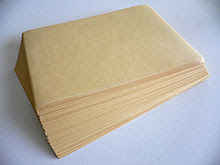
A stack of manila paper
Paper is a thin material mainly used for writing upon, printing upon or for packaging. It is produced by pressing together moist fibers, typically cellulose pulp derived from wood, rags or grasses, and drying them into flexible sheets.
Paper is a versatile material with many uses. Whilst the most common is for writing and printing upon, it is also widely used as a packaging material, in many cleaning products, in a number of industrial and construction processes, and occasionally as a food ingredient, particularly in Asian cultures.

History

Main article: History of paper

The word paper derives from the Greek term for the ancient Egyptian writing material called papyrus, which was formed from beaten strips of papyrus plants. The immediate predecessor to modern paper is believed to have originated in China in approximately the 2nd century AD, although there is some evidence for it being used before this date. Papermaking is considered to be one of the Four Great Inventions of Ancient China, since the first pulp papermaking process was developed in China during the early 2nd century AD by the Han court eunuch Cai Lun. China used paper as an effective and cheap alternative to silk, letting them sell more silk, leading to a Golden Age.
The use of paper spread from China through the Islamic world and entered production in medieval Europe in the 13th century, where the first water-powered paper mills were built and mechanization of papermaking began. The industrial production of paper in the early 19th century caused significant cultural changes worldwide, allowing for relatively cheap exchange of information in the form of letters, newspapers and books for the first time. In 1844, both Canadian inventor Charles Fenerty and German inventor F.G. Keller had invented the machine and process for pulping wood for the use in paper making. This would end the nearly 2000-year use of pulped rags and start a new era for the production of newsprint and eventually all paper out of pulped wood.
Papermaking


The microscopic structure of paper: Micrograph of paper autofluorescing under ultraviolet illumination. The individual fibres in this sample are around 10 µm in diameter.
Main article: Papermaking
Chemical pulping
Main articles: kraft process, sulfite process, and soda pulping
The purpose of a chemical pulping process is to break down the chemical structure of lignin and render it soluble in the cooking liquor, so that it may be washed from the cellulose fibers. Because lignin holds the plant cells together, chemical pulping frees the fibres and makes pulp. The pulp can also be bleached to produce white paper for printing, painting and writing. Chemical pulps tend to cost more than mechanical pulps, largely due to the low yield, 40–50% of the original wood. Since the process preserves fibre length, however, chemical pulps tend to make stronger paper. Another advantage of chemical pulping is that the majority of the heat and electricity needed to run the process is produced by burning the lignin removed during pulping.
Paper made from chemical pulps are also known as wood-free papers. Not to be confused with tree-free paper.
The Kraft process is the most commonly practiced strategy for pulp manufacturing and produces especially strong, unbleached papers that can be used directly for bags and boxes but are often processed further, e.g. to make corrugated cardboard.
Mechanical pulping
There are two major mechanical pulps, thermo mechanical pulp (TMP) and groundwood pulp (GW). In the TMP process, wood is chipped and then fed into large steam-heated refiners where the chips are squeezed and fibreized between two steel discs. In the groundwood process, debarked logs are fed into grinders where they are pressed against rotating stones and fibreized. Mechanical pulping does not remove the lignin, so the yield is very high, >95%, but also causes paper made from this pulp to yellow and become brittle over time. Mechanical pulps have rather short fibre lengths and produce weak paper. Although large amounts of electrical energy are required to produce mechanical pulp, it costs less than chemical pulp.
Deinked pulp
Main article: deinking
Paper recycling processes can use either chemical or mechanical pulp. By mixing with water and applying mechanical action the hydrogen bonds in the paper can be broken and fibres separated again. Most recycled paper contains a proportion of virgin fibre in the interests of quality. Generally deinked pulp is of the same quality or lower than the collected paper it was made from.
There are three main classifications of recycled fibre:.
Mill Broke or Internal Mill Waste — this incorporates any substandard or grade-change paper made within the paper mill which then goes back into the manufacturing system to be repulped back into paper. Such out-of-specification paper is not sold and is therefore often not classified as genuine reclaimed recycled fibre. However, most paper mills have been recycling their own waste fibre for many years, long before recycling become popular.
Preconsumer Waste — this is offcuts and processing waste, such as guillotine trims and envelope blank waste. This waste is generated outside the paper mill and could potentially go to landfill, and is a genuine recycled fibre source. Also includes de-inked preconsumer (recycled material that has been printed but did not reach its intended end use, such as waste from printers and unsold publications).
Postconsumer waste — this is fibre from paper which has been used for its intended end use and would include office waste, magazine papers and newsprint. As the vast majority of this paper has been printed (either digitally or by more conventional means such as litho or gravure), it will either be recycled as printed paper or go through a deinking process first.
Recycled papers can be made from 100% recycled materials or blended with virgin pulp. They are (generally) not as strong nor as bright as papers made from virgin pulp.
Additives
Besides the fibres, pulps may contain fillers such as chalk or china clay, which improve the characteristics of the paper for printing or writing. Additives for sizing purposes may be mixed into the pulp and/or applied to the paper web later in the manufacturing process. The purpose of sizing is to establish the correct level of surface absorbency to suit the ink or paint.
Producing paper
Main articles: Papermachine and handmade paper
See also: Air-laid paper
The pulp is feed to a paper machine where it is formed as a paper web and the water is removed from it by pressing and drying.
Pressing the sheet removes the water by force. Once the water is forced from the sheet, felt (not to be confused with the traditional felt) is used to collect the water. When making paper by hand, a blotter sheet is used.
Drying involves using air and or heat to remove water from the paper sheet. In the earliest days of papermaking this was done by hanging the paper sheets like laundry. In more modern times, various forms of heated drying mechanisms are used. On the paper machine, the most common is the steam-heated can dryer. These dryers can heat to temperatures above 200°F (93°C) and are used in long sequences of more than 40 cans. The heat produced by these can easily dry the paper to less than 6% moisture.
Finishing
The paper may then undergo sizing to alter its physical properties for use in various applications.
Paper at this point is uncoated. Coated paper has a thin layer of material such as calcium carbonate or china clay applied to one or both sides in order to create a surface more suitable for high-resolution halftone screens. (Uncoated papers are rarely suitable for screens above 150 lpi.) Coated or uncoated papers may have their surfaces polished by calendering. Coated papers are divided into matte, semi-matte or silk, and gloss. Gloss papers give the highest optical density in the printed image.
The paper is then fed onto reels if it is to be used on web printing presses, or cut into sheets for other printing processes or other purposes. The fibres in the paper basically run in the machine direction. Sheets are usually cut "long-grain", i.e. with the grain parallel to the longer dimension of the sheet.
All paper produced by paper machines as the Fourdrinier machine are wove paper, i.e. the wire mesh that transports the web leaves a pattern that has the same density along the paper grain and across the grain. Textured finishes, watermarks and wire patterns imitating hand-made laid paper can be created by the use of appropriate rollers in the later stages of the machine.
Wove paper does not exhibit "laidlines", which are small regular lines left behind on paper when it was handmade in a mould made from rows of metal wires or bamboo. Laidlines are very close together. They run perpendicular to the "chainlines", which are further apart. Handmade paper similarly exhibits "deckle edges", or rough and feathery borders.
Applications


A Paper cutter
To write or print on: the piece of paper becomes a document; this may be for keeping a record (or in the case of printing from a computer or copying from another paper: an additional record) and for communication; see also reading.
Paper can be produced with a wide variety of properties, depending on its intended use.
To represent a value: paper money, bank note, cheque, security (see Security paper), voucher and ticket
For storing information: book, notebook, magazine, newspaper, art, zine, letter
for personal use: diary, note to remind oneself, etc.; for temporary personal use: scratch paper
for communication to someone else:
by transportation of the paper from the place where it is written or printed to the place where it is read: delivered by sender, transported by a third party (e.g. in the case of mail), or taken by the receiver
by writing at the same place as where it is read:
if sender and receiver are not there at the same time, in the case of a posted notice
if sender and receiver are both present, but use paper for illustration, or if communication by talking is not suitable:
because one is mute or the other is deaf
to avoid other people hearing it, because it is secret, or in order not to disturb them
in a noisy environment
For packaging: corrugated box, paper bag, envelope, wrapping tissue, Charta emporetica and wallpaper
For cleaning: toilet paper, handkerchiefs, paper towels, facial tissue and cat litter
For construction: papier-mâché, origami, paper planes, quilling, Paper honeycomb, used as a core material in composite materials, paper engineering, construction paper and paper clothing
Other uses: emery paper, sandpaper, blotting paper, litmus paper, universal indicator paper, paper chromatography, electrical insulation paper (see also dielectrics and permittivity) and filter paper
Types, thickness and weight


Card and paper stock for craft use comes in a wide variety of textures and colors.
Main articles: Paper size and Paper density
The thickness of paper is often measured by caliper, which is typically given in thousandths of an inch. Paper may be between 0.07 millimetres (0.0028 in) and 0.18 millimetres (0.0071 in) thick.
Paper is often characterized by weight. In the United States, the weight assigned to a paper is the weight of a ream, 500 sheets, of varying "basic sizes", before the paper is cut into the size it is sold to end customers. For example, a ream of 20 lb, 8.5 × 11 in (216 × 279 mm) paper weighs 5 pounds, because it has been cut from a larger sheet into four pieces. In the United States, printing paper is generally 20 lb, 24 lb, or 32 lb at most. Cover stock is generally 68 lb, and 110 lb or more is considered card stock.
The 8.5 × 11 in (215.9 × 279.4 mm) size stems from the original size of a vat that was used to make paper.[citation needed] At the time, paper was made from passing a fiber and water slurry through a screen at the bottom of a box. The box was 17 in (431.8 mm) deep and 44 in (1,117.6 mm) wide. That sheet, folded in half in the long direction, then twice in the opposite direction, made a sheet of paper that was exactly 8.5 × 11 in (215.9 × 279.4 mm).
In Europe, and other regions using the ISO 216 paper sizing system, the weight is expressed in grammes per square metre (g/m2 or usually just g) of the paper. Printing paper is generally between 60 g and 120 g. Anything heavier than 160 g is considered card. The weight of a ream therefore depends on the dimensions of the paper and its thickness.
The sizing system in Europe is based on common width to height ratios for different paper sizes. The largest standard size paper is A0 (A zero). Two sheets of A1, placed upright side by side fit exactly into one sheet of A0 laid on its side. Similarly, two sheets of A2 fit into one sheet of A1 and so forth. Common sizes used in the office and the home are A4 and A3 (A3 is the size of two A4 sheets).
The density of paper ranges from 250 kg/m3 (16 lb/cu ft) for tissue paper to 1,500 kg/m3 (94 lb/cu ft) for some speciality paper. Printing paper is about 800 kg/m3 (50 lb/cu ft).
Some paper types include:
Bank paper
Banana paper
Bond paper
Book paper
Coated paper: glossy and matte surface
Construction paper/sugar paper
Cotton paper
Electronic paper
Fish paper (vulcanized fibres for electrical insulation)
Inkjet paper
Kraft paper
Laid paper
Leather paper
Mummy paper
Sandpaper
Tyvek paper
Wallpaper
Washi
Waterproof paper
Wax paper
Wove paper
Xuan paper
Paper stability

Much of the early paper made from wood pulp contained significant amounts of alum, a variety of aluminium sulfate salts that are significantly acidic. Alum was added to paper to assist in sizing the paper, making it somewhat water resistant so that inks did not "run" or spread uncontrollably. The early papermakers did not realize that the alum they added liberally to cure almost every problem encountered in making their product would eventually be detrimental. The cellulose fibres which make up paper are hydrolyzed by acid, and the presence of alum would eventually degrade the fibres until the paper disintegrated in a process which has come to be known as "slow fire". Documents written on rag paper were significantly more stable. The use of non-acidic additives to make paper is becoming more prevalent and the stability of these papers is less of an issue.
Paper made from mechanical pulp contains significant amounts of lignin, a major component in wood. In the presence of light and oxygen lignin reacts to give yellow materials, which is why newsprint and other mechanical paper yellows with age. Paper made from bleached kraft or sulfite pulps does not contain significant amounts of lignin and is therefore better suited for books, documents and other applications where whiteness of the paper is essential.
It is important to note that just because a paper is made of wood pulp, does not necessarily mean it is any less durable than a rag paper. The factor that determines the ageing behavior of a paper is how it was manufactured, not the original source of the fibres. Furthermore, tests sponsored by the Library of Congress prove that all paper is at risk of acid decay, because cellulose itself produces formic, acetic, lactic and oxalic acids.
Mechanical pulping yields almost a tonne of pulp per tonne of dry wood used (which is why mechanical pulps are sometimes referred to as "high yield" pulps), which is about twice as much as chemical pulping. Consequently, paper made with mechanical pulps is often cheaper than that made with bleached chemical pulps. Mass-market paperback books and newspapers use these mechanical papers. Book publishers tend to use acid-free paper, made from fully bleached chemical pulps for hardback and trade paperback books.
The future of paper

Some manufacturers have started using a new, significantly more environmentally friendly alternative to expanded plastic packaging made out of paper, known commercially as paperfoam. The packaging has very similar mechanical properties to some expanded plastic packaging, but is biodegradable and can also be recycled with ordinary paper.
With increasing environmental concerns about synthetic coatings (such as PFOA) and the higher prices of hydrocarbon based petrochemicals, there is a focus on zein (corn protein) as a coating for paper in high grease applications such as popcorn bags.
Also, synthetics such as Tyvek and Teslin have been introduced as printing media as a more durable material than paper.


(source:wikipedia)