

Today, the sole intercity passenger railroad in the continental United States is Amtrak. Commuter rail systems exist in more than a dozen metropolitan areas, but these systems are not extensively interconnected, so commuter rail cannot be used alone to traverse the entire continent. Commuter systems have been proposed in approximately two dozen other cities[citation needed], and still others used to exist via light rail trolley-based surface transit before being dismantled in the 1940s in what critics cite as the Great American Streetcar Scandal.
The most notable exception to the general rule of lack of significant passenger rail transport is New York City, with its extensive subway system, the Long Island Rail Road, the Metro-North rail extending into Connecticut, and links through the New Jersey Transit system to the Philadelphia-based Southeastern Pennsylvania Transit Authority trains to points as far south as Newark, Delaware. About two-thirds of all U.S. passenger rail riders, and one in every three U.S. mass transit users, uses the New York City-based system; for more on that phenomenon, see Transportation in New York City. Other major cities, such as Chicago, with its elevated system and regional passenger rail system Metra, and Boston, with the T system, have similar but smaller systems. The commuter rail systems of San Diego and Los Angeles, Coaster and Metrolink, meet each other in Oceanside, CA, which is a terminus for both systems.
Despite the difficulties, U.S. railroads carried 427 billion ton-miles of cargo annually in 1930. This increased to 750 billion ton-miles by 1975 and doubled to 1.5 trillion ton-miles in 2005. In the 1950s, the U.S. and Europe moved roughly the same percentage of freight by rail; but, by 2000, the share of U.S. rail freight was 38% while in Europe only 8% of freight traveled by rail. In 1997, while U.S. trains moved 2,165 billion ton-kilometers of freight, the 15-nation European Union moved only 238 billion ton-kilometers of freight.
Railroad companies in the United States are generally separated into three categories based on their annual revenues: Class I for freight railroads with annual operating revenues above $346.8 million (2006 dollars), Class II for freight railroads with revenues between $27.8 million and $346.7 million in 2006 dollars, and Class III for all other freight railroads. These classifications are set by the Surface Transportation Board.
In 1939 there were 132 Class I railroads. Today, as the result of mergers, bankruptcies, and major changes in the regulatory definition of "Class I," there are only seven railroads operating in the United States that meet the criteria for Class I. As of 2006, U.S. freight railroads operated 140,490 route-miles (226,097 km) of standard gauge in the United States.
Although Amtrak qualifies for Class I status under the revenue criteria, it is not considered a Class I railroad because it is not a freight railroad.
railroad because it is not a freight railroad.

History
Further information: History of rail transport in the United States
1826–1850
During this period, Americans watched closely the development of railways in England. The main competition came from canals, many of which were in operation under state ownership, and from privately owned steamboats plying the nation's vast river system. The state of Massachusetts in 1829 prepared an elaborate plan. However private enterprise built nearly all the country's railroads, using charters from state government that created the business corporation and gave a limited right of eminent domain, allowing the railroad to buy needed land, even if the owner objected. The Baltimore and Ohio Railroad (B&O) was chartered in 1827 to build a steam railroad west from Baltimore, Maryland to a point on the Ohio River. In 1835 it also completed a branch from Baltimore southward to Washington, D.C.:157 The Boston and Providence Railroad was incorporated in 1831 to build a railroad between Boston, Massachusetts and Providence, Rhode Island; the road was completed in 1835 with the completion of the Canton Viaduct.
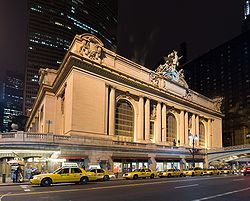 |
| Grand Central Terminal, New York |
Numerous short lines were built, especially in the south, to provide connections to the river system. From 1829-1830, the Tuscumbia, Courtland and Decatur Railroad, the first railroad constructed west of the Appalachian Mountains, was built connecting the two Alabama cities of Decatur and Tuscumbia. The Pontchartrain Rail-Road, a 5-mile (8.0 km) route connecting the Mississippi River with Lake Pontchartrain at New Orleans, Louisiana was completed in 1831, starting over a century of operation.
Soon, other roads that would themselves be purchased or merged into larger entities, formed. The Camden and Amboy Railroad (C&A), the first railroad built in New Jersey, completed its route between its namesake cities in 1834. The C&A eventually became part of the Pennsylvania Railroad.
1851–1900
Transcontinental Railroad


The First Transcontinental Railroad in the United States was built across North America in the 1860s, linking the railroad network of the eastern U.S. with California on the Pacific coast. Finished on May 10, 1869 at the famous Golden spike event at Promontory Summit, Utah, it created a nationwide mechanized transportation network that revolutionized the population and economy of the American West, catalyzing the transition from the wagon trains of previous decades to a modern transportation system. Although an accomplishment, it achieved the status of first transcontinental railroad by connecting myriad eastern US railroads to the Pacific and was not the largest single railroad system in the world. The Canadian Grand Trunk Railway (GTR) had, by 1867, already accumulated more than 2,055 kilometres (1,277 mi) of track by connecting Portland, Maine, and the three northern New England states with the Canadian Atlantic provinces west as far as Port Huron, Michigan, through Sarnia, Ontario.
Celebration of the meeting of the railroad in Promontory Summit, Utah, in 1869.
Authorized by the Pacific Railway Act of 1862 and heavily backed by the federal government, it was the culmination of a decades-long movement to build such a line and was one of the crowning achievements of the presidency of Abraham Lincoln, completed four years after his death. The building of the railroad required enormous feats of engineering and labor in the crossing of plains and high mountains by the Union Pacific Railroad and Central Pacific Railroad, the two federally chartered enterprises that built the line westward and eastward respectively. The building of the railroad was motivated in part to bind the Union together during the strife of the American Civil War. It substantially accelerated the populating of the West by white homesteaders, led to rapid cultivation of new farm lands. The Central Pacific and the Southern Pacific Railroad combined operations in 1870 and formally merged in 1885; the Union Pacific originally bought the Southern Pacific in 1901 and was forced to divest it in 1913, but finally took it over for good in 1996.
Much of the original right-of-way is still in use today and owned by the modern Union Pacific Railroad, which is descended from both of the original railroads.
Rail gauge selection
Many Canadian and United States railroads originally used various broad gauges, but most were converted to 4 ft 8 1⁄2 in (1,435 mm) by 1886, when the conversion of much of the southern rail network from 5 ft (1,524 mm) gauge took place, see Broad gauge#United States. This and the standardization of couplings and air brakes enabled the pooling and interchange of locomotives and rolling stock. See Rail gauge in North America.
Impact of railroads on the economy
The railroad had its largest impact on the American transportation system during the second half of the 19th century. The conventional historical view has been that the railroads were indispensable to the development of a national market in the United States in the late 19th century. American economic historian Robert Fogel, however, disagrees, arguing that without the railroad, America's gross national product (GNP) would have been 7.2% less in 1890. While this is the largest contribution to GNP growth made by any single innovation before 1900, this percentage only represents 2–3 years of GNP growth, which is relatively small. Fogel concluded that the railroads were important but not essential to late 19th century growth in the US. The railway would remain the dominant form of transportation until the invention and production of the automobile.
Fogel's specific hypothesis is that the primary effect of the invention of the railroad was the resulting social savings from converting from a system based in water and wagon transport to one which used railroads. Switching to railroads served as a means of reducing not only the cost but also the time of transportation, which had important subsequent opportunity cost implications as well. Fogel calculated railroads produced increased social savings of about 1.2% of the total gross domestic product (GDP), noting the unique efficiency of the railroad lies in that it can be operated in any weather condition throughout the year. Specifically, one industry in which savings were significantly large was the shipping of agricultural commodities inter-regionally. Fogel calculates that the absence of the railroad would have "doubled the cost of shipping agricultural commodities inter-regionally."
Much of the actual capital came from Europe—especially Britain and also Dutch and German banks, which purchased large blocks of shares. The Northern Pacific for example, originally financed by Jay Cooke (his bank failed after the Panic of 1873), might not have survived some of its many setbacks without the help of Deutsche Bank. DB held $20 million in NP bonds in 1883, and it was on the road's board until World War I.

Railroad mileage increase by groups of states
Source: Chauncey Depew (ed.), One Hundred Years of American Commerce 1795-1895 p 111
1850 1860 1870 1880 1890
New England 2,507 3,660 4,494 5,982 6,831
Middle States 3,202 6,705 10,964 15,872 21,536
Southern States 2,036 8,838 11,192 14,778 29,209
Western States and Territories 1,276 11,400 24,587 52,589 62,394
Pacific States and Territories 23 1,677 4,080 9,804
Totals 9,021 30,626 52,914 93,301 129,774
Monopolies, anti-trust law, and regulation
Industrialists such as Cornelius Vanderbilt and Jay Gould became wealthy through railroad ownerships, as large railroad companies such as the New York Central, Grand Trunk Railway and the Southern Pacific spanned several states. In response to monopolistic practices (such as price fixing) and other excesses of some railroads and their owners, Congress created the Interstate Commerce Commission (ICC) in 1887. The ICC indirectly controlled the business activities of the railroads through issuance of extensive regulations. Congress also enacted antitrust legislation to prevent railroad monopolies, beginning with the Sherman Antitrust Act in 1890.
1901–1970
Passenger, Freight and Interurbans
The principal mainline railroads concentrated their efforts on moving freight and passengers over long distances. Unlike railroads in Europe and elsewhere they left suburban traffic to Streetcar and Interurban lines. The Interurban was an almost uniquely North American concept which relied almost exclusively on passenger traffic for revenue. Unable to survive the Great Depression the failure of Interurbans left most US conurbations without surbuban passenger railroads. The major railroads passenger flagship services were usually multi day journeys on luxery trains resembling hotels - which could not compete with airlines in the 1950s. Rural communities were served by slow trains no more than twice a day. They survived until the 1960s because the same train hauled the Railway Post Office cars paid for by the U.S Post Office. RPOs were withdrawn when mail sorting was mechanised.


An Atchison, Topeka and Santa Fe Railway freight train pauses at Cajon, California, in March 1943 to cool its braking equipment after descending Cajon Pass. U.S. Route 66 (a section that is now part of Interstate 15) is visible to the right of the train.
As early as the 1930s, automobile travel had begun to cut into the rail passenger market, somewhat reducing economies of scale, but it was the development of the Interstate Highway System and of commercial aviation in the 1950s and 1960s, as well as increasingly restrictive regulation, that dealt the most damaging blows to rail transportation, both passenger and freight (some also cite the Great American Streetcar Scandal). There was little point in operating passenger trains to advertise freight service when those who made decisions about freight shipping traveled by car and by air, and when the railroads' chief competitors for that market were interstate trucking companies. Soon, the only things keeping most passenger trains running were legal obligations. Meanwhile, companies who were interested in using railroads for profitable freight traffic were looking for ways to get out of those legal obligations, and it looked like intercity passenger rail service would soon become extinct in the United States beyond a few highly-populated corridors. The final blow for passenger trains in the U.S. came with the loss of railroad post offices in the 1960s. On May 1, 1971, the federally-funded Amtrak took over (with a few exceptions) all intercity passenger rail service in the continental United States. The Rio Grande, with its Denver-Ogden Rio Grande Zephyr and the Southern with its Washington, DC-New Orleans Southern Crescent chose to stay out of Amtrak, and the Rock Island, with two intrastate Illinois trains, was too far gone to be included into Amtrak.
Economic decline
Freight transportation continued to labor under regulations developed when rail transport had a monopoly on intercity traffic, and railroads only competed with one another. An entire generation of rail managers had been trained to operate under this regulatory regime. Labor unions and their work rules were likewise a formidable barrier to change. Overregulation, management and unions formed an "iron triangle" of stagnation, frustrating the efforts of leaders such as the New York Central's Alfred E. Perlman. In particular, the dense rail network in the Northeastern U.S. was in need of radical pruning and consolidation. A spectacularly unsuccessful beginning was the 1968 formation and subsequent bankruptcy of the Penn Central, barely two years later.
1970–present


Amtrak
Historically, on routes where a single railroad has had an undisputed monopoly, passenger service was as spartan and as expensive as the market and ICC regulation would bear, since such railroads had no need to advertise their freight services. However, on routes where two or three railroads were in direct competition with each other for freight business, such railroads would spare no expense to make their passenger trains as fast, luxurious, and affordable as possible, as it was considered to be the most effective way of advertising their profitable freight services.
The National Association of Railroad Passengers (NARP) was formed in 1967 to lobby for the continuation of passenger trains. Its lobbying efforts were hampered somewhat by Democratic opposition to any sort of subsidies to the privately owned railroads, and Republican opposition to nationalization of the railroad industry. The proponents were aided by the fact that few in the federal government wanted to be held responsible for the seemingly inevitable extinction of the passenger train, which most regarded as tantamount to political suicide. The urgent need to solve the passenger train disaster was heightened by the bankruptcy filing of the Penn Central, the dominant railroad in the Northeast U.S., on June 21, 1970.
Under the Rail Passenger Service Act of 1970, Congress created the National Railroad Passenger Corporation (NRPC) to subsidize and oversee the operation of intercity passenger trains. The Act provided that
Any railroad operating intercity passenger service could contract with the NRPC, thereby joining the national system.
Participating railroads bought into the new corporation using a formula based on their recent intercity passenger losses. The purchase price could be satisfied either by cash or rolling stock; in exchange, the railroads received Amtrak common stock.
Any participating railroad was freed of the obligation to operate intercity passenger service after May 1971, except for those services chosen by the Department of Transportation as part of a "basic system" of service and paid for by NRPC using its federal funds.
Railroads who chose not to join the Amtrak system were required to continue operating their existing passenger service until 1975 and thenceforth had to pursue the customary ICC approval process for any discontinuance or alteration to the service.
The original working brand name for NRPC was Railpax, which eventually became Amtrak. At the time, many Washington insiders viewed the corporation as a face-saving way to give passenger trains the one "last hurrah" demanded by the public, but expected that the NRPC would quietly disappear in a few years as public interest waned. However, while Amtrak's political and financial support have often been shaky, popular and political support for Amtrak has allowed it to survive into the 21st century.
Similarly, to preserve a declining freight rail industry, Congress passed the Regional Rail Reorganization Act of 1973 (sometimes called the "3R Act"). The act was an attempt to salvage viable freight operations from the bankrupt Penn Central and other lines in the northeast, mid-Atlantic and midwestern regions. The law created the Consolidated Rail Corporation (ConRail), a government-owned corporation, which began operations in 1976. Another law, the Railroad Revitalization and Regulatory Reform Act of 1976 (the "4R Act"), provided more specifics for the Conrail acquisitions and set the stage for more comprehensive deregulation of the railroad industry.Portions of the Penn Central, Erie Lackawanna, Reading Railroad, Ann Arbor Railroad, Central Railroad of New Jersey, Lehigh Valley, and Lehigh and Hudson River were merged into Conrail.
The freight industry continued its decline until Congress passed the Staggers Rail Act in 1980, which largely deregulated the rail industry. Since then, U.S. freight railroads have reorganized, discontinued their lightly-used routes and returned to profitability.
:245-252
Freight railroads in today's economy
Freight railroads still play an important role in the United States' economy. In terms of ton-miles, railroads annually move more than 25% of the United States’ freight and connect businesses with each other across the country and with markets overseas. They also directly contribute tens of billions of dollars each year to the economy through wages, purchases, retirement benefits, and taxes.
Types of rail
There are four different types of freight railroads: Class I, regional, local line haul, and switching & terminal. Class I railroads are defined as those with revenue of at least $346.8 million in 2006. They comprise just one percent of freight railroads, but account for 67 percent of the industry’s mileage, 90 percent of its employees, and 93 percent of its freight revenue.
A regional railroad is a line haul railroad with at least 350 miles (560 km) and/or revenue between $40 million and the Class I threshold. There were 33 regional railroads in 2006. Most have between 75 and 500 employees.
Local line haul railroads operate less than 350 miles and earn less than $40 million per year (most earn less than $5 million per year). In 2006, there were 323 local line haul railroads. They generally perform point-to-point service over short distances.
Switching and terminal (S&T) carriers are railroads that primarily provide switching and/or terminal services, regardless of revenue. They perform pick up and delivery services within a certain area.
Traffic and public benefits
U.S. freight railroads operate in a highly-competitive marketplace. To compete effectively against each other and against other transportation providers, railroads must offer high-quality service at competitive rates. Railroads account for just over 40 percent of freight ton-miles, more than any other mode of transportation. However, railroads’ revenue share has been falling for decades, a reflection of the intensity of the competition they face and of the large rate reductions railroads have passed through to their customers over the years.
Railroads carry a wide variety of commodities, coal being the most single important commodity. In 2006, coal accounted for 21 percent of rail revenue. Coal accounts around half of U.S. electricity generation. Other major commodities carried include chemicals, grain, non-metallic minerals, lumber, cars, and waste materials.
The fastest growing rail traffic segment is currently intermodal. Intermodal is the movement of shipping containers or truck trailers by rail and at least one other mode of transportation, usually trucks or ocean-going vessels. Intermodal combines the door-to-door convenience of trucks with the long-haul economy of railroads. Rail intermodal has tripled in the last 25 years. It plays a critical role in making logistics far more efficient for retailers and others. The efficiency of intermodal provides the U.S. with a huge competitive advantage in the global economy.
Freight railroads offer major public benefits in addition to cost-competitiveness and efficiency. First, railroads are more fuel efficient than other modes of transportation. On average, they are three times more fuel efficient than trucks. In 2006, railroads moved a ton of freight an average of 436 miles per gallon of fuel. That number is an 80 percent increase from 1980. Because of their fuel efficiency, railroads also have a clear advantage over other modes of transportation in terms of greenhouse gas emissions, most notably carbon dioxide.
Highway congestion costs $78 billion per year just in wasted travel time (4.2 billion hours) and wasted fuel (2.9 billion gallons). Railroads may change traffic congestion by replacing some trucks currently transporting goods on our highways.
Freight rail working with passenger rail
Prior to Amtrak’s creation in 1970, intercity passenger rail service in the U.S. was provided by the same companies that provided freight service. When Amtrak was formed, in return for government permission to exit the passenger rail business, freight railroads donated passenger equipment to Amtrak and helped it get started with a capital infusion of some $200 million.
The vast majority of the 22,000 or so miles over which Amtrak operates are actually owned by freight railroads. By law, freight railroads must grant Amtrak access to their track upon request. Amtrak pays fees to freight railroads to cover the incremental costs of Amtrak’s use of freight railroad tracks.
Passenger rail
Car types
The basic design of a passenger car was standardized by 1870. By 1900 the main car types were: baggage, coach, combine, diner, dome car, lounge, observation, private, Pullman, railroad post office (RPO) and sleeper.
19th century: First passenger cars and early development
 |
| The interior of a Pullman car on the Chicago and Alton Railroad, circa 1900. |
Passenger car (rail)
The first passenger cars in the resembled stagecoaches. They were short, often less than 10 ft (3.05 m) long, tall and rode on a single pair of axles.
American mail cars first appeared in the 1860s and at first followed English design. They had a hook that would catch the mailbag in its crook.
As locomotive technology progressed in the mid-19th century, trains grew in length and weight. Passenger cars grew along with them, first getting longer with the addition of a second truck (one at each end), and wider as their suspensions improved. Cars built for European use featured side door compartments, while American car design favored a single pair of doors at one end of the car in the car's vestibule; compartmentized cars on American railroads featured a long hallway with doors from the hall to the compartments.
One possible reason for this difference in design principles between American and European carbuilding practice could be the average distance between stations on the two continents. As most European railroads connected towns and villages that were still very closely spaced, American railroads had to travel over much greater distances to reach their destinations. Building passenger cars with a long passageway through the length of the car allowed the passengers easy access to the restroom, among other things, on longer journeys.
Dining cars first appeared in the late 1870s and into the 1880s. Until this time, the common practice was to stop for meals at restaurants along the way (which led to the rise of Fred Harvey's chain of Harvey House restaurants in America). At first, the dining car was simply a place to serve meals that were picked up en route, but they soon evolved to include galleys in which the meals were prepared.
1900–1950: Lighter materials, new car types
 |
| The observation car on CB&Q's Pioneer Zephyr. The carbody was made of stainless steel in 1934, it is seen here at the Museum of Science and Industry in Chicago in 2003. |
By the 1920s, passenger cars on the larger standard gauge railroads were normally between 60 and 70 feet (18 and 21 m) long. The cars of this time were still quite ornate, many of them being built by experienced coach makers and skilled carpenters.
With the 1930s came the widespread use of stainless steel for carbodies. The typical passenger car was now much lighter than its "heavyweight" wood cousins of old. The new "lightweight" and streamlined cars carried passengers in speed and comfort to an extent that had not been experienced to date. Aluminum and Cor-ten were also used in lightweight car construction, but stainless steel was the preferred material for car bodies. It is not the lightest of materials, nor is it the least expensive, but stainless steel cars could be, and often were, left unpainted except for the car's reporting marks that were required by law.
By the end of the 1930s, railroads and carbuilders were debuting carbody and interior styles that could only be dreamed of before. In 1937, the Pullman Company delivered the first cars equipped with roomettes—that is, the car's interior was sectioned off into compartments, much like the coaches that were still in widespread use across Europe. Pullman's roomettes, however, were designed with the single traveler in mind. The roomette featured a large picture window, a privacy door, a single fold-away bed, a sink and small toilet. The roomette's floor space was barely larger than the space taken up by the bed, but it allowed the traveler to ride in luxury compared to the multilevel semiprivate berths of old.
Now that passenger cars were lighter, they were able to carry heavier loads, but the size of the average passenger that rode in them didn't increase to match the cars' new capacities. The average passenger car couldn't get any wider or longer due to side clearances along the railroad lines, but they generally could get taller because they were still shorter than many freight cars and locomotives. As a result, the railroads soon began building and buying dome and bilevel cars to carry more passengers.
1950–present: High-technology advancements
 |
| A Bombardier BiLevel Coach. Shown here is a Tri-Rail coach, a regional commuter rail system in Florida. Similar cars are used in California by Metrolink. |
Carbody styles have generally remained consistent since the middle of the 20th century. While new car types have not made much of an impact, the existing car types have been further enhanced with new technology.
Starting in the 1950s, the passenger travel market declined in North America, though there was growth in commuter rail. The higher clearances in North America enabled bi-level commuter coaches that could hold more passengers. These cars started to become common in the United States in the 1960s.
While intercity passenger rail travel declined in America, ridership continued to increase in other parts of the world. With the increase came an increased use of newer technology on existing and new equipment. The Spanish company Talgo began experimenting in the 1940s with technology that would enable the axles to steer into a curve, allowing the train to move around the curve at a higher speed. The steering axles evolved into mechanisms that would also tilt the passenger car as it entered a curve to counter the centrifugal force experienced by the train, further increasing speeds on existing track. Today, Talgo trains are used in many places in Europe and they have also found a home in North America on some short and medium distance routes such as Seattle, Washington, to Vancouver, British Columbia.
U.S. high-speed rail
 |
| This map from 2001 shows a number of proposed high-speed routes in the U.S. |
High-speed rail in the United States
High-speed rail in the United States is extremely limited. Although the United States has large areas with population densities comparable to Western Europe and East Asia, there exists only one high-speed rail line. Moreover, this line is considerably slower than high-speed rail lines provided in most other developed societies. High-speed rail began in 1969 with the introduction of the Metroliner. Services initially ran at 125 mph (200 km/h), with speeds later increasing to 135 mph (220 km/h).[citation needed] In 2000 Amtrak introduced the Acela Express, which operates at a maximum speed of 160 mph (260 km/h) between Washington, D.C. and Boston. These trains tilt into curves along the track, allowing them to travel between Washington and New York in 2 hours and 45 minutes. This time—an average speed of only 83 mph (130 km/h)—is heavily influenced by the need to travel through and around Baltimore on tracks which are in some places over 160 years old. Ambitious long-term plans by the Maryland DOT to create a new express route through Baltimore for Acela and MARC commuter trains would significantly reduce this travel time.
Rolling stock reporting marks
Every piece of railroad rolling stock operating in North American interchange service is required to carry a standardized set of reporting marks. The marks are made up of a two- to four-letter code identifying the owner of the equipment accompanied by an identification number and statistics on the equipment's capacity and tare (unloaded) weight. Marks whose codes end in X (such as TTGX) are used on equipment owned by entities that are not common carrier railroads themselves. Marks whose codes end in U are used on containers that are carried in intermodal transport, and marks whose codes end in Z are used on trailers that are carried in intermodal transport.
Typically, railroads operating in the United States reserve one- to four-digit identification numbers for powered equipment such as diesel locomotives and six-digit identification numbers for unpowered equipment. There is no hard and fast rule for how equipment is numbered; each railroad maintains its own numbering policy for its equipment.
Equipment specific to the United States
The types of equipment seen in trains on American railroads are not substantially different from the types seen around the world. The AAR (Janney) coupler has been standard on North American equipment for over a century, though some car types use particular variants for operational or safety reasons. Two axle cars remain the rare exception.
 |
| Acela Express at Union Station (Washington, D.C.) |
It is possible to trace the development of long-distance rail transport back to the streamliners that criss-crossed the United States in the 1930s, 1940s, and 1950s which, in turn, can be traced further back to the competing companies operating different routes between London and Scotland, and to railways in Germany and France. However, several factors contributed to the stagnation of rail passenger transport in the United States, a decline which occurred just as Europe and Japan were pushing forward with new technologies. Little investment has been made in high-speed rail infrastructure. In the Northeast Corridor, rail travel is time and price competitive with air travel, but other routes travel at highway speeds, putting rail in direct competition with buses and private automobiles. Long-distance travel is currently dominated by airlines, but given continued population growth and congestion at airports and on highways, there has been a resurgence of interest in high-speed rail in the United States in recent decades. Several corridors are being examined for potential high-speed service, either at the federal or state level.
(source:wikipedia)


