
| Newark Liberty International Airport | |||
|---|---|---|---|
 | |||
 | |||
| IATA: EWR – ICAO: KEWR – FAA LID: EWR – WMO: 72502 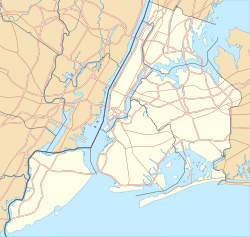  EWR | |||
| Summary | |||
| Airport type | Public | ||
| Owner | City of Newark | ||
| Operator | Port Authority of New York and New Jersey | ||
| Serves | New York metropolitan area | ||
| Location | Newark, New Jersey and Elizabeth, New Jersey | ||
| Hub for |
| ||
| Elevation AMSL | 18 ft / 5 m | ||
| Coordinates | 40°41′33″N 074°10′07″W | ||
| Website | |||
| Runways | |||
| Direction | Length | Surface | |
| ft | m | ||
| 4L/22R | 11,000 | 3,353 | Asphalt/Concrete |
| 4R/22L | 10,000 | 3,048 | Asphalt |
| 11/29 | 6,800 | 2,073 | Asphalt |
| Helipads | |||
| Number | Length | Surface | |
| ft | m | ||
| H1 | 40 | 12 | Concrete |
| Source: Federal Aviation Administration | |||


Newark Liberty International Airport (IATA: EWR, ICAO: KEWR, FAA LID: EWR), first named Newark Airport and later Newark International Airport, is an international airport within the city limits of both Newark and Elizabeth, New Jersey, United States (although it is entirely owned by the city of Newark). It is about 15 miles (24 km) southwest of Midtown Manhattan (New York City).
The airport is operated by the Port Authority of New York and New Jersey, which also manages the two other major airports in the New York/New Jersey metropolitan area, John F. Kennedy International Airport (JFK) and LaGuardia Airport (LGA), in addition to three smaller airports, Stewart International Airport, Teterboro Airport and the Downtown Manhattan Heliport. Newark is the tenth busiest airport in the United States and the nation's fifth busiest international air gateway; JFK ranks first.
Newark Liberty is the second-largest hub, after George Bush Intercontinental Airport in Houston, for Continental Airlines, which is the airport's largest tenant (operating all of Terminal C and part of Terminal A). Primarily due to this large hub operation, Continental Airlines is by far the leading carrier in the New York market. Once the merger between Continental and United Airlines is complete, Newark will be the third largest hub for United Airlines. Newark's second largest tenant is FedEx Express, which operates its third largest cargo hub from the airport. FedEx operates from three buildings on two million square feet within the airport complex.
In 2008, Newark Airport handled slightly more than 35.4 million passengers,compared with JFK's 47.8 million and LaGuardia's 23.1 million. In total over 107 million passengers used New York-area airports in 2008, making the New York-area the busiest airport system in the United States in terms of passenger numbers and second in the world behind London.
History
 |
| Major airports in the New York Metropolitan Area: John F. Kennedy (1),LaGuardia (2) and Newark Liberty (3). |
Newark Airport was the first major airport in the New York area: it opened on October 1, 1928, occupying an area of New Jersey marshland filled with dredged soil.
In 1935, Amelia Earhart dedicated the Newark Airport Administration Building, which was North America's first commercial airline terminal. Newark was the busiest airport in the world until LaGuardia Airport opened in 1939, dividing New York's air traffic and allowing Chicago Midway International Airport to take the lead in some years thereafter. Newark was temporarily closed to passenger traffic and taken over by the United States Army for logistics operations during World War II. In 1945, captured German aircraft brought from Europe on the HMS Reaper for evaluation under Operation Lusty, were off-loaded at Newark AAF and then either flown or shipped to Freeman Field, Indiana or Naval Air Station Patuxent River, Maryland.
Airline traffic resumed after the war; in 1948 the Port Authority of New York and New Jersey took over the airport, later making major investments in new hangars, a new terminal and runway 4/22. The art deco Administration Building served as the main terminal until the opening of the North Terminal in 1953, and was added to the National Register of Historic Places in 1979.
In the 1950s, there were suggestions to move the airport after two crashes within a month occurred at nearby Elizabeth, New Jersey. A new international airport to serve the New York City area would have been built in what is now the Great Swamp National Wildlife Refuge, however local protests defeated the plan. The April 1957 Official Airline Guide showed 144 weekday passenger fixed-wing departures from Newark: 40 Eastern, 19 Capital, 16 American, 14 United, 14 Mohawk, 13 Allegheny, 11 TWA, 8 National, 5 Delta and 4 Braniff. National had a nonstop to Miami, Eastern had nonstops to Miami, New Orleans and Houston, Braniff had a nonstop DC-7C to Dallas and TWA flew nonstop to St Louis; no other nonstops to points west of Chicago, and no international nonstops. Jet airliners arrived in 1961; a few years later major airlines were flying nonstop to California, though Newark's longest runway remained 7,000 ft (2,100 m) until about 1970.
In the 1970s the airport underwent a significant enlargement, including the construction of the current Terminals A, B, and C, and was renamed Newark International Airport. Terminals A and B opened in 1973, although some charter and international flights requiring customs clearance remained at the North Terminal. The main building of Terminal C was completed at the same time, but only metal framing work was done on the terminal's satellites, and it lay dormant until the mid-1980s, when for a brief time the west third of the terminal was equipped for international arrivals and used for certain People Express transcontinental flights. Terminal C was fully completed and opened to the public in June 1988.
Underutilized throughout the 1970s, Newark expanded dramatically in the 1980s. People Express struck a deal with the Port Authority to use the North Terminal as both its air terminal and corporate office in 1981 and began operations at Newark that year. It quickly rose to become one of the largest American airlines, steadily increasing Newark's traffic through most of the 1980s. Virgin Atlantic Airways began flights from Newark to London in 1984, challenging JFK's status as New York's international gateway (however, Virgin Atlantic now has more flights going out of JFK than out of Newark). Federal Express (Now known as FedEx Express) opened its second hub at the airport in 1986. When People Express was merged into Continental in 1987, operations at the North Terminal were greatly reduced, and the building was demolished to make way for cargo facilities in the early 1990s. Newark has remained a hub for Continental.
Today, Continental has its Global Gateway at Terminal C, having completed a major expansion project that included the construction of a new, third concourse and a new Federal Inspection Services facility. With its Newark hub, Continental is the largest provider of air service to the New York metropolitan area.
 |
| A flag flies over Gate A17,. |
United Airlines Flight 93 pushed back from gate A17 at 8:01 am, on its way from Newark to San Francisco International Airport, on September 11, 2001. Two hours later it would crash into a field in Shanksville, Pennsylvania, when passengers attempted to take over the plane from a team of hijackers. Based on the direction that the plane was flying at the time and information gathered afterwards, most observers believe that the hijackers intended to crash the plane into a target in Washington, D.C., such as the Capitol or White House. To honor the victims that died on September 11, in 2002 the airport's name was changed from Newark International Airport to Newark Liberty International Airport. This name was chosen over the initial proposal, Liberty International Airport at Newark, and refers to the landmark Statue of Liberty, just 7 miles (11 km) east of the airport.
Further information: September 11, 2001 attacks
In 2001, Newark Liberty International Airport became the terminus of the world's longest non-stop scheduled airline route, Continental's service to Hong Kong. Continental began flying from Newark to Beijing on June 15, 2005 and Delhi on November 1, 2005. When these services began, Continental became for a time the only airline to serve India nonstop from the United States, and the third U.S. carrier, after United and Northwest to serve mainland China nonstop and the first U.S. carrier to offer nonstop flights to Beijing from New York. On July 16, 2007, Continental Airlines announced that it would seek government approval for nonstop flights between Newark and Shanghai in 2009. In September 2007, the United States Department of Transportation tentatively awarded Continental the right to fly to Shanghai from Newark beginning March 25, 2009 using Boeing 777-200ER aircraft.
Since June 2008 flight caps restricting the number of flights to 81 per hour have been in use. The flight caps, which were only in effect until 2009, are intended to be a short-term solution to Newark Airport's congestion problem.
Facilities
Newark Liberty International Airport covers 2,027 acres (820 ha) and has three runways and one helipad:
Runway 4L/22R: 11,000 x 150 ft (3,353 x 46 m), Surface: Asphalt/Concrete
Runway 4R/22L: 10,000 x 150 ft (3,048 x 46 m), Surface: Asphalt
Runway 11/29: 6,800 x 150 ft (2,073 x 46 m), Surface: Asphalt
Helipad H1: 40 x 40 ft (12 x 12 m), Surface: Concrete
Runway 11/29 is part of the original paved runway system developed in the 1940s. In 1952, original Runways 1/19 and 6/24 were closed in response to concerns about obstructions and noise, and a modern Runway 4/22 (now 4R/22L) was commissioned at a length of 7,000 ft (2,100 m) This runway was later extended to 9,800 feet (3,000 m), shortened for a while to 9,300 ft (2,800 m) and finally brought to its present length by 2000. Runway 4L/22R was built in the early 1970s at a length of 8,200 ft (2,500 m) and was extended to its current dimensions by 2000.
All approaches except Runway 29 are equipped with Instrument Landing Systems, and Runway 4R is certified for Category III ILS approaches.
Most departing traffic use Runway 4L/22R, while most arriving traffic use 4R/22L, and 11/29 is used more often by smaller aircraft or when there are strong crosswinds on the two main runways. Newark's two parallel runways (4L and 4R) have a lateral separation of only 900 feet (270 m), which is the fourth smallest of major airports in the U.S., after SFO, LAX and SEA. (Calculated from the lat-lons at the parallel runways are 950 ft (290 m) apart.)
Terminals


Newark Liberty International Airport has three passenger terminals. Terminal A and Terminal B were completed in 1973 and have four levels. Ticket counters are on the top floor, except for the second-floor Air India and first-floor British Airways desks. Gates and shops are on the third floor. An international arrivals lounge (Terminal B) and baggage carousels (both A and B) are on the second floor. Finally, short-term parking and ramp operations (restricted areas) are on the ground floor. Terminal C, completed in 1988, has two ticketing levels, one for international check-in and one for domestic check-in. At the time of its opening, it was considered to be the most modern airport terminal in the United States. The gates, as well as food and shopping outlets, are located on a mezzanine level between the two check-in floors. From 1998 to 2003, Terminal C was renovated. The baggage claim area was renovated and turned into a second departure level, a 19-gate third concourse was added, an international arrivals facility was added, and a 3,400-space parking garage and new baggage processing facilities were added, including turning the former underground parking area into a new baggage claim. Parking had been prohibited underneath the terminal as a security measure after the first attack on the World Trade Center in 1993.
As of 2008, Terminal B is being renovated to increase capacity for departing passengers and passenger comfort. The renovations include expanding and updating the ticketing areas, building a new departure level for domestic flights, and building a new arrivals hall. Plans are also in place to expand Terminal A by adding a new parking garage and radically expanding the size of the first concourse to add new gates, ticketing, baggage and security areas.
Each terminal is subdivided into three numbered concourses: Terminal A, for instance, is divided into concourses A1, A2, and A3. Gate numbering is continuous through all the terminals. Wayfinding signage throughout the terminals was designed by Paul Mijksenaar.
Terminal A is the only terminal at Newark not fitted with immigration facilities: flights arriving from other countries cannot use Terminal A (except countries with US customs preclearance), although some departing international flights use the terminal.
Following the business model of the Port Authority's other facilities, in some cases entire terminals are operated by terminal operators and not by the Port Authority directly. At Newark Liberty, Terminal A is operated by United Airlines and Terminal C is operated by Continental Airlines. Terminal B is the only passenger terminal directly operated by the Authority.
When Continental's merger with United is complete, Newark will become a major northeast hub for the combined carrier. Newark will become the third largest hub for United Airlines; behind Houston's George Bush Intercontinental Airport and Chicago's O'Hare International Airport.
Airlines and destinations
Airlines Destinations Terminal
Air Canada Calgary, Toronto-Pearson, Vancouver A
Air Canada Jazz Montréal-Trudeau, Toronto-Pearson A
Air France Paris-Charles de Gaulle B
Air India Mumbai B
Alaska Airlines Seattle/Tacoma B
Alitalia Rome-Fiumicino B
American Airlines Chicago-O'Hare, Dallas/Fort Worth, Los Angeles, Miami A
American Eagle Chicago-O'Hare A
British Airways London-Heathrow B
Continental Airlines Aguadilla, Amsterdam, Anchorage, Antigua, Aruba, Athens, Atlanta, Austin, Barcelona, Beijing-Capital, Belfast-International, Berlin-Tegel, Bermuda, Birmingham (UK), Bogotá, Boston, Brussels, Cairo [begins May 18], Cancún, Caracas, Charlotte, Chicago-O'Hare, Cleveland, Copenhagen, Curaçao, Dallas/Fort Worth, Delhi, Denver, Dublin, Edinburgh, Fort Lauderdale, Fort Myers, Frankfurt, Geneva, Glasgow-International, Guatemala City, Hamburg, Hong Kong, Honolulu, Houston-Intercontinental, Jacksonville (FL), Las Vegas, Lima, Lisbon, London-Heathrow, Los Angeles, Madrid, Manchester (UK), Mexico City, Miami, Milan-Malpensa, Montego Bay, Mumbai, Munich, Nassau, New Orleans, Orange County, Orlando, Oslo-Gardermoen, Panama City, Paris-Charles de Gaulle, Phoenix, Port of Spain, Providenciales [begins February 18], Portland (OR), Puerto Plata, Puerto Vallarta, Punta Cana, Raleigh/Durham, Rome-Fiumicino, St. Maarten, St. Thomas, San Antonio, San Diego, San Francisco, San José de Costa Rica, San José del Cabo, San Juan, San Pedro Sula, San Salvador, Santo Domingo, São Paulo-Guarulhos, Seattle/Tacoma, Shanghai-Pudong, Shannon, Stockholm-Arlanda, Tampa, Tel Aviv, Tokyo-Narita, West Palm Beach, Zürich
Seasonal: Acapulco, Belize City, Bonaire, Cozumel, Eagle/Vail, Grand Cayman, Hayden/Steamboat Springs, Liberia (Costa Rica), Montrose, Myrtle Beach, Roatán, Vancouver C
Continental Connection operated by Colgan Air Albany, Boston, Buffalo, Burlington (VT), Columbus (OH), Greensboro(NC), Halifax, Montréal-Trudeau, Norfolk, Ottawa, Pittsburgh, Portland (ME), Providence, Raleigh/Durham, Rochester (NY), Toronto-Pearson, Washington-Reagan
Seasonal: Myrtle Beach C
Continental Connection operated by CommutAir Albany, Harrisburg, Hartford, Ithaca, Philadelphia, Syracuse, Washington-Dulles, Wilkes-Barre/Scranton
Seasonal: Mont-Tremblant, Nantucket C
Continental Express operated by ExpressJet Airlines Albany, Asheville, Atlanta, Baltimore, Boston, Buffalo, Burlington (VT), Charleston (SC), Charlotte, Chicago-O'Hare, Cincinnati/Northern Kentucky, Columbus (OH), Dayton, Des Moines [Begins May 3], Detroit, Fayetteville (AR), Grand Rapids, Green Bay, Greensboro, Greenville/Spartanburg, Halifax, Indianapolis, Jacksonville, Kansas City, Knoxville, Little Rock, Louisville, Madison, Manchester (NH), Memphis, Milwaukee, Minneapolis/St. Paul, Moncton, Montréal-Trudeau, Nashville, Norfolk, Oklahoma City, Omaha, Ottawa, Pittsburgh, Providence, Québec City, Raleigh/Durham, Richmond, Rochester (NY), St. John's, St. Louis, Savannah, Syracuse, Toronto-Pearson, Tulsa, Washington-Dulles, Washington-Reagan A, C
Delta Air Lines Amsterdam, Atlanta, Detroit, Minneapolis/St. Paul, Salt Lake City B
Delta Connection operated by Atlantic Southeast Airlines Cincinnati/Northern Kentucky, Detroit, Memphis B
Delta Connection operated by Comair Cincinnati/Northern Kentucky, Detroit, Memphis B
Delta Connection operated by Compass Airlines Minneapolis/St. Paul B
Delta Connection operated by Mesaba Airlines Memphis B
Delta Connection operated by Pinnacle Airlines Detroit B
Direct Air operated by USA Jet Airlines Seasonal: Myrtle Beach B
El Al Tel Aviv B
EVA Air Taipei-Taoyuan B
Frontier Airlines operated by Chautauqua Airlines Milwaukee A
Iceland Express operated by Astraeus Reykjavik-Keflavik B
Jet Airways Brussels, Mumbai B
JetBlue Airways Boston [begins May 4], Fort Lauderdale, Fort Myers, Orlando, Tampa, West Palm Beach A
LOT Polish Airlines Warsaw
Seasonal: Kraków, Rzeszów B
Lufthansa Düsseldorf, Frankfurt, Munich B
OpenSkies Paris-Orly B
Porter Airlines Toronto-Billy Bishop B
Scandinavian Airlines Copenhagen, Oslo-Gardermoen [begins March 27], Stockholm-Arlanda B
Singapore Airlines Singapore B
Southwest Airlines Baltimore [begins June 5], Chicago-Midway [begins March 27], Denver [begins June 5], Houston-Hobby [begins June 5], Phoenix [begins June 5], St. Louis [begins March 27] A
Swiss International Air Lines operated by PrivatAir Zürich B
TAP Portugal Lisbon, Porto B
United Airlines Chicago-O'Hare, Denver, San Francisco A
United Express operated by GoJet Airlines Chicago-O'Hare [ends January 2], Washington-Dulles A
United Express operated by Shuttle America Atlanta [begins January 4], Charlotte [begins January 4], Columbus (OH) [begins January 4], Detroit [begins January 4], Indianapolis [begins January 4], Pittsburgh [begins January 4], Raleigh/Durham [begins January 4], St. Louis [begins January 4] A
United Express operated by Trans States Airlines Washington-Dulles A
US Airways Charlotte, Phoenix A
US Airways Express operated by Mesa Airlines Charlotte A
US Airways Express operated by Piedmont Airlines Philadelphia A
Virgin Atlantic Airways London-Heathrow B
WestJet Seasonal: Calgary A
Scheduled cargo airlines and destinations
Airlines Destinations
Astar Air Cargo Cincinnati/Northern Kentucky
Capital Cargo International Airlines Boston, Toledo
Cargojet Airways Bermuda
FedEx Express Anchorage, Boston, Burlington, Chicago-O'Hare, Cleveland, Cologne/Bonn, Columbus (OH), Detroit, Dubai, Hartford, Indianapolis, London-Stansted, Los Angeles, Memphis, Miami, Oakland, Paris-Charles de Gaulle, Pittsburgh, Raleigh/Durham, Syracuse, Tokyo-Narita, Toronto-Pearson, Washington-Dulles
FedEx Feeder operated by Mountain Air Cargo Washington-Dulles
FedEx Feeder operated by Wiggins Airways Albany, Boston, Harrisburg, Hartford, Manchester (NH), Plattsburg, Providence, Rochester
Kalitta Air Bahrain, Chicago-O'Hare, Liège
UPS Airlines Chicago-Rockford, Cologne/Bonn, Dallas/Fort Worth, Des Moines, Hartford, London-Stansted, Louisville, Tokyo-Narita
Traffic and statistics
In 2009, Newark Liberty International Airport handled 32,825,570 passengers.
Busiest International Routes from Newark (2008)
Rank City Passengers Top Carriers
1 London-Heathrow, United Kingdom 1,022,834 British Airways, Continental Airlines, Virgin Atlantic
2 Paris-Charles de Gaulle, France 607,822 Air France, Continental Airlines
3 Toronto, Ontario, Canada 528,248 Air Canada, Air Canada Jazz, Continental Airlines, Porter Airlines
4 Tel Aviv, Israel 480,949 Continental Airlines, El Al
5 Amsterdam, Netherlands 365,661 Continental Airlines, Delta Air Lines
6 Frankfurt, Germany 302,076 Continental Airlines, Lufthansa
7 Rome, Italy 268,516 Continental Airlines, Alitalia (Air One)
8 Stockholm, Sweden 263,750 Continental Airlines, Scandinavian Airlines System
9 Cancun, Mexico 256,963 Continental Airlines
10 Mumbai, India 250,977 Air India, Jet Airways, Continental Airlines
Busiest Domestic Routes from Newark (October 2009- September 2010)
Rank City Passengers Top Carriers
1 Orlando, Florida 673,000 JetBlue Airways, Continental Airlines
2 Chicago, Illinois 644,000 Continental Airlines, Continental Express, American Airlines, United Airlines
3 Houston, Texas 532,000 Continental Airlines
4 Atlanta, Georgia 507,000 AirTran Airways, Continental Airlines, Continental Express, Delta Air Lines
5 Fort Lauderdale, Florida 488,000 JetBlue Airways, Continental Airlines
6 Charlotte, North Carolina 478,000 Continental Airlines, Continental Connection, US Airways, US Airways Express
7 Los Angeles, California 398,000 American, Continental Airlines
8 San Francisco, California 387,000 Continental Airlines, United Airlines
9 Miami, Florida 383,000 American, Continental Airlines
10 Las Vegas, Nevada 361,000 Continental Airlines
Ground transportation
AirTrain


Newark is an intermodal airport. A monorail system, AirTrain Newark, connects the terminals with the Newark Liberty International Airport Rail Link Station for connection to Amtrak and New Jersey Transit service. Passengers can use this connection to travel from EWR to any station along New Jersey Transit's Northeast Corridor Line or North Jersey Coast Line, including regional transit hubs such as New York City's Penn Station.
Continental Airlines uses this rail connection to book passengers through Newark to 30th Street Station in Philadelphia, Pennsylvania; Wilmington Station in Wilmington, Delaware; Penn Station in New York City; Stamford Station in Stamford, Connecticut; and Union Station in New Haven, Connecticut.
The monorail is free for use between all stations, but passengers wishing to exit or enter the Rail Link station must pay a fee. NJ Transit tickets to or from the Rail Link station that are sold at ticket windows and vending machines automatically include this fee. Tickets purchased on a train will not allow passengers to enter the Rail Link station; they will have to pay the fee at the station.
Other connections
Numerous bus services run between Newark Liberty and nearby population centers, including New Jersey Transit, Airporter, and Olympia Trails. Express buses to Manhattan transit hubs (Grand Central Terminal, Port Authority Bus Terminal, etc.), and a bus service to JFK Airport are also available.
The airport is also served by a number of New Jersey Transit buses, providing local service from downtown Newark, including Newark Penn Station, Irvington, Lakewood and Toms River.
The New Jersey Turnpike has 2 exits that allow motorists to gain access to Newark Liberty International Airport.
Taxis also operate from the airport at flat rates based on destination. From the City of New York, fares are set by New York City's Taxi and Limousine Commission. Newark Liberty, along with destinations in Nassau and Westchester Counties, is one of the exceptions to the rule that a New York City taxi driver may refuse to take a passenger to any destination outside the five boroughs.
Continental Airlines also books passengers via Trans-Bridge Lines to Lehigh Valley International Airport in Allentown, Pennsylvania, a 90-minute trip.
There are also private limousine and car service companies providing service to the airport.
Accommodations
Within Newark Liberty International Airport's complex is a Marriott hotel, the only hotel located on the airport's property. Shuttle vans stop at all terminals to transport guests to the hotel because the Marriott is not serviced by the monorail and is not physically connected to any terminal. There are also a variety of hotels located adjacent to Newark Airport including the Hilton Newark Airport Hotel and Renaissance Newark Airport Hotel.
Airport information
Airport information can be obtained in several ways both before traveling to the airport and while there. In addition to the Web site listed below, travelers may call the airport at +1-973-961-6000 or from within the United States and Canada, toll-free at 888-EWR-INFO (397-4636).
In the immediate vicinity of the airport, parking and other information can be obtained by tuning to a highway advisory radio station at 530 AM.
Newark Airport, along with LaGuardia and Kennedy airports, uses a uniform style of signing throughout the airport properties. Yellow signs direct passengers to airline gates, ticketing and other flight services; green signs direct passengers to ground transportation services, and black signs lead to restrooms, telephones and other passenger amenities.
New York City traffic reporter Bernie Wagenblast provides the voice for the airport's phone system, radio station and curbside announcements, as well as the messages heard onboard AirTrain Newark and in its stations.
The airport has the IATA designation EWR, rather than a designation that begins with the letter 'N' because the U.S. Navy discourages the use of IATA codes that begin with the letter 'N' for United States airports, and because the obvious designator of "NEW" is already assigned to Lakefront Airport in New Orleans, LA.
Incidents and accidents
April 18, 1979: New York Airways Commuter Chopper on a routine flight to Laguardia and JFK Airports plunged 150 feet (46 m) into the area between Runways 4L/22R and 4R/22L killing 3 passengers and injuring 15. It was later determined the crash was due to a failure in the copter's tail rotor.
July 31, 1997: FedEx Flight 14, a McDonnell Douglas MD-11, crashed during landing from Anchorage International Airport. The No. 3 engine contacted the runway during a rough landing which caused the aircraft to flip upside down, after which it was destroyed by fire. The two crewmembers and three passengers escaped uninjured.
September 11, 2001: United Airlines Flight 93 to San Francisco International Airport was hijacked as part of the September 11, 2001 terrorist attacks. The passengers revolted forcing the hijackers to crash the aircraft into an empty field in Shanksville, Pennsylvania. All of the passengers, crew and hijackers died in the crash.
On October 28, 2006: Continental Airlines Flight 1883, a Boeing 757-200, mistakenly landed on Taxiway Z instead of Runway 29. There were no reported injuries or damage from the incident. Both pilots were grounded by the airline after the incident but were later returned to duty.
February 12, 2009: Colgan Air Flight 3407, a Bombardier Dash 8 Q400 operating under contract with Continental Connection crashed into a home in Clarence Center, New York. The flight was scheduled to arrive at Buffalo Niagara International Airport and was approximately six miles away from the airport when it crashed. All 49 passengers and crew members on board the aircraft and one person on the ground perished in the incident.
January 3, 2010: Terminal C was evacuated after a person passed through from the public side to the sterile side of the airport without going through security. Passengers reported seeing a man walk through the checkpoint's exit lane after a TSA security officer momentarily left his post. The sterile side of the terminal was evacuated for about six hours. Security cameras caught the incident, and on January 8, Haisong Jiang was arrested and charged with definant trespassing.
January 10, 2010: United Airlines Flight 634, an Airbus A319, made an emergency landing after the aircraft's right rear landing gear failed to deploy. No passengers or crew members were injured during the landing. The aircraft sustained substantial damage in the accident.
(source:wikipedia)


