
New York Giants Financial history,
The New York Giants, an American football team which plays in the National Football League (NFL), have had a long, and at times turbulent financial history. The Giants were founded by businessman and bookmaker Tim Mara with an investment of US$500, and became one of the first teams of the NFL. Mara gave control of the team over to his two sons—Wellington and Jack—early in their lives.
Although the Giants were successful on the field in their initial seasons, they struggled financially. A key event in franchise history occurred in the 11th game of the Giants inaugural season. The Chicago Bears, led by star running back Red Grange, came to town attracting a then pro football record 73,000 fans, and giving the Giants a much needed financial influx. The following year, Grange and his agent formed a rival league and stationed a competing team, led by Grange, in New York. Though the Giants lost $50,000 that season, the rival league folded and was subsumed into the NFL. After these initial struggles, the Giants financial status stabilized, and they led the league in attendance several times in the 1930s and 1940s. By the early 1960s, the Giants had firmly established themselves as one of the league's biggest attractions. However, rather than continue to receive their higher share of the league television revenue, the Mara sons pushed for equal sharing of revenue for the benefit of the entire league. Revenue sharing is still practiced in the NFL today, and is credited with strengthening the NFL.After struggling in the latter half of the 1960s and the entire 1970s, the Giants hired an outsider, George Young, to run the football operations for the first time in franchise history. Until that point, all major team operations had been controlled by the Maras. The Giants on-field product and business aspects improved rapidly following the hiring. In 1990, Jack Mara's son, Tim, who was struggling with cancer at the time, sold his half of the team to Bob Tisch. This marked the first time in franchise history the team had not been solely owned by the Mara family. In 2005, Wellington Mara, who had been with the team since its inception in 1925 when he worked as a ball boy, died. His death was followed two weeks later by the death of Tisch.
The Giants are currently owned by the sons of Wellington Mara and Bob Tisch—John K. Mara and Steve Tisch. Estimates at the franchise's current value approach nearly $900 million.
Early history and success: 1925–1963
 This article or section is part of the New York Giants history series. |
| History of the New York Giants |
| History of the New York Giants (1925–1978) |
| History of the New York Giants (1979–1993) |
| History of the New York Giants (1994–present) |
| Financial history of the New York Giants |
The Giants were founded in 1925 by Tim Mara, a bookmaker (legal at the time), businessman, and promoter, with an investment of $500. Mara decided to invest the $500 in the Giants as opposed to heavyweight boxer Gene Tunney, and started the team with the statement, "an exclusive franchise for anything in New York is worth $500." To differentiate themselves from the baseball team of the same name, they took the name "New York Football Giants", which they still use as their legal corporate name.
Although the Giants were successful on the field in their first season, going 8–4 in 1925, their financial status was a different story. Overhadowed by baseball, boxing, and college football, professional football was not a popular sport in 1925. Mara had to spend $25,000 of his own money during the season just to keep the franchise alive, and close friend and future New York state Governor Al Smith even implored him to sell the team. This struggle continued until the eleventh game of the season when Red Grange and the Chicago Bears came to town attracting over 73,000 fans—setting a pro football record. The game attracted such attention that 20,000 fans had to be turned away at the gates.This gave the Giants a much needed influx of revenue, and perhaps altered the history of the franchise.
The Giants went 8–4–1 in 1926, and withstood a challenge from an upstart American football league led by a team featuring Grange. Grange and his agent had formed the American Football League and placed their flagship team, the Yankees, in New York. According to a story by The New York Times published at the time, the Giants lost over $50,000 during the season.Grange's league lasted one season however, and was subsumed into the NFL. The Yankees folded two years later. The Giants paid a total of $21,000 in player salary in 1926, including paying all player expenses during the season, and player salaries ranged from $1,500 to $3,000. According to the team's secretary Dr. Harry A. March, the attendance for the season was nearly equal to the 274,500 the team reported in their inaugural season. However, home attendance for games at the Polo Grounds dropped from 25,000 to 15,000 a game. The team's attendance on the road was significantly higher in their early history—the team averaged 57,000 in their three road games in 1925.
Before the 1929 season, Mara purchased the entire squad of the rival Detroit Wolverines, including star quarterback Benny Friedman, a team which had finished in third place the year before. The rosters of the two teams were combined under the Giants name and this led to immediate improvement as the Giants record improved to 13–1–1 in 1929.Friedman's arrival in particular boosted tickets sales and fan interest, which more than covered the expense of his high salary ($10,000).Following the 1930 season, Mara transferred ownership of the team over to his two sons to insulate the team from creditors, and by 1946, he had given over complete control of the team to them. Jack, the older son, controlled the business aspects, while Wellington controlled the on-field operations.
In 1939 and 1940, the Giants led the league in attendance, with 233,440 in six home games in 1939, and 247,646 over seven home games in 1940.They also had the league's two biggest turnouts in 1939 in their games against the Washington Redskins (62,543) and Bears (58,693). In 1940, their game against the Brooklyn Dodgers, drew 54,997 on December 1 at the Polo Grounds, which was also the league high for that season. In 1943, the Giants led the league in attendance again with 245,398 for six games, and the league's highest single game attendance for their game versus the Bears with 56,691. In 1946, NBC televised the Giants game versus the Green Bay Packers on September 20—the first non-experimental televised game in league history.In 1953, John Mara stated that he felt television was actually harmful to the Giants financial prospects. In court testimony at the government's anti-trust case against the NFL, Mara called for what he termed a "full-house guarantee", stating that unless all home game were guaranteed to be sold out, they should not be televised within a 75-mile (121 km) radius of New York City. The Giants had made $49,000 in gate revenue, $50,000 in radio receipts, and $108,000 in television receipts in 1952.
Although the Giants were no longer the league's top draw by 1955, falling to ninth in attendance and being one of three teams which had decreased attendance compared to the previous season, the Maras were still financially secure enough to turn down an offer of one million dollars for the team. NFL commissioner Bert Bell had personally made the offer on behalf of an unidentified group of investors, and accorded to Bell the Maras responded, "[f]ootball is our business and we intend to remain in it." The offer was the largest for a franchise in pro football up to that point. The investment group was reportedly enticed by the team's potential television revenue—at the time the Giants "television-radio" income led the league at $150,000 annually—and the 8,000,000 population of New York City from which it could draw. Despite the size of the offer, John Mara considered the figure low, and stated that he had "no idea" who was in the group attempting to buy the team.
Before the 1956 season, the Giants, who had previously been renting the Polo Grounds from baseball's Giants at a rate of $75,000 a year, began playing their home games at Yankee Stadium.The Giants run of championship game appearances in their late 1950s and early 1960s combined with their large market location translated into financial success. By the early 1960s, the Giants were receiving $175,000 a game under the NFL's television contract with CBS—four times as much as small-market Green Bay, which was one of the most successful teams of the era. However, in the league's new contract, the Maras convinced the other owners that it would be in the best interest of the NFL to share television revenue equally, a practice which is still current, and is credited with strengthening the league.
Wilderness years: 1964–1978
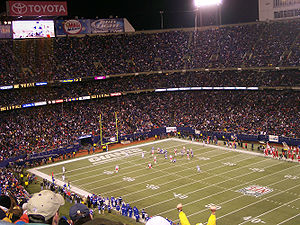
Giants Stadium was home to the Giants from 1976 to 2009. Its construction cost $78 million and it sat 80,242.
After advancing to the league championship game in five out of the past six seasons, the Giants financial outlook was bright heading into the 1964 season. The team even went so far as to book movie theaters where fans could watch the team's games for six dollars. However, the team fell apart quickly following the 1963 season, finishing 2–10–2 in 1964,beginning an 18-season playoff drought. This period in team history is often referred to as "the wilderness years".In 1965, Jack Mara died, leaving his 50 percent share in the team to his son Tim.
Desiring their own home stadium, in the early 1970s the Giants reached an agreement with the New Jersey Sports and Exposition Authority to play their home games at a brand-new, state-of-the-art, dedicated football stadium.The stadium, which would be known as Giants Stadium, was to be built at a brand new sports complex in East Rutherford, New Jersey.
As the complex was being built, and their current home at Yankee Stadium was being renovated, they would be without a home for three years. Their final full season at Yankee Stadium was 1972. After playing their first two games there in 1973, the Giants played the rest of their home games in 1973, as well as all of their home games in 1974, at the Yale Bowl in New Haven, Connecticut. This was done primarily out of a desire to have their own home field, as opposed to having to share Shea Stadium with the Jets.However, between access problems, neighborhood issues, the fact that the Yale Bowl was not ideally suited for pro football (the stadium did not have lights, nor does it have lights today), the age of the stadium (it was built in 1914), and the lack of modern amenities, the Giants reconsidered their decision and ultimately agreed to share Shea Stadium with the Jets for the 1975 season. The Giants left Yale Bowl after losing all seven home games played at Yale in the 1974 season and compiling a home record of 1–11 over that two-year stretch.
Giants Stadium opened in 1976 to a sellout crowd. The stadium cost $78 million to build, and has a capacity of 80,242. The Giants led the league in home attendance in 1978, drawing 604,800 in their eight games. However, one of the low points in team history occurred during the season: the so-called "Miracle at the Meadowlands". With the Giants needing only to kneel the ball to secure a certain victory against the Philadelphia Eagles, they chose to call a running play—which resulted in a fumble that was returned for a game winning touchdown by the Eagles. Two games later, angry Giants fans burned tickets in the parking lot. Protests continued throughout the remainder of the season, reaching a crescendo in the final home game. A group of fans hired a small plane to fly over the stadium on game day carrying a banner that read: "15 years of lousy football ... we've had enough." The game had 24,374 no-shows, and fans hanged an effigy of Wellington Mara in the Stadium parking lot.
Modern history: 1979–present
The Giants made the decision to hire a general manager for the first time in team history following the 1978 season. However, the search grew contentious and severely fractured the relationship between owners Wellington and Tim Mara. Finally, the Maras asked NFL Commissioner Pete Rozelle to step in with a recommendation.Rozelle recommended George Young,who worked in personnel for the Miami Dolphins and had been an assistant coach for the Baltimore Colts. Young was hired; however the rift between the Maras lasted for several years (in fact, at one point a partition was put between the two in the owner's box).
Following the 1983 season, the Giants were involved in a fight for the services of star linebacker Lawrence Taylor—who the team had drafted number two overall in the 1981 NFL Draft—with the New Jersey Generals of the USFL and the Giants. Taylor had been given a $1 million interest-free, 25-year loan by the Generals' owner Donald Trump on December 14, 1983, with the provision that he would begin playing in the USFL in 1988. Taylor quickly regretted the decision and less than a month later attempted to get out of the agreement. The Giants, who were eager to keep Taylor, took part in attempting to free Taylor from it. The results of this tussle included many considerations but the ultimate result was threefold: Taylor had to return the $1 million to Trump; the Giants were required to pay Trump $750,000 over the next five seasons in order for Trump to release Taylor's rights; and Taylor was given a new six-year $6.2-million contract by the Giants.With Taylor retained, the Giants won two Super Bowls; in 1986, led by Taylor, who won the league's Most Valuable Player award, they defeated the Denver Broncos in Super Bowl XXI, and in 1990, they defeated the Buffalo Bills in Super Bowl XXV.

Giants estimated value from 1998 to 2006 according to Forbes magazine.

The Mara family gravesite
The 1990 season and Super Bowl win marked the end of an era for the Giants. Shortly after the win, defensive coordinator Bill Belichick left to become head coach of the Cleveland Browns, and Parcells decided in the spring of 1991 to leave the Giants for a career in broadcasting. There was also an ownership change in what had been one of the most stable front offices in professional sports. In February 1991, after being diagnosed with Cancer,Tim Mara sold his 50% interest in the team to Bob Tisch for a reported $80 million.The sale was actually worked out before the Super Bowl but not announced until afterwards, so as to avoid distracting the team. It marked the first time since their inception in 1925 that the Giants had not been wholly owned and controlled by the Mara family.
Tisch was technically the team's co-chief executive at first, however given his lack of football knowledge he chose to defer to Wellington Mara on football decisions in his initial seasons with the club. Although he later took a more active role in making decisions related to the football side of the team, in general, Tisch concentrated on the financial aspects, while Mara focused on the on-field product. After leading the league in attendance in 2001, the Giants finished second to Washington from 2002 to 2005.
On October 25, 2005, Giants patriarch Wellington Mara died after a brief illness, at the age of 89. Mara had been involved with the Giants since he was nine years old, when he was a ball boy for the team. Except for a tour of duty in the military during World War II, Mara spent his entire adult life with the Giants. The New York Giants dedicated their next game to Mara, and shut out the Washington Redskins 36–0.
Just twenty days after Mara's death, on November 15, 2005, the other Giants executive officer, Bob Tisch died at the age of 79. He was diagnosed in 2004 with inoperable brain cancer. Tisch was a philanthropist all his life and donated considerable sums of money to charitable causes. After his diagnosis, he donated money to institutions aimed towards the research of drugs and treatments to control brain tumors.
During the 2005 season, it was also announced that the New York Giants, New York Jets, and the New Jersey Sports and Exhibition Authority had reached an agreement where both teams will work together to build a new stadium adjacent to the current Giants Stadium. The Giants had previously planned a $300-million renovation to the Meadowlands, before deciding in in favor of the new stadium which was originally estimated to cost approximately $600 million, before rising to an estimated cost of $1.2 billion. One advantage gained by owning the stadium is that the teams will save considerable money in tax payments. They plan to lease the land from the state at a cost of $6.3 million per year. The state will pay for all utilities, including the $30 million needed to install them. Both teams received $150 million loans from the NFL to pay for construction of the stadium. Representatives from the league's teams voted 30–2 in favor of the loan.
The Giants are currently owned and operated by John K. Mara and Steve Tisch—the sons of Wellington Mara and Bob Tisch. Mara had run the day-to-day operations under Bob Tisch's supervision in the years leading up to his father's death. Forbes magazine estimates the current value of the team at $890 million. This ranks them 15th in the 30 team league in terms of value.The value has steadily increased from $288 million in 1998, to the current value. The magazine estimated their revenue in 2004 at $175 million, of which $43 million came from gate receipts. Operating revenue was $26.7 million, and player salary was $97 million.The team finished second in the NFL in attendance in 2006, drawing 628,910 in eight games.
Current major sponsors include Gatorade, Anheuser Busch, Toyota, and Verizon Wireless. Recent former sponsors include Miller Brewing and North Fork Bank. Game day concessions are provided by Aramark, and the Giants average ticket price is $72.
(source:wikipedia)


 Current season


