 History of the Cincinnati Bengals,
Details the history of the Cincinnati Bengals American football club.
Origins
In 1967 a Cincinnati-based ownership group led by Paul Brown was granted a franchise in the American Football League.
As the founder and head coach of the Cleveland Browns from 1946 to 1962, Brown led his team to a .759 winning percentage and seven championships, which includes four championships earned while a member of the All-America Football Conference. The Browns were champions of that league in each of the four years it existed. When the AAFC folded after the 1949 season, the Browns, as well as the San Francisco 49ers and the first incarnation of the Baltimore Colts, were absorbed into the National Football League.
Brown became a recognized innovator for his approach to training, game planning, and the passing game. However, Brown sold majority interest in the team in 1961 to businessman Art Modell. On January 9, 1963, Modell controversially fired Brown. Many believe that Modell had tired of complaints of Brown's autocratic style; others claim it was Brown's decision to trade for Syracuse University's Heisman Trophy-winning running back Ernie Davis, who was drafted by the Washington Redskins, without Modell's knowledge. However, tragically, Davis was diagnosed with leukemia shortly afterward. Brown didn't want to play Davis; Modell insisted he could play. The relationship between Paul Brown and Art Modell, which was never warm to begin with, deteriorated further. Davis died on May 18, 1963.
By 1966, Paul Brown wanted to become involved in professional football again. James A. Rhodes, then the governor of Ohio, convinced Brown that Ohio needed a second team. Cincinnati was deemed the logical choice, in essence, splitting the state.
Brown named the team the Bengals in order "to give it a link with past professional football in Cincinnati." Another Bengals team existed in the city and played in a previous American Football League from 1937 to 1942. Possibly as an insult to Art Modell, Paul Brown chose the exact shade of orange used by his former team. He added black as the secondary color. Brown chose a very simple logo: the word "BENGALS" in black lettering. Ironically, one of the potential helmet designs Brown rejected was a striped motif that was similar to the one featuring the "varicose pumpkin" helmets adopted by the team in 1981 and which is still in use to this day; however, that design featured orange stripes on a black helmet which were more uniform in width.
However, Brown was not a supporter of the rival American Football League, stating that "I didn't pay ten million dollars to be in the AFL", . He only acquiesced to joining the AFL when he was guaranteed that the team would become an NFL franchise after the impending merger of the two leagues.
There was also a complication: the Major League Baseball Cincinnati Reds were in need of a facility to replace the antiquated, obsolete Crosley Field, which they had used since 1912. Parking nightmares had plagued the city as far back as the 1950s, the little park lacked modern amenities, and New York City, which in 1956 had lost both their National League teams, the Dodgers and the Giants to Los Angeles and San Francisco, respectively, was actively courting Powel Crosley. However, Crosley was adamant that the Reds remain in Cincinnati and tolerated worsening problems with the Crosley Field location, which were increased with the Millcreek Expressway (I-75) project that ran alongside the park.
With assistance from Ohio governor James A. Rhodes, Hamilton County and the Cincinnati city council agreed to build a single multi-purpose facility on the dilapidated riverfront section of the city. The new facility had to be ready by the opening of the 1970 NFL season and was officially named Riverfront Stadium, which was its working title.
With the completion of the merger in 1970, the Cleveland Browns were moved to the AFL-based American Football Conference and placed in the AFC Central, the same division as the Bengals. An instant rivalry was born, fueled initially by Paul Brown's rivalry with Art Modell.
The first three seasons
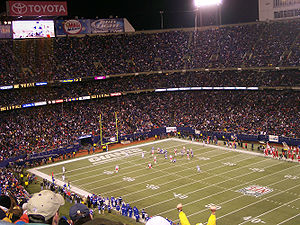
Paul Brown Stadium in Cincinnati, home of the Bengals.
For their first two seasons, they played at Nippert Stadium which is the current home of the University of Cincinnati Bearcats. The team finished its first season with a 3-11 record, although one bright spot was running back Paul Robinson. Robinson rushed for 1,023 yards and was named the AFL Rookie of the Year.
First three seasons coach
Founder Paul Brown coached the team for its first three seasons, accumulating 15 wins and 27 losses and one tie. One of Brown’s college draft stategies was to draft players with above average intelligence. Punter/wide receiver Pat McInally attended Harvard, and linebacker Reggie Williams attended Dartmouth College and served on Cincinnati city council while on the Bengals’ roster. Because of this policy, many former players were highly articulate and went on to have successful careers in commentary and broadcasting as well as the arts. In addition, Brown had a knack for locating and recognizing pro football talent in unusual places.
See more about American football
First three seasons game notes
September 6, 1968 - The Bengals play their first regular season game in San Diego, falling short to the Chargers 29–13.
September 15, 1968 - The team wins its first regular season game in week two of the inaugural season, taming the Denver Broncos 24–10.
November 17, 1968 - The first road victory as the Bengals upset the Miami Dolphins 38–21.
November 9, 1969 - The Bengals record the first tie in franchise history with a 31–31 stalemate against the Houston Oilers. Tight end Bob Trumpy caught 3 touchdown passes in the game, becoming the first tight end in francise history to do so.
December 20, 1970 - In the final game of its third season as a pro football franchise, the Cincinnati Bengals defeated the Boston Patriots 45-7 to clinch the AFC Central division title. This was the first season after the NFL/AFL merger (which brought about the NFL as it is structured today), and the Bengals became the first AFC Central division champion.
December 26, 1970 - In their first playoff appearance, the Bengals fall short 17–0 in Baltimore to the eventual Super Bowl champion Baltimore Colts.
The 1970s
In 1970, the Bengals moved to play at Riverfront Stadium, a home they shared with the Cincinnati Reds until the team moved to Paul Brown Stadium in 2000.
1970s coaches
Four men coached the team to a 72–76 record during this period:
Paul Brown led the team to a 40–32 record. He later moved to General Manager and eventually majority ownership of the Bengals.
Bill "Tiger" Johnson took over the team in 1976. Johnson won 18 and lost 15, but resigned five games into the 1978 season after starting 0–5.
Homer Rice took over at head coach in 1978 and led the team through 1979, winning 8 and losing 19.
Forrest Gregg went 6–10 as head coach in 1980. Gregg played in Green Bay for the legendary coach, Vince Lombardi. Lombardi called Gregg the greatest football player he had ever coached.
Memorable players from the 1970s
Greg Cook (1969–1974) - Record-setting rookie quarterback whose career was cut short by a devastating shoulder injury the following spring. He would return three years later for just one game. As a rookie, Cook set a single-season NFL record for average gain per completed pass (17 yards).
Ken Anderson (1971–1986) – A four time Pro Bowl quarterback, particularly noted for his high efficiency in passing, holding a handful of NFL records. Returned as QB position coach and, later was offensive coordinator. No player logged a longer tenure as a Bengal than Anderson, at 16 seasons. In his 13 seasons as Bengals' starting quarterback, Anderson completed 59.3% of his passes, and threw for 32,838 yards and 197 touchdowns, with only 160 interceptions. He holds the Bengal record for career passing yards and career touchdown passes. Anderson led his team to the NFL playoffs four times, won three AFC Central division titles (1973, 1981, 1982) and one AFC Championship. He still holds the NFL season completion percentage record (70.6%), set in 1982, and he won four season passing titles. At the time of his retirement, he also held the record for consecutive passes completed (20), set against the Houston Oilers in a regular season game in January 1983, and was 6th in passing yards for a career. The NFL awarded him the MVP trophy in 1981, and he went on to lead Cincinnati to Super Bowl XVI where he set then-Super Bowl records for most completions (25) and highest completion percentage (73.5). He completed 25 of 34 passes for 300 yards, 2 touchdowns and 2 interceptions, while rushing for another touchdown. He was also one of the innovators of the West Coast offense. Despite these credentials, Ken Anderson has not been voted into the Pro Football Hall of Fame.
Paul Robinson (1968–1972) – two-time pro bowl running back, rookie of the year, 1968 (expansion year).
Isaac Curtis (1973–1984) - four-time Pro Bowl wide receiver known for his speed and exceptional pass-catching ability. Isaac played twelve seasons and held the team record for receiving yards (7,101) until 2007. His 17.1 yards per catch average remains a franchise record.
Jim LeClair (1972–1983) - linebacker who played 12 seasons for the Bengals and made the pro bowl in 1976. Also a member of the United States Army Reserve for six years, LeClair became famous for wrestling a bear in the Cincinnati convention center as a promotional stunt for the army.
Bob Trumpy (1968–1977) - Outspoken three-time pro bowl tight end who now does radio and television commentary. Bob holds the team record for touchdown catches and average yards per catch by a tight end.
Pete Johnson (1977–1983) - Large pro bowl fullback who holds the team record for career touchdowns (70).
Dave Lapham (1974–1983) - A multi-position offensive lineman who now does commentary for the team's radio broadcasts.
Pat McInally (1976–1985) – wide receiver and pro bowl punter. A Harvard graduate, McInally became the only player to attain a perfect score (50 points) on an NFL intelligence test. He was also the first Harvard graduate to ever play in a Pro Bowl and a Super Bowl.
Bruce Coslet (1969–1976) - Played tight end for the Bengals. Returned as offensive coordinator under Sam Wyche, left the team for a head coaching position with the New York Jets, to returned to Cincinnati as head coach from 1996 to 2000, winning 21 and losing 39.
Mike Reid (1970–1974) – two-time pro bowl defensive end who retired early from football to pursue a career in piano and song writing. Reid has written several Grammy-winning songs.
Coy Bacon (1976–1977) - Coy was an expert pass rusher. He earned a pro bowl spot by setting the single season team record for quarterback sacks in 1976 with 22.
Ken Riley (1969–1983) - Ken was one of the best cornerbacks of all time. He set the team single-season record for interceptions (9) and the career record (65). In his last season of play, Riley led the AFC with eight interceptions. At the time of his retirement, Ken Riley was number three in the NFL record book for all-time career interceptions with 65. Despite his accomplishments, Riley has not been voted into the Pro Football Hall of Fame.
Lemar Parrish (1970–1977) - An 8-time pro bowler (six times with the Bengals) at cornerback, Lemar had 25 interceptions with the Bengals and 47 total in his career. In addition to being a great defensive back, he excelled at kick and punt returning on special teams. Parrish is the Bengals' all time leader in touchdowns scored by "return or recovery" with 13 (4 on punt returns, 4 on interception returns, 3 on fumble returns, 1 on a kickoff return, and 1 on a blocked field goal return). He was is the only player in franchise history ever to score 2 "return or recovery" touchdowns in a single game, a feat he accomplished 3 times.
Tommy Casanova (1972–1977) - A three-time pro bowl selection, hard-hitting free safety, Tommy collected 17 career interceptions.
1970s games of note
November 28, 1971 - The Bengals defense earned its first shutout as Cincinnati shorted the San Diego Chargers 31–0.
December 17, 1972 - The Bengals set a team scoring record as they massacred the Houston Oilers 61–17. In the game, Bengals' defensive back Lemar Parrish set a single-game team record by intercepting three passes, returning two of them for touchdowns.
December 2, 1973 - The Bengals defense earns another shutout as Cincinnati defeats the Minnesota Vikings 27–0.
December 16, 1973 - Traveling to Houston, the Bengals defeat the Oilers 27–24 to clinch its second AFC Central division crown. Cincinnati won its final six games (the last two of which were on the road) to finish 10–4 in the '73 season, edging out the Pittsburgh Steelers for the division championship.
December 22, 1973 - In their second playoff game, the Bengals were once again on the road and fall again to the eventual Super Bowl champions. In the Miami Orange Bowl, the Miami Dolphins defeat the Bengals 34–16.
November 10, 1974 - Precision quarterback Ken Anderson completes 20 of 22 passes (a single game team completion percentage record) as Cincinnati defeats the Pittsburgh Steelers 17–10.
December 14, 1974 - Though his team lost the season finale 27–3 to the Steelers in Pittsburgh, Bengals quarterback Ken Anderson finished the season winning the NFL passing title (the highest quarterback rating).
September 28, 1975 - The Bengals defense earned its third shutout, drumming the New Orleans Saints 21–0.
November 17, 1975 - In one of the more memorable games in the history of Monday Night Football, Buffalo Bills' running back O.J. Simpson ran for 197 yards, but Bengals' quarterback Ken Anderson passed for 447 yards as the Bengals defeated the Bills 33–24 in front of a sellout crowd in Cincinnati's Riverfront Stadium.
December 7, 1975 - The 1975 season is the only one that sees the Bengals shut out two opponents. The Bengals would shut out the Philadelphia Eagles 31–0.
December 21, 1975 - In the regular season's final game, the Bengals blew up the San Diego Chargers 47–17. Despite their 11–3 season record, the Bengals finished second in the AFC Central division to the defending and eventual Super Bowl champion Pittsburgh Steelers, who finished 12–2. The 11–3 record enabled the Bengals to capture the AFC Wild Card gave the team their highest winning percentage in franchise history. Ken Anderson won his second consecutive NFL passing title.
December 28, 1975 - In the organization's third playoff game, the Bengals once again had to travel. Despite a 14–10 victory over the Oakland Raiders in week five of the regular season, the Raiders top the Bengals in Oakland, 31–28.
October 10, 1976 - Cincinnati shut out the Tampa Bay Buccaneers 21–0.
December 12, 1976 - During the final game of the season in New York's Shea Stadium, Bengals' defensive end Coy Bacon sacked New York Jets' quarterback Joe Namath four times in a 42–3 Bengals' rout. Coy got to the opposing passer 22 times in 1976, but the NFL did not record quarterback sack statistics until 1982. Defensive back Ken Riley also recorded a franchise record 3 interceptions in the game, 2 from Namath and 1 from Richard Todd. It was a bitter ending in Namath's final game as a New York Jet.
November 20, 1977 - In a game against the Miami Dolphins, during a driving rainstorm, quarterback Ken Anderson threw a 29-yard touchdown pass to tight end Bob Trumpy, on a flea flicker play, to give the team a 23–17 win, knocking Miami out of playoff contention. The play involved 3 different players handling the ball before Trumpy caught it, first a handoff to Archie Griffin, then a pitch to receiver John McDaniel, and finally a handoff back to Anderson, setting up the game-winning touchsdown pass. Trumpy's touchdown catch in the game was his only touchdown of the season and the last one of his stellar career. Trumpy retired after the season ended.
October 22, 1978 - In the lowest scoring game in Cincinnati Bengals' history, the Buffalo Bills pitched a 5–0 shutout.
October 19, 1980 - The Bengals shut out the Vikings again, 14–0.
December 21, 1980 - Bengals defensive end Eddie Edwards set a single game team record by sacking Cleveland Browns' quarterback Brian Sipe five times. The Browns, needing a win to qualify for the playoffs, came out ahead 27–24.
The 1980s
The Bengals were an entertaining and successful team reaching the Super Bowl twice, but overall, the 1980s was a decade of missed opportunities for the team.
1980s coaches
Forrest Gregg continued to coach the Bengals through the 1983 season, winning 28 and losing 17. He led them to their first AFC Championship in team history for the 1981 season, losing to the San Francisco 49ers in Super Bowl XVI at the Pontiac Silverdome near Detroit, Michigan.
Former Bengals' backup quarterback Sam Wyche began coaching the Bengals in 1984. Sam would stay on as head coach through the rest of the decade, winning 61 and losing 57. Famous quote: “The next person that throws anything onto this field, point ‘em out and get ‘em outta here! You don’t live in Cleveland, you live in Cincinnati!”
Memorable players from the 1980s
Eddie Edwards (1977–1988) - Defensive end who holds the team single game record for quarterback sacks (5) and career record (83.5).
Eddie Brown (1985–1991) - Superb deep threat Wide Receiver who finished his career with 363 receptions for 6,134 yards (an impressive 16.9 yards per catch average) and 41 touchdowns. Brown was selected as the NFL's offensive rookie of the year in 1985. In 1988, he recorded 53 receptions for 1,273 yards and 9 touchdowns, helping the Bengals to Super Bowl XXIII and setting franchise single-season records for receiving yards and yards per catch. Chad Johnson surpassed Brown's receiving record with 1,355 yards in 2003, but it took him 37 more receptions than Brown (90) to do so. Brown also set a franchise record with 216 receiving yards in a single game in the 1988 season.
Ross Browner (1978–1986) - Defensive end who collected 59 quarterback sacks. The father of current Pittsburgh Steelers offensive tackle Max Starks.
Reggie Williams (1976–1989) – played effectively at outside linebacker and served on the Cincinnati city council. Williams intercepted 14 passes in his career.
Louis Breeden (1978–1987) – Breeden is second on the list for all-time career interceptions with 33.
Jim Breech (1980–1992) – Breech was the Bengals' placekicker for 13 seasons. He is the team's all-time leading scorer with 1,151 points, and was a perfect 9 for 9 in overtime field goals during his career, an NFL record. Breech was also automatic in both of the Bengals' Super Bowl appearances in the 1980s, not missing a field goal or extra point in either one.
Tim Krumrie (1983–1994) – All-Pro nose tackle who led the team in tackles in five seasons. He returned as DL position coach until 2002. He suffered a gruesome broken leg in one of the most replayed moments of Super Bowl XXIII.
David Fulcher (1986–1992) - hard-hitting, All-Pro linebacker-sized strong safety. The "vulture" had 31 career interceptions and made the Pro Bowl three times. He also led the team in tackles and caused a fumble in Super Bowl XXIII.
Rodney Holman (1982–1992) - A three-time pro bowl (1988–1990) tight end, Holman's superb blocking and pass catching was a key reason for the Bengals' success in the 1980s and assisted them to Super Bowl XXIII. Career stats are 365 receptions for 4,771 yards and 36 touchdowns. As of 2005, Holman's 318 receptions with the Bengals ranks him as their 6th all-time leading receiver.
Dan Ross (1979–1985) - Pro Bowl tight end who assisted the Bengals to Super Bowl XVI. Ross recorded a Super Bowl record 11 receptions for 104 yards and 2 touchdowns in the game, which would have likely earned him the Super Bowl MVP award if his team had won. Career stats are 290 receptions for 3,419 receiving yards and 19 touchdowns.
Eric Thomas (1987–1992) – Pro Bowl cornerback. Thomas was a vital part of the defense on the Bengals' 1988 Super Bowl team. In his career, Thomas collected 15 interceptions.
Anthony Muñoz (1980–1992) - Considered by many peers and fans alike to be one of the finest offensive tackles ever and even as far as the greatest player to ever grace the face of the NFL, Anthony Muñoz was a perennial Pro Bowl selection, a three-time Offensive Lineman of the Year (1981, 1987, and 1988), and was named to the Pro Bowl squad 11 consecutive times. In 1994, Muñoz, a USC alumni, was named to the National Football League's 75th anniversary all-time team. In 1998, Anthony Muñoz was enshrined in the Pro Football Hall of Fame, becoming the first Hall of Fame player ever to play his entire career for the Bengals.
Cris Collinsworth (1981–88) - Tall, lanky, affable wide receiver and three-time Pro Bowler. His initial foray into broadcasting was substituting for former Bengals tight end Bob Trumpy on Trumpy's WLW radio show. He has done commentary for HBO, NBC, and Fox Sports.
James Brooks (1984–1991) – In his eight years as a Bengal running back, Brooks rushed for 6,447 yards averaging 4.8 yards per carry. Brooks earned spots on four pro bowls. He left the Bengals as the team’s all-time leading rusher, a record now held by Corey Dillon with 8,061 yards.
Boomer Esiason (1984–1992, 1997) - Bengals' quarterback who became renowned early on in his career for his ability to execute the play action pass. His 14 year NFL career ended after completing 57% of his passes for 247 touchdowns and 37,920 passing yards. He holds the Bengals single game records for passing yards (490) and touchdown passes (5). Esiason led the Bengals to two AFC Central division titles (1988, 1990) and one AFC Championship, 1988. The season before his last, as quarterback for the Arizona Cardinals, Boomer threw for over 1500 yards in just a three-week span, leading the Cardinals to victories over the Washington Redskins, Philadelphia Eagles, and New York Giants. He was the NFL MVP in 1988. Boomer currently does national broadcasting for Monday Night Football on Westwood One radio, and the NFL on CBS. He also heads fund-raising for cystic-fibrosis charities.
Tim McGee(1986–1992, 1994) - McGee recorded 282 receptions for 4,703 yards in his 8 seasons with the Bengals, a 16.7 yards per catch average, the third highest in franchise history. He also led the NFL in kickoff return yards in his rookie season.
Ickey Woods (1988–1991) - Fullback who balanced well with his halfback counterpart, James Brooks, to provide balance in the highly-potent offense during the Super Bowl season of 1988. Ickey was famous for his “Ickey Shuffle” dance after he would score a touchdown. He rushed for 1,066 yards, caught 21 passes for 199 yards, and scored an NFL rookie record 15 touchdowns in his first season, but two knee surgeries cut his promising career short.
1980s games of note
September 6, 1981 - In the season-opening game of the 1981 season, against the Seattle Seahawks, quarterback Ken Anderson was intercepted 3 times in the first half as the Seahawks built up a 21–0 halftime lead. Coach Forrest Gregg decided to bench Anderson in the second half and brought in third-string quarterback Turk Schonert (second string quarterback Jack Thompson was injured at the time). With Schonert in command of the offense, the Bengals stormed back and won the game 27–21. Despite his poor performance in the game, Anderson went on to have the best season of his career and win the NFL's MVP award while leading the Bengals to Super Bowl XVI. He threw only 7 interceptions in the remaining 15 games of the season.
December 20, 1981 - The Bengals defeated the Atlanta Falcons 30–28 in the final regular season game. With their 12–4 record, the Bengals won the AFC Central division title. Quarterback Ken Anderson won his third NFL passing title.
January 3, 1982 - Cincinnati hosted its first NFL playoff game as the Bengals defeated the Buffalo Bills 28–21 in Riverfront Stadium. It was the first postseason win in franchise history.
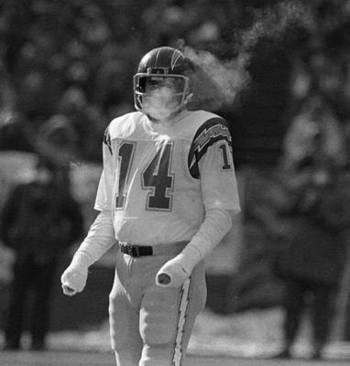
January 10, 1982 - "The Freezer Bowl," The Bengals defeated the San Diego Chargers in the AFC Championship Game, 27–7, the coldest game ever played in NFL history. The wind chill factor brought the game-time temperature down to −56 degrees Fahrenheit (−45 °C). The Bengals' offensive linemen were on the field with their standard sleeveless jerseys in an effort to intimidate a Charger team more accustomed to the warmer California weather. The game has entered NFL lore as the Freezer Bowl.
Super Bowl XVI, January 24, 1982 - Cincinnati appeared in Super Bowl XVI facing the San Francisco 49ers. Played in Detroit's Silverdome, it was the first Super Bowl north of the Mason Dixon line. It was also the first Super Bowl since Super Bowl III to feature two teams who had never appeared in a Super Bowl before. (Super Bowl XX is the only game since with this feature.) The Bengals hurt themselves early and often in the game. After recovering a fumble from the 49ers on the opening kickoff, the Bengals gave the ball right back to San Francisco by throwing an interception, which lead to a 49ers touchdown on their next possession. Later, a fumble cost the Bengals a sure score and another gave the 49ers a field goal. By halftime, the 49ers had built a 20–0 lead, the largest halftime margin in Super Bowl history, at the time. The Bengals made a valiant comeback attempt in the second half, and managed to outscore San Francisco by 15 points, but committed even more costly turnovers; another interception and a turnover on downs when the 49ers stuffed an attempted fourth down conversion attempt on the San Francisco one-yard line. Cincinnati ended up losing the game 26–21 despite outgaining the 49ers in total yards 356 to 274 and setting 3 Super Bowl records: most receptions by one player (11 by Dan Ross), most completions (25 by Ken Anderson), and highest completion percentage (73.5).
December 20, 1982 - On a Monday Night Football stage, Bengals' quarterback Ken Anderson set a single-game team record by completing 40 passes in a 50–34 loss to the San Diego Chargers.
November 28, 1982 - Defensive back Ken Riley tied his own franchise record by intercepting 3 passes from Los Angeles Raiders quarterback Jim Plunkett, leading the Benglas to a 31–17 win.
January 2, 1983 - In the regular season's final game, the Bengals beat the Houston Oilers 35–27. Cincinnati once again won the AFC Central division crown. Ken Anderson set an NFL record by completing 20 consecutive passes in the game and finished the season winning his second consecutive passing title. It was the second time in his career he had won the title in back-to-back seasons. Anderson finished the season completing 70.55% of his passes, an NFL single season record.
January 9, 1983 - The New York Jets traveled to Cincinnati and blasted the Bengals 44–17 in the first round of the NFL playoffs.
December 17, 1983 - Bengals cornerback Ken Riley played his last game in a 20–14 loss to the Minnesota Vikings.
October 28, 1984 - Bengals' bruising fullback Larry Kinnebrew scored four touchdowns setting a team single game scoring record as the Bengals drilled the Houston Oilers 31–13.
September 28, 1986 - In one of the worst losses in franchise history, the defending Super Bowl Champion Chicago Bears went into Cincinnati and trucked the Bengals 44–7.
December 21, 1986 - In the final game of the 1986 season, Bengals' quarterback Boomer Esiason set a team record by throwing five touchdown passes as Cincinnati shot down the New York Jets 52–21. It was also the last game for Bengals' quarterback Ken Anderson.
September 4, 1988 - The Bengals opened the season against the newly relocated Phoenix Cardinals. A goal line stand on both the first and the last drive of the game preserved a 21–14 victory and showed the Bengals could win the close games in a new season after losing so many heartbreakers the year before.
October 16, 1988 - After leading Cincinnati to six straight wins to begin the season, Boomer Esiason set a single game team record throwing 5 interceptions in a 27–21 loss to the New England Patriots.
November 6, 1988 - Bengals' wide receiver Eddie Brown set a single-game team record by amassing 216 receiving yards as the Bengals abused the Pittsburgh Steelers 42–7 in Cincinnati's Riverfront Stadium.
December 17, 1988 - In the regular season finale, Bengal place kicker Jim Breech kicked a short field goal in overtime to edge the Washington Redskins 20–17. The win brought the team to 12–4 and locked up the organization's fifth AFC Central division title. Quarterback Boomer Esiason finished the season as the NFL's top rated passer.
December 31, 1988 - Cincinnati hosted its fourth NFL playoff game. A sellout crowd at Riverfront Stadium watched the Bengals beat the Seattle Seahawks 21–13.
January 8, 1989 - The Cincinnati Bengals shut down the Buffalo Bills 21–10 to win the organization's second AFC Championship
Super Bowl XXIII, January 22, 1989 - The Bengals earned a rematch with the 49ers in Super Bowl XXIII, but lost 20–16 in Miami's Joe Robbie Stadium. The Bengals boasted the highest-scoring offense in 1988, and rebounded from a 4–12 record in 1987. But a few unfortunate events prevented the team from capturing the world championship. The night before the game, Bengals fullback Stanley Wilson suffered a "cocaine relapse," and did not participate in the game. Head coach Sam Wyche was forced to alter the game plan only hours before the opening kickoff. Bengals All-Pro nose tackle Tim Krumrie broke his leg in three places while tackling Roger Craig early in the first quarter. At the start of the fourth quarter, Bengals cornerback Lewis Billups dropped a sure interception in the end zone which would have sealed a Cincinnati win. The 49ers Jerry Rice scored on the next play. Despite all the adversity, the game remained close and the Bengals led the 49ers in the waning minutes of the game until the memorable drive late in the game, capped by a touchdown pass from Joe Montana to John Taylor with only 34 seconds left in the contest, which erased a Bengal lead and put the 49ers ahead for good.
October 29, 1989 - Boomer Esiason tied his own record for touchdown passes in a game as the Bengals demolished the Tampa Bay Buccaneers 56–23. The Bengals tied a team record with eight touchdowns in the game.
December 3, 1989 - The Bengals were on the winning end of the first shutout in the Battle of Ohio, flushing the Cleveland Browns 21–0. It was the last shutout for the Bengals until 2006 when they once again shut the Browns out.
December 17, 1989 - Head coach Sam Wyche was known as an emotional, quotable and outspoken leader. A rivalry developed with the head coach of the Houston Oilers, Jerry Glanville. In an extremely unusual move for an NFL coach, Wyche grossly inflated the final score on Glanville's Oilers. Up 45–0 in the final period, Wyche called for a fourth down conversion attempt (which was successful), and an onside kick (also successful). The final score was 61-7. After the game, Wyche said his only regret was that Bengal kicker Lee Johnson missed an extra point. Sam also observed that Glanville's Oilers were the dumbest, most undisciplined team he had ever seen.
October 7, 1990 - Bengals' quarterback Boomer Esiason threw for 490 yards (a single game team passing record) in a 34-31 victory over the Los Angeles Rams.
December 30, 1990 - The Bengals won the Battle of Ohio, beating the Cleveland Browns 21–14. The victory made the team once again AFC Central division champs.
January 6, 1991 - In the organization's sixth home playoff game, Sam Wyche and the Bengals again drilled the Houston Oilers 41–14.
January 13, 1991 - A week after the victory over the Oilers, the Los Angeles Raiders knock the Bengals out of the playoffs by a 20–10 score. During the game, All-Pro running back Bo Jackson suffered a career ending hip injury on a routine tackle by linebacker Kevin Walker.
The 1990s
Paul Brown, legendary NFL personality and innovator, died in 1991. He had already transferred control to his son, Mike Brown, but was reported to still influence the daily operations of the team. Shortly after his passing, the Bengals' fortunes changed for the worse for a long time.
1990s coaches
Sam Wyche's last year as head coach came was in 1991. After a 3–13 season, Bengals' president and CEO Mike Brown insisted that Wyche resign; but Sam insists that Brown fired him.
David Shula (son of legendary Miami Dolphins' coach Don Shula) was promoted from WR position coach to head coach in 1992 as the youngest NFL head coach. His last full season was 1995. Shula lost his job after starting the 1996 season 1–6. Shula's accumulated win/loss record was 19–52.
Former Bengals' tight end, and long-time offensive coordinator, Bruce Coslet took over the coaching duties midway through the 1996 season and coached the Bengals through the first three games of the 2000 season, losing his last game to the Baltimore Ravens 37–0. Coslet won 21 and lost 39 as Bengals' head coach.
Dick LeBeau, former DB for Detroit, filled the coaching vacancy left by Coslet. He was the defensive coordinator for the Bengals under Coslet after being coordinator for the division rival Pittsburgh Steelers. LeBeau led the Bengals to a season record of 4–12 in 2000.
Memorable players from the 1990s
Lee Johnson (1988–1998) - Was the Bengals punter for 11 seasons. Set a Super Bowl record for longest punt with a 63 yard punt in Super Bowl XXIII. Overall, Johnson played 18 seasons in the NFL and recorded a career total of 51,979 punting yards, the third most in NFL history when he was cut from the team. During the dismal decade Johnson made a bitter comment about team management (referring to individuals higher than the coaches) and was suspended, fined and then cut from the team before the Pickens' incident. Johnson was one of the more recognizable and veteran players.
Carl Pickens (1992–99) and Darnay Scott (1994–2001), both wide receivers along with quarterback Jeff Blake (1994–99). The trio rekindled the Bengals' identity as a high-powered offense. Pickens was a fast and elusive receiver; he was well disciplined in running routes displaying excellent hands. Darnay complimented him with his own amazing speed. Pickens was the more favored target of Blake and when Pickens left, Darnay was unable to fill the vacancy. Pickens, with other teams, was nowhere near as successful without Blake as his quarterback. The three worked excellently together and when one wasn't there the chemistry was gone for them as a team or individual.
Pickens made the Pro Bowl twice with the Bengals and held the team record for most receptions in the regular season until 2007. He left the team due to personality conflicts (which led to some fines as well as a new player contract clause for later players nicknamed the "Pickens Clause" which penalizes players for disparagring remarks about the club or management).
Scott recorded over 800 receiving yards in all of his 7 seasons with the Bengals, with the sole exception of 1997, when he recorded 797 yards.
Blake was the only other quarterback, other than Esiason in '97, to lead the team to a non-losing record (8-8) during the string of bad seasons. He was famous for his short stature and his "moon ball" (nicknamed such for its high arc) which was a very successful play to Carl Pickens and Darnay Scott. He was drafted by the Jets under their head coach of the time, Coslet, and came over as a backup to Klingler when Coslet arrived. He got the start due to injuries and was never challenged for the quarterback position by Klingler again. He was benched after the drafting of Akili Smith. Blake remained in the league as a starter and backup beyond 2005 whereas neither of his favorite receivers remained in the league for another 2 years after they left the Bengals.
Corey Dillon (1997–2003) - Controversial but highly talented running back. He broke many league rookie records (which were subsequently broken in the next year) and Bengal franchise records (which were broken by his replacement Rudi Johnson). He left the Bengals prior to the 2004 campaign and won Super Bowl XXXIX with the New England Patriots. Left the Bengals with insulting statements which many Bengals' fans reacted to with anger. He holds Bengals records for most career rushing yards(8,061) and rushing yards in one game (274)
Takeo Spikes (1998–2002) - Fast, strong (tackled hulking and lumbering RB Jerome Bettis with one hand by the neck collar from behind), emotional and talented inside linebacker. Coupled with Brian Simmons, he was a powerful force and emotional leader for the maligned defense. He left Cincinnati for the Buffalo Bills after the 2–14 season under LeBeau, believing Cincinnati would not turn itself around under rookie head coach Marvin Lewis. The Bengals went 27–21 over the next three seasons, including an 11–5 Division Championship season in 2005. The Bills went 20–28 over the same period with no postseason appearances.
Ki-Jana Carter, Dan Wilkinson, Akili Smith, and David Klingler, were four players drafted during this period touted as "franchise saving" individuals. Whether it was a lack of talent, poor coaching, bad luck with injuries, each one of these drafts proved to be an astoundingly horrible selection. Dan Wilkinson is the only one who remained in the league with other teams but never had the "breakout season" to justify his 1st-round draft status and high paying initial contract.
1990s games of note
September 1, 1991 - The Denver Broncos stomped the Bengals 45–14 to open the season. This game would prove to be the beginning of what would come to be known as "the lost decade." Including 1991, the Bengals would go on to post a losing record in eleven of the next twelve seasons. There would be few games of note during this period.
December 27, 1992 - Left tackle Anthony Muñoz, the man who almost all agree was the greatest NFL player to ever wear a Bengal uniform, played his last professional regular season game. Muñoz was voted to eleven consecutive Pro Bowls, played in two Super Bowls and, after his retirement, was named to the NFL 75th Anniversary All-Time Team. The Bengals lost the game, 20–17 to the Indianapolis Colts.
December 17, 1995 - The Bengals lose to intrastate rival Cleveland Browns 26–10, in the last NFL game ever played at Cleveland Municipal Stadium. It would also be the last game played in the "Battle of Ohio" series for the next four years, as the Browns relocated to Baltimore following the '95 season and became the Baltimore Ravens
December 4, 1997 - Running back Corey Dillon rushed for 246 yards on 39 carries, breaking the NFL rookie record of 237 yards set by Jim Brown in 1957. This mark would later be eclipsed by Mike Anderson of the Denver Broncos.
December 21, 1997 - Bengals' quarterback Boomer Esiason played his last NFL game. His last play was a 79 yard touchdown play-action pass to wide receiver Darnay Scott. Cincinnati won the game 16–14 against the Baltimore Ravens. Boomer finished the season with a 107 quarterback rating.
2000s
Intensification of rivalry with Pittsburgh Steelers
Bengals-Steelers rivalry
The Bengals have played the Steelers more than any other team in the NFL (the Browns missed keeping pace by being out of the league for three years, the Oilers/Titans team was moved from the division, and the Baltimore Ravens are considered a "new" franchise as Cleveland retained its rights to the name and history). While the Bengals were in the midst of a terrible decade the intensity of the rivalries tapered off.
Myron Cope exemplified the ridicule the Steelers' fans subjected the Bengals to during the 1990s. In part, he helped to popularize the infamous nickname given to the Bengals at that time, the "Bungles".
Ben Roethlisberger, an Ohio native who attended college at nearby Miami of Ohio, was brought onto the Steelers' team in 2004 and his impressive early achievements, along with those of Carson Palmer, have been heralded as the beginning of a dynamic rivalry for some time to come.
Dick LeBeau was fired from the head coach position from Cincinnati and returned to Pittsburgh as defensive coordinator. He either coached for Pittsburgh or Cincinnati for most of his NFL coaching career often going from one directly to the other.
Kimo Von Oelhoffen was drafted by the Bengals and when LeBeau returned to Pittsburgh (the first time after being defensive coordinator for the Bengals) he took Kimo with him. Kimo, the former Bengal, was responsible for the hit that took Carson Palmer out of the '05-'06 AFC Wild Card game with a knee injury. Von Oelhoffen left the Steelers (and the rivalry) that offseason when he signed with the New York Jets.
Troy Polamalu, the high profile safety for the Steelers, and Palmer were USC roommates. In one
particular play Polamalu intercepted Palmer and, on the runback, Palmer was the last remaining Bengal in position to tackle him but missed as Polamalu surged passed him and scored.
Head coaches, Lewis and former Steelers coach Bill Cowher, grew up in the same area of Pittsburgh and actually played against each other in little-league football. Later, Cowher would hire Lewis as an assistant coach for defense, giving him his first NFL job.
The Steelers began taunting the Bengals by using Cincinnati cheers and chants in a mocking fashion. On December 4, 2005 Hines Ward celebrated a touchdown against the Bengals at Heinz Field by doing the "Ickey Shuffle." However, Cincinnati went on to win the game 38-31. After the Steelers beat the Bengals in the 1st round of playoffs the Steelers were noted chanting "Who-Dey!" followed by a "We dey!" Steelers head coach Bill Cowher was again quoted chanting "We dey!" weeks later, at a Pittsburgh parade celebrating the Steelers' Super Bowl victory.
Longtime Bengals quarterback Ken Anderson, who also served as an assistant coach with the team over the years, was hired by the Steelers as their quarterbacks coach under new head coach Mike Tomlin for the 2007 season.
Another incident occurred on December 4, 2005, after a 38-31 Bengals victory over the Steelers in Pittsburgh. As Bengals wide receiver TJ Houshmandzadeh walked off Heinz Field, he asked a member of the Bengals support staff to hand him a Terrible Towel. When one was provided, he sat down in the visitors tunnel and shined his football cleats with the yellow cloth. Then, he twirled the towel over his head as he walked down the runway toward the Bengals locker room.
On March 19, 2007 former Steelers linebacker Joey Porter and several of his friends initiated a fight with Bengals offensive tackle Levi Jones at the Palms Casino in Las Vegas. Porter was cited for misdemeanor battery by the Las Vegas police, fined $1,000 and 3 game checks.
2000–present coaches
Dick LeBeau lost his job as head coach after winning just two games throughout the 2002 season. LeBeau went 12-33 as head coach. His last season was a franchise worst 2-14 and had the worst winning percentage of all non-interim Bengal coaches of 26.67%. He returned to Pittsburgh as the defensive coordinator.
Current head coach Marvin Lewis won 8 and lost 8 in both the 2003 and 2004 seasons. He secured the 1st winning season (11–5) for the Bengal's franchise since 1991–92 playoff. He has introduced season "themes", from "Do Your Job" in 2004–05 to "Keep on Digging" 2003–04.
Defensive coordinators under Lewis were Leslie Frazier, followed by Chuck Bresnahan. Frazier, who was hired by Lewis in his first year, left the club citing personality differences and left to become a successful defensive coordinator for Chicago Bears. Bresnahan was brought in and the Bengals' turnover differential in his 1st year was a huge turnaround, amounting to a +24 differential after the 12th game.
Offensive coordinator Bob Bratkowski was held over from Dick LeBeau's coaching staff. In the years following Cincinnati has regained its franchise-characteristic high-potency offense.
[edit]Memorable players 2000–present
Carson Palmer, 2002 Heisman Trophy Award winner. First Bengals QB to have a 100+ passer rating for the season, and broke several team passing records in his 2nd year as a starter (attempts, completions, and touchdowns). He also tied the NFL record for consecutive games with a 100+ rating during the same season. He holds the Bengals' Single Season Passing Yards with 4035 yards [2006], as well as the record for touchdown passes in a season (32) and single game (6).
The Johnsons, wide receiver: Chad Johnson, tailback: Rudi Johnson, and fullback: Jeremi Johnson formed an offensive trio that propelled the Bengals' offense into its high-standing.
Chad Johnson broke the team record for reception yards in consecutive years ('04 & '05 season, 1400+ yards), also first Bengal ever to lead the NFL in receiving yards in 2006. In 2007 he became the team's all time leader in receptions and receiving yards.
Rudi Johnson broke the team record for rushing yards in consecutive years ('04 & '05 season)
Jeremi Johnson, while used primarily as a blocking fullback, is a very capable receiver and elusive in the open field.
Willie Anderson and Levi Jones are the left and right tackles. Willie Anderson has started a franchise record number of consecutive games.
Deltha O'Neal and Tory James alternated leading the Bengals in interceptions, where one or both gained yearly recognition by making it into the Pro Bowl. In 2005, O'Neal set a franchise record with 10 interceptions.
Shayne Graham signed by the Bengals after being cut from 2 other teams, Graham set a Bengals record by making 88% (22 of 25) of his field goals in his first season with them. He made the Pro Bowl in 2005, and has missed but two extra points in his career.
T.J. Houshmandzadeh was a collegiate teammate of Chad Johnson's at Oregon State and, like Johnson, had a troubled history. Originally a third and fourth receiver, Houshmandzadeh overcame hamstring problems that plagued him in his second year, shed some weight to improve his performance and was promoted to the starting lineup in 2004 with the release of Peter Warrick. While not quite as fast as Johnson, Houshmandzadeh has proven himself a dependable possession receiver who's willing to make the tough short and medium range catches in traffic where he is prone to taking hard hits. In 2007 he set the team record for receptions in a season.
Linebacker Odell Thurman and wide receiver Chris Henry. Both were high draft picks in 2005 and they made immediate positive impacts on the field for the Bengals. Odell was a candidate for NFL Defensive Rookie of the Year. Chris Henry provided a second deep threat alongside of Chad Johnson and bolstered the offense tremendously. Both, however, had off field issues involving league substance violations and legal troubles. During their short careers they had a limited amount of playing time before being released between the 2007-2008 seasons. Their non-football related troubles are often considered to be the most visible incidents giving the Bengals a stigma of being in trouble with the law and the league.
[edit]2000–present games of note
September 24, 2000 - The Baltimore Ravens mauled the Bengals 37–0 in the most lop sided loss in franchise history.
October 22, 2000 - In a 31–21 victory against the Denver Broncos, Bengals Pro Bowl running back Corey Dillon captured the single game rushing record. Dillon ran for 278 yards breaking the previous mark set by the Chicago Bears' Walter Payton. Jamal Lewis of the Baltimore Ravens broke Dillon's record in 2003.
December 8, 2002 - The Carolina Panthers drop 52 points on the Bengals, the most ever relinquished by any Bengal team. The final score was 52–31.
November 16, 2003 - By week 11 of the 2003 regular season, the Kansas City Chiefs were the only remaining undefeated team in the league, at 9–0. The Bengals had the worst record of any NFL team between 1991 and 2002, and at the time had a record of only 4–5 under rookie head coach Marvin Lewis. Chad Johnson, Cincinnati's 3rd-year wide receiver, made headlines with a pre-game guarantee that the Bengals would win the game [3]. The Bengals went on to beat the Chiefs, 24–19. After the game, Marvin Lewis declared, "The NFL is back in Cincinnati."
October 17, 2004 - Prior to this game in Cleveland, WR Chad Johnson sent his team's in-state rival, the Cleveland Browns, some Pepto Bismol to his opposing defenders, because he thought that they would get sick of trying to cover him. Unfortunately for him and the Bengals, the Browns would win Round 1 of 2004's Battle of Ohio, holding Chad Johnson to just three receptions for 37 yards and no touchdowns. Also, then-opposing QB Jeff Garcia completed a 99-yard TD pass to former Browns WR André Davis, marking the 10th time in NFL history that a 99-yard pass was recorded. The Bengals fell to 1–4, as they lost to the Browns 34–17.
October 25, 2004 - With much fanfare from Cincinnati residents, Monday Night Football returned to Cincinnati after a fifteen-year absence. In their first MNF appearance in twelve years, the Bengals (1–4) were matched against the Denver Broncos (5-1), whose defense was ranked number one in the NFL. Considered a long shot, the Bengals defeated the Broncos, 23-10.
November 28, 2004 - The Cleveland Browns once again find themselves on the losing end of the Battle of Ohio, losing 58–48 to the Bengals in the second-highest scoring game in NFL history (106 total points). In this game, the Bengals won the re-match for this season.
December 5, 2004 - In another hopeful sign for fans that the Bengals were truly shedding their losing ways, they beat the Baltimore Ravens, 27–26. More importantly than the divisional win was the fact that it marked the first time since 1990 the Bengals had won a game on the road when facing a team with a winning record (an NFL record 42 straight losses).
September 24, 2005 - After forcing five interceptions the previous week against the Vikings, the Bengals intercepted five more this game against the Bears. In doing so, the team accomplished a feat that had not been done in 34 years. The last team to have back-to-back games with 5 or more interceptions was the 1971 Browns. Later in the season, they faced the Green Bay Packers, another NFC North team, and also intercepted 5 passes on their way to victory.
December 4, 2005 - With a 38-31 win over the Pittsburgh Steelers, the Bengals assured themselves of the team's first winning season since 1990. Additionally, the team moved ahead of the Steelers by 2 games, taking a major step towards securing a playoff berth, and just as important, gained respect for the Bengals after years of futility.
December 18, 2005 - The Bengals clinch the AFC North title and their first playoff appearance in fifteen years with a 41–17 rout of the Detroit Lions. Carson Palmer (QB) sets a franchise record with 32 touchdown passes in a single season, Deltha O'Neal (CB) even sets a franchise record for most interceptions in a season with 10.
AFC Wild-Card Round
January 8, 2006 - The Bengals hosted their first ever playoff game at Paul Brown Stadium, against the Pittsburgh Steelers. Star quarterback Carson Palmer was injured on Cincinnati's second play from scrimmage, his first postseason pass attempt, (which was completed to rookie wide receiver Chris Henry for a Bengals postseason record play of 66 yards; Henry was also injured on that very play) with a torn ACL, and the team failed to rally around Jon Kitna. Multiple injuries and many fights marred the game demonstrating the intense friction due to familiarity and tension between the teams. The close relationship between management and players (due to trades, mentoring, even players growing up in the same neighborhood) bind the teams closely together and are a great source of bitterness as well. Many have predicted that this game will escalate the rivalry between the Steelers and Bengals. Some Cincinnati fans even go as far as feeling a great deal of hate twords the Steelers and say that Palmer will never be the same.
This year neither team's home field advantage proved advantageous. In the series the home team lost every game. The Steelers defeated the Bengals in the wild-card playoff game, 31–17.
November 11 and November 19, 2006 - After the Week 4 loss to NE in the 2006–07 NFL season, the Bengals' offense appeared to be out-of-sync and inconsistent. Chad Johnson was relegated to having games of less than 4 catches. There were key injuries to the offensive line. The defenses' propensity for getting turnovers were getting less than one every game. The Bengals faced off against the San Diego Chargers in Week 9 followed by the New Orleans Saints in Week 10 and appeared to have regained the previous year's character. Although the San Diego game ended with the Bengals losing 49–41, the seemingly dormant Cincinnati offense came to life that day. Carson Palmer threw a career high 440 yards and Chad Johnson had a career high and Bengal record 260 yard day. They followed up the next week with another explosive game where Chad caught another 190 yards breaking the record for most yards in two consecutive games for 450 yards total, as Cincinnati won over the Saints 31–16.
November 26, 2006 - The Bengals get their first shutout since the '89 season when they shut out the Cleveland Browns 30-0 in Cleveland. This is also only the second shutout in the history of the Battle of Ohio. Carson Palmer threw for 275 passing with three touchdown passes. The Bengals' defense, who had been struggling throughout the season, had four sacks, four interceptions, and two forced fumbles. Free safety Kevin Kaesviharn had two of those interceptions and one sack.
2000–05
The Bengals began to emerge from more than a decade of being the worst-performing team of that era (edging out the Cardinals) into a new era of increased consistency under Marvin Lewis. Carson Palmer, the future star quarterback, was drafted in 2003 but did not play a snap that whole season, as Jon Kitna had a comeback year (voted NFL Comeback Player of the Year). Despite Kitna's success, Carson was promoted to starting quarterback the following season and Kitna, apparently happily, took the position of backup quarterback and embraced the role of mentor for the young quarterback.
Paul Brown Stadium was built for the 2000 season using private and public money. In tribute to his father, Mike Brown refused corporate offers to have the stadium renamed for their company which became a trend in the NFL and other sports team around that time.
During the 2005 season, the Bengals became known for their players' off-field and non-football related violations of league substance policies and legal troubles.
2006 Cincinnati Bengals season
Like the previous years, Marvin Lewis and his staff developed a theme to rally around, this time it was The Pyramid (a listing of qualities developed by the successful former UCLA basketball coach John Wooden). During the offseason the Bengals made very few free-agent acquisitions and a large number of drafted players (or new ones to the team) were not positioned as starters which is considered a sign of an established team instead of one in the midst of rebuilding (as there was considerable player turnover in the first few years under Lewis). There were concerns about many players' personal legal troubles which kept them in the news but one of the biggest concerns was Carson Palmer's ability to rebound from the serious knee injury he suffered in the playoffs to Pittsburgh.
As the preparations were being made for the season, the Bengals went undefeated at 4-0 for the first time in preseason games and went on to win their first three games, including winning the first two intradivision games versus the Cleveland Browns and Pittsburgh Steelers. The team lost quite a few players of value during these first weeks, due to injury or suspension causing many of the rookies, originally not intended to start, into starting roles. In the fourth week, Cincinnati lost a one-sided game to the New England Patriots at home.
Coming out of their early bye, the team went to Tampa, Florida to face the winless Buccaneers and went home with a 13–14 loss. In week seven, the Bengals would face the Carolina Panthers at home, managing the win. Cincinnati went on to lose their next three games against the Atlanta Falcons, Baltimore Ravens, and San Diego Chargers. During the San Diego game, however, the team had a memorable offensive experience. Carson Palmer threw for a career-high 440 passing yards. Chad Johnson also set a franchise record of 260 receiving yards in a single game.
The team went to New Orleans in week 11 to face the Saints and ended their losing streak. Chad Johnson had 190 receiving yards in that game, along with 3 touchdowns. The Bengals continued to improve their playoff chances when they went to Cleveland to face the Browns. They were on the winning side of the second shutout in the history of the Battle of Ohio with the final score 30-0. Carson Palmer threw three touchdown passes and 275 passing yards. The previously struggling Bengals' defense recorded four interceptions, four sacks, and two forced fumbles. With this win they got themselves back to a winning record of 6-5.
The Bengals would win two more games against Baltimore and Oakland before the win streak ended with a loss to Indianapolis. The Bengals then lost to Denver 24-23 the following week on a snowy Sunday when Brad St. Louis' long snap on an extra point in the final minute sailed through the hands of holder Kyle Larson, preventing Shayne Graham from even attempting the conversion.
In week 17, The Bengals lost in overtime to the Pittsburgh Steelers 23–17, thus ending any possibility of post-season play. Chris Henry gained 124 receiving yards and he scored a touchdown. Shayne Graham missed a 38-yard field goal on the last Bengals' play in regulation with 0:08 left on the clock. The Bengals were eliminated by losing to the Steelers by a Santonio Holmes touchdown reception on the third play of the extra session. Cincinnati ended the season at 8–8.
2008 Cincinnati Bengals season
The 2008 season would see Cincinnati crash to the ground. The team lost its first eight games before finally beating the Jaguars in Week 9. After that, they hosted the Eagles in a rare tie, the final score being 13-13. There followed three more losses followed by three wins to end the year at 4-11-1 and third in the division.
2009 Cincinnati Bengals season
After such a poor performance, little was expected of the Bengals in 2009, but the results surprised everyone. The season opener against Denver was a 12-7 defeat, but afterwards the Bengals won four in a row against the Packers, Steelers, Browns, and Ravens. The team lost at home to the Texans, then beat the Bears, Ravens, and Steelers. In Week 11 however, Cincinnati fell into a trap game when it lost to the 3-7 Raiders. After another defeat of Cleveland, the Bengals had won all six of their divisional matches for the year. Following the next game (an easy win at home over Detroit), Chad Ochocino was fined $20,000 by the NFL for donning a poncho and sombrero after scoring a touchdown (he had been fined three weeks earlier for joking about bribing the referees). Week 14 saw the Bengals travel to Minnesota, where the Vikings routed them 30-10. During the week after that game, tragedy struck when Chris Henry fell out of a pickup truck during a domestic dispute and died from his injuries. The team's previously lighthearted mood turned to one of mourning, and they lost the next match against San Diego. After a victory over the Chiefs, the Bengals secured the AFC North title for only their second playoff berth since 1990. On the season ended, they traveled to the Meadowlands for a match with the New York Jets, but still shaken from Chris Henry's death, they were shut out 37-0. The Bengals and Jets had to face each other again in the wild card round of the playoffs, but now in Cincinnati. Their season, which looked so promising a few weeks earlier, ended with a whimper as the Jets won a second time, the score being 24-14.
(source:wikipedia)