| LeAnn Rimes |
|---|
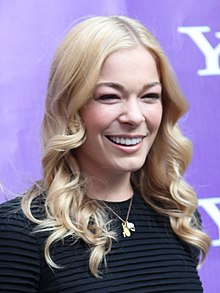
LeAnn Rimes in October 2009 |
| Background information |
|---|
| Birth name | Margaret LeAnn Rimes |
|---|
| Born | August 28, 1982 (age 28) |
|---|
| Origin | Pearl, Mississippi, United States |
|---|
| Genres | Country pop
Country |
|---|
| Occupations | Singer-songwriter, actress,Author |
|---|
| Years active | 1994 - present |
|---|
| Labels | Asylum-Curb |
|---|
| Associated acts | Bon Jovi, Elton John, Ronan Keating, Brian McFadden, Marc Broussard |
|---|
| Website | Official Website |
|---|
Margaret LeAnn Rimes (born August 28, 1982) is an American Country singer-songwriter, actress, and author. She is best known for her rich vocals similar to country music singer Patsy Cline, and her rise to fame at the age of 13, becoming the youngest country music star since Tanya Tucker in 1972. Rimes made her breakthrough into country music in 1996. Her debut album, Blue, reached Number 1 on the Top Country Albums chart and was certified "multi-platinum" in sales by the Recording Industry Association of America. The album's lead single of the same name (originally intended to be recorded by Patsy Cline in the early 1960s) became a Top 10 hit. With immediate success, Rimes attained widespread national acclaim for her similarities to Cline's vocal style. When Rimes released her sophomore studio effort in 1997, You Light up My Life: Inspirational Songs, Rimes went more towards country pop material, which would set the trend for a string of albums that would be released into the next decade. Since her debut, Rimes has won many major industry awards, which include two Grammys, three ACMs, one CMA, twelve Billboard Music Awards, and one American Music award. In addition, Rimes has also released ten studio albums and four compilation albums through her record label of 13 years, Asylum-Curb, and placed over 40 singles on American and international charts since 1996. She has sold over 37 million records worldwide.
Early life
Born Margaret LeAnn Rimes (in Pearl, Mississippi); the only child of Belinda Butler Rimes and Wilbur Rimes. The family relocated to Garland, Texas when she was six years old, where Rimes was raised. She was singing by the age of two, was enrolled into vocal and dance training, and by the age of five was performing at local talent shows.One of her best friends, Jordan Villarreal, supported her when she sang. Rimes initially began her career in musical theatre, performing in a Dallas, Texas production of A Christmas Carol, and almost landed the lead part in the Broadway production of Annie. However, after appearing on the network television competition show, Star Search, Rimes decided to pursue a career in country music. Following her national television appearance, Rimes made a number of appearances on Johnnie High's Country Music Revue in Arlington, Texas, which garnered the attention of national talent scouts.
By the age of nine, LeAnn was already an experienced singer. She toured nationally with her father and also regularly performed a cappella renditions of "The Star Spangled Banner" at the opening ceremonies of the Dallas Cowboys football games. In order to bring his daughter more national attention, he began recording her under the independent label Nor Va Jak when she turned eleven. She released three albums under the label between 1992 and 1996.
Rimes was discovered by Dallas disc jockey and record promoter, Bill Mack. Mack was impressed by Rimes' vocal ability, and over the following three years, he also made various attempts to bring Rimes to a mainstream level. The center of Mack's plan to bring her success was his self-penned composition, "Blue," which he had written in the early 1960s. Mack claimed that the song was intended to be recorded and made a hit record by Patsy Cline, but she had been killed in a plane crash before ever recording the composition. By 1995, Mack was able to gain Rimes a contract with Curb Records, after record executives heard Rimes sing "Blue." In 2000 LeAnn was diagnosed with Epstein-Barr virus.
Music career
1994: All That
Before releasing "Blue" LeAnn Rimes released one CD called "All That". "All That" can be found on Amazon.com.
1996: Blue
After signing with Curb, Rimes re-recorded a new version of "Blue" that was to be released on her debut studio album on the label. In 1996, the new version of "Blue" was released as a single, peaking at Number 10 on the Billboard Country Chart. While Curb was releasing "Blue," a claim was also sent out that Mack had been waiting over 30 years to find the perfect artist to record "Blue." However, the story was later found to be an exaggeration, as it was discovered that "Blue" had already been recorded by three different artists. Mack himself and Kenny Roberts both released versions of the song on Starday Records in the 1960s. In 1993, Australian artist Catherine Britt released her own version as a single in her native country. The story, though, was continually spread throughout the national press, adding to the idea that Rimes was the successor to Patsy Cline's legacy. Rimes's album Blue was also released in 1996, and sold 123,000 copies in its first week, which was the highest figure in SoundScan history up to that point. The album peaked at Number 1 on the Top Country Albums and debuted at Number 3 on the Billboard 200 albums chart, eventually selling a total of four million copies in the United States and 8 million copies worldwide. Allmusic considered the album to be "delightful" and that it could "help inspire other young teens." Rimes followed up the single with several charting country singles from her 1996 album, starting with "One Way Ticket (Because I Can)", which reached Number 1 on the Billboard Country Chart in 1996. She also released a duet single with Eddy Arnold from the album, a remake of his 1955 hit "The Cattle Call". The album's other hits included the Top 5 "The Light in Your Eyes" and the minor hit "Hurt Me."
With the album's success, Rimes received many major industry awards. In 1996 she won the Country Music Association's "Horizon Award," becoming the youngest person to ever be nominated and win a Country Music Association award. The following year she was awarded Grammy awards, one for Best New Artist and another for Best Female Country Vocal Performance for "Blue."
1997–2001: Pop crossover and Worldwide Success
In 1997, Rimes released a compilation of previously recorded material under the Nor Va Jak label, Unchained Melody: The Early Years. The album mainly consisted of cover versions, ranging from Country to pop covers, including songs originally recorded by The Beatles, Whitney Houston, Bill Monroe, and Dolly Parton. Rimes' version of the title track became a major country hit in early 1997 and helped increase sales for the album. In September 1997, Rimes released her follow-up studio album to Blue entitled You Light up My Life: Inspirational Songs. The album covered classic inspirational songs, such as "Clinging to Saving a Hand" and "Amazing Grace". It also featured pop music remakes of songs such as Debby Boone's "You Light up My Life" and Bette Midler's "The Rose". The album was a departure from Rimes' previous releases as it contained more Adult Contemporary-styled music than Country. The album sold over four million copies in the United States, certifying 4× Multi-Platinum by the Recording Industry Association of America. The album contained the single "How Do I Live", which became a major pop hit on the Billboard Hot 100, reaching Number 2. "How Do I Live" set a new record for becoming the longest-running single in Billboard Hot 100 history, spending 69 weeks on the chart. The song was originally recorded for the film Con Air, along with a version also recorded by Trisha Yearwood. Yearwood's manager at the time had told the press that Rimes's version sounded "too pop". Therefore Rimes's version received little country airplay (only reaching Number 43) and was rejected for the film. Yearwood's rendition was released to country radio shortly afterwards, peaking at Number 2 on the Billboard Country Chart in 1997, becoming the country hit instead of Rimes's version.
Rimes released her third album for Curb in May 1998, Sittin' on Top of the World. The album leaned more progressively towards Adult Contemporary and mid-tempo pop music. It included pop material written by Carol Bayer Sager and David Foster. It also included a remake of Prince's "Purple Rain" and was produced by her father. The album was given mixed reviews. Allmusic gave the album two out of five stars. Rolling Stone said Rimes vocal style "holds her own in the more popular style of Mariah Carey and Celine Dion, wherein a spectacular voice upstages a song, grins and goes on about her business." Upon its release, Sittin' on Top of the World debuted at Number 2 on the Top Country Albums chart, and Number 3 on the Billboard 200, and sold over a million copies in the United States, certifying "Platinum" in sales by the RIAA. The album spawned the Number 4 Country hit "Commitment", the Top 20 Pop hit "Looking Through Your Eyes", and the Number 10 country hit "Nothin' New Under the Moon".
Rimes released her fourth studio album for Curb, LeAnn Rimes, in October 1999, a collection of country standards. The album covered songs mainly by Patsy Cline – which included "Crazy", "I Fall to Pieces", and "She's Got You" – that were primarily taken from her 12 Greatest Hits album. The album also covered Marty Robbins's "Don't Worry" and Kris Kristofferson's "Me and Bobby McGee". The album included one new song, "Big Deal". The song gained many positive reviews. Allmusic called the song, "a return to her roots" and "a salute to one of her idols, Patsy Cline." The album in general received much praise. Allmusic called the album one of her "better" efforts, since they had disliked her previous releases. Entertainment Weekly gave the album a positive review and said that Rimes's voice, "dares listeners to take note of what is missing in her interpretations -- the gutsiness and gut-wrenching urgency of performers who felt what they sang." The album was a major success like her previous releases, debuting at Number 1 on the Top Country Albums chart, topping the country albums chart for two weeks. In addition, it also peaked at Number 8 on the Billboard 200 albums chart. The album also sold over one million copies in the United States, and was certified "Platinum" in sales by the RIAA. The album's new song, "Big Deal", was the lead single off the album, and became a Top 10 country hit that year, peaking at Number 6. Also in 1999, Rimes recorded a duet with Elton John for the stage musical Aida, titled "Written in the Stars". The song became a Top 40 hit on the Billboard Hot 100. The album would spawn a second single, a cover of Cline's "Crazy" that was released outside of the United States.
In January 2001, Rimes released her sixth studio album, I Need You, an album aimed at the pop market. The album topped the Top Country Albums chart for one week, and also peaked at Number 10 on the Billboard 200. I Need You did not garner praise from many critics and was mainly given negative reviews. Rolling Stone gave the album two and a half out of five stars and called the album, "synthetic-feeling." Despite very little praise from critics, the album was sold well, certifying "Gold" in sales by the RIAA. Rimes would later go on to publicly disown the album, which she stated was compiled together from studio outtakes her father had produced. The album's lead single, "I Need You" – which was characterized by Allmusic as having similarities to that of Adult Contemporary and Pop music — was originally recorded for the TV movie Jesus. The song became a Top 10 country hit and also a major pop hit, reaching Number 11 on the Hot 100. Also included on the album was the song "Can't Fight the Moonlight", released from the soundtrack of the film Coyote Ugly. The song was released as the album's second single in 2001, and by February 2002 the song also became a crossover Pop hit, reaching Number 11. "Can't Fight the Moonlight" won Rimes a Blockbuster Entertainment Award for "Favorite Song from a Movie." In mid-October 2001, Curb released a compilation of patriotic and inspirational songs, titled God Bless America, in order to benefit the disaster recovery for the September 11 attacks. It included the title track, as well as inspirational songs such as "The Lord's Prayer" and "The Sands of Time".
2002–2004: I Need You, Twisted Angel, Greatest Hits
In February 2002 Rimes re-released the I Need You album with 9 of the songs originally released on the album, an extended version of the song You Are, the song Light the Fire Within which she sang at the Olympics the previous year and 4 bonus remixes. Rimes would later that year release her seventh album (sixth studio album) titled Twisted Angel, which contained more adult material. After battling managerial control over her career the previous year, Twisted Angel became the first album released by Rimes that was not produced by her father. Instead, Rimes executive produced the album. A month following the album's release, Twisted Angel was certified "Gold" by the RIAA, her second Gold-certified album. The album received mainly negative reviews by most music critics and magazines. Allmusic stated that the album could possibly "alieniate her from her original fans" and "the songwriting is a little uneven." Rolling Stone gave the album two out of five stars, stating that the album sounded too "country-pop crossover." The album peaked at Number 3 on the Top Country Albums chart and Number 12 on the all-genre Billboard 200 chart. Three singles were spawned from the album between 2002 and 2003, however none of the singles were Top 40 hits on the country or pop charts. The lead single, "Life Goes on", reached the Top 40 only on the Hot Adult Contemporary Tracks chart, peaking at Number 19. The second single, "Tic Toc" was a Top 40 Dance club hit in 2003. The third single, "Suddenly" only peaked at 43 on the US Country charts, 47 on the UK charts and 53 on the Australian charts.
The following year when Rimes turned 21, she released a Greatest Hits compilation in November. The album recapped Rimes' major hits under Curb records from "Blue" in 1996, to "Life Goes on" in 2002. The album peaked at Number 3 on the Top Country Albums chart and Number 24 on the Billboard 200 in November. Featured on the album was the single, We Can, which was originally released on the soundtrack of Legally Blonde 2 in July 2003. The album would eventually be certified "Platinum" in 2007 The following year in October 2004, Rimes issued her first holiday-themed album titled, What a Wonderful World.
2005–2006: Return to country; This Woman
In January 2005, Rimes released her seventh studio album, This Woman, her first album of contemporary country music in many years. Although the album received mixed reviews from magazines and critics, it was Rimes's best-selling album in over five years, reaching Number 3 on the Billboard 200 and Number 2 on the Top Country Albums chart in 2005, selling more than 100,000 copies within its first week. Rimes explained to the Chicago Sun-Times that the album helped mature her as a person, "I have 10 years of experience, so it's tough to get anything past me in this business. I've become a very strong woman because of all I've gone through, good and bad." This Woman would eventually be certified "Gold" later in 2005, after selling more than 500,000 units nationwide. The album's singles were Rimes's first Top 10 hits on the Hot Country Songs chart in five years. The three singles released from the album — "Nothin' 'Bout Love Makes Sense", "Probably Wouldn't Be This Way", and "Something's Gotta Give" — all peaked within the Top 5 on the country charts between 2005 and 2006. From the album, Rimes was nominated for a Grammy award for Best Female Country Vocal Performance for "Something's Gotta Give". In addition, she was also nominated for an American Music Award for "Favorite Female Country Artist." In 2006, Rimes recorded a cover version of Barbara Mandrell's "If Loving You Is Wrong (I Don't Want to Be Right)", for a tribute album to Mandrell's career entitled, She Was a Country When Country Wasn't Cool: A Tribute to Barbara Mandrell. Rimes also would record a track for Disneyland's fiftieth anniversary celebration album entitled, "Remember When." Sing Me a Story with Belle on September 9, 2010, and My Christmas List on December 11, 2010
In summer 2006, Rimes released the studio album Whatever We Wanna, which was released exclusively outside of the United States and Canada. It was originally planned on being released in North America, however due to the success of This Woman, it was never released. The album spawned minor hits in the United Kingdom, including "And it Feels Like" and a duet with Brian McFadden entitled, "Everybody's Someone". The album leaned more towards Pop Rock and R&B music instead of country.
Rimes would release one final single in the US from her album This Woman in August 2006 called "Some People" which would peak at 34 on the US country charts.
2007-2009: Family
Rimes took a two-year break, and then released her next studio album in October 2007, Family. The album was a mix of country, pop, and rock music, and included a duet with Bon Jovi, "Til We Ain't Strangers Anymore". Family was the first album released by Rimes in which every track was co-written by Rimes herself. Rolling Stone said the songs on the album are "uneven" and rated it three and half out of five stars. Allmusic gave Family four out of five stars and said that the album, "illustrates her range as a singer along with some true strength as a writer." The album helped nominate Rimes for the Academy of Country Music's "Top Female Vocalist" award in 2008. The album's lead single, "Nothin' Better to Do" was released in mid 2007, and peaked at Number 14 on the Billboard Country Chart before the end of the year. The album has released two singles to date; "Good Friend and a Glass of Wine" and "What I Cannot Change."
In 2008, Rimes toured with Kenny Chesney where she opened every show on his 2008 Poets and Pirates Tour, along with other artists on select dates such as Brooks & Dunn, Keith Urban, Sammy Hagar, Gary Allan, Big & Rich, and Luke Bryan. In late 2008, Rimes was nominated for a Grammy award for Best Female Country Vocal Performance for "What I Cannot Change", the third single from the album. In 2008, she recorded For Good with Delta Goodrem for the Wicked 5th Anniversary album. LeAnn teamed up with Joss Stone for a CMT Crossroads special aired in fall 2007.
2010-present: Lady And Gentlemen
Despite singing new material at several live shows earlier in the year, it was announced on May 24, 2010 by Rimes via her Twitter account that her new studio album would be a cover album of country songs, entitled Lady and Gentlemen. The first single from the album is a cover of John Anderson's 1983 single, "Swingin'. LeAnn first debuted the song at the 2010 CMT Music Awards. The single was released on June 8, 2010. According to LeAnn Rimes' official website, she is planning on re-recording her hit,"Blue" for the new album. She stated that she wants "the album to be perfect." Since she is doing this, the album would take a longer waiting time to come out. It will not come out October 5, 2010. On November 8, 2010, LeAnn released her second single, "Crazy Women" to radio. Crazy Women along with a re-recorded version of Blue and Tonight The Bottle Let Me Down were announced in the same post as the 3 extra tracks that LeAnn went back in the studio to add to the album. Before the CMA Awards 2010, LeAnn stated that the album is currently going to come out in March 2011.
Books
On October 13, 1997 LeAnn Rimes and Tom Carter released her first book "Holiday in Your Heart" and it was made into a TV Movie. In 2003 and 2004 LeAnn along with Richard Bernal released two Children's Books. "Jag" and "Jag's New Friend". LeAnn and Darrel Brown released "What I Cannot Change" on April 14, 2009.
Musicianship
Vocal ability and musical stylings
Since her debut in 1996, Rimes' voice and vocal style have often been compared to and identified with Patsy Cline. Cline showed distinctive emotional expression in most of her material. Rimes has also used distinctive emotional expression in many of her songs, most notably her first single, "Blue", which was sung in the style of Cline. Rimes' vocal similarities to Cline had brought wide interest to the idea that Rimes was the successor to Cline's legacy, and brought her novelty appeal. Many music critics have argued that Rimes' vocals were only a reproduction of Cline's original sound, while others have disagreed.[ Allmusic has called Rimes' vocals "rich and powerful." Her vocal ability has also brought Rimes to comparisons to past teenage country stars, including 50s country star Brenda Lee and 70s country star Tanya Tucker. Rimes was also known for choosing mature material that was beyond her age range. In her first album, Rimes recorded such material as Deborah Allen's "My Baby", whose lyrics provocatively say, "my baby is a full-time lover, my baby is a full-grown man." Other material such as Diane Warren's "How Do I Live" had also been considered too mature for Rimes' age and was the main reason why her version of the song was not chosen to be used in the soundtrack for the film Con Air.
Influences
Rimes has given credit to artists from various music genres, mainly from the genres of country and pop. She has stated that Barbra Streisand, Wynonna Judd, and Reba McEntire have been primary influences on her career. Rimes has stated the main influence on her career is Patsy Cline. She has covered many of Cline's hit songs since the beginning of her career. Her 1999 self-titled album is primarily a tribute to Cline, as Rimes recorded five out of ten songs for the album that had been hits for Cline years before.
Film and television
After beginning to date actor Andrew Keegan in 1998, Rimes said to the press that she had some ideas about possibly getting involved in an acting career. Rimes later moved to Los Angeles, California later in the year with her mother to pursue an acting career. That year Rimes played a role in the Made for television movie, Holiday in Your Heart, which is based on a book she had helped write. For participating in the film, Rimes was awarded the "Rising Star" award from the Lone Star Film & Television Awards. She made her official film debut in 2001 for Coyote Ugly, providing the singing voice for Piper Perabo's character Violet Sanford and making a cameo appearance towards the end of the film. In addition, she also recorded four songs for the film's soundtrack, including the Top 20 Pop hit, "Can't Fight the Moonlight." In 2005 Rimes hosted the country music television competition, Nashville Star on the USA television network. However she only held the position for one season after deciding to depart from the show's cast.
In early June 2007, she was chosen at the last minute to record the leading song for the soundtrack of Evan Almighty called "Ready For A Miracle" (previously recorded by Patti LaBelle). The song can be heard in the movie, during the end credits, and in the trailers of Evan Almighty. Rimes played in the movie Good Intentions with her friend Elaine Hendricks which is filming near Atlanta, Georgia. Rimes plays Meg Galligan in the made for TV movie, Northern Lights, based on the Nora Roberts novel of the same name. The film aired on the Lifetime network on March 12, 2009.
Personal life
 |
President George W. Bush and Laura Bush listen to LeAnn Rimes perform in the
East Room of the White House in a performance honoring the
Dance Theatre of Harlem on February 6, 2006,. |
Lawsuits
On May 21, 2000, Rimes filed a lawsuit against her father, Wilbur Rimes, and her former manager, Lyle Walker in Dallas, Texas. Rimes claimed that her father and former manager took over seven million dollars from her in the preceding five years. Rimes also alleged that both men made unreasonable fees and took advantage of Rimes's label, Asylum-Curb, in order to acquire financial gain. Rimes sought unspecified damages because her attorney was not sure of how much money had been lost in the preceding five years. According to Rimes's lawyer, her mother hired two accountants to investigate how much was taken from Rimes's fortune, and it was estimated that the men acquired around eight million dollars in royalties. In 2002, Rimes's lawsuit with her father was "settled on undisclosed terms." Rimes reconciled with her father for her wedding.
In November 2000, Rimes filed a second lawsuit against her label, Asylum-Curb. Rimes wanted permission to be released from the contract that was signed by her parents on Rimes's behalf when she originally signed with the label in 1995. She also wanted her label to turn over the rights of her music, video work, and publishing interests, and omit all of her recordings that were currently being distributed at the time of the lawsuit. Part of Rimes's legal battles ended in December 2001, when Asylum-Curb started a new contract with Rimes.
Marriage and divorce
Amid the legal battles, Rimes fell in love with backup dancer Dean Sheremet. The two had met when he was chosen to dance during Rimes's hosting of the 2001 Academy of Country Music Awards. After her first date with Sheremet, Rimes told InStyle Magazine: "This is the guy I want to marry." The couple married the next year, in 2002. In July 2009, the couple separated and in September 2009, Rimes announced their plans to divorce. The divorce was finalized on June 19, 2010, exactly six months after Sheremet filed divorce documents for dissolution of marriage.
Rimes is currently involved in a relationship with her Northern Lights co-star Eddie Cibrian, with whom she had a well-publicized extra-marital affair prior to the split from her own husband. Cibrian, the father of two children, left his wife for Rimes and filed for divorce in August 2009, after ten years of marriage. In June 2010 Rimes spoke for the first time about the end of her marriage, stating that, while she was sorry that people were hurt, she had no regrets about the outcome of the affair.
On December 27, 2010, it was announced via Billboard that Rimes and Cibrian were engaged.
Philanthropy
In 2008, she opened up about her lifelong struggle with the autoimmune disease psoriasis. She participated in a PSA to raise awareness about the disease.
Rimes lent her voice to the 2008 song Just Stand Up. The proceeds benefited Stand Up to Cancer. As a result of SU2C fundraising endeavors, the SU2C scientific advisory committee, overseen by the American Association for Cancer Research, was able to award $73.6 million towards cancer research.
Wealth
According to "Celebrity Net Worth", Rimes has a current estimated net worth of $38 million as of 2010, is one of the richest female country singers in America.
Discography
LeAnn Rimes discography
Studio albums
1994: All That
1996: Blue
1997: Unchained Melody: The Early Years
1997: You Light up My Life: Inspirational Songs
1998: Sittin' on Top of the World
1999: LeAnn Rimes
2001: I Need You
2002: Twisted Angel
2004: What a Wonderful World
2005: This Woman
2006: Whatever We Wanna
2007: Family
2011: Lady and Gentlemen
Compilation albums
2001: God Bless America
2003: Greatest Hits
2004: The Best of LeAnn Rimes
Filmography
Year Name Role Other notes
1997 Holiday in Your Heart Herself Main Role
"Moesha" Herself
1998 Days of Our Lives Madison Episode 1
2000 Coyote Ugly Herself cameo appearance/singing voice:Piper Perabo
2003 American Dreams Connie Francis Season 3 episode; "Where the Boys Are"
2004 Extreme Makeover Home Edition Herself Cox Family; guest star
2006 Holly Hobbie and Friends: Christmas Wishes Kelly Deegan TV film
2008 Good Intentions Pam Released on DVD March 9, 2010
2009 Northern Lights Meg Galligan TV film
Released on DVD October 6, 2009
I Get That a Lot Waitress Television special (1 episode)
Awards
Country Music Association awards
Year Award Notes
1997 Horizon Award
Academy of Country Music awards
Year Award Notes
1996 Top New Female Vocalist
Single of the Year for "Blue"
Song of the Year for "Blue" Award given to "Blue"'s songwriter, Bill Mack.
2009 Humanitarian Award
Grammy awards
Year Award For
1997 Best New Artist Herself
Best Female Country Vocal Performance "Blue"
[edit]American music awards
Year Award Notes
1997 Favorite New Artist Only American music award
[edit]CMT music awards
Year Award Video
2008 Collaborative Video of the Year "'Til We Ain't Strangers Anymore" (w/ Bon Jovi)
(source:wikipedia)



